
For those who were unable to attend the last Keck lecture or view the live webcast, you missed a pretty good discussion. Never fear! We have the recording, now ready for viewing.
Primero
Every astronomer has a first telescope, mine is a 6″ f/5.1 Newtonian I first built as a teenager. As life progressed I was forced to dismantle the telescope and it dwelt for a time as a pile of parts in a box. Eventually I had an opportunity to rebuild the telescope, but as both my technical capability and my financial means had increased I was able to do a substantially better job.
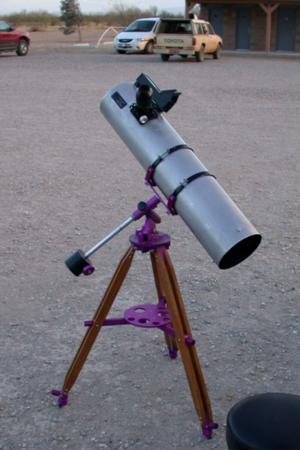
The optical design of the telescope is standard Newtonian with a f/5.1 primary mirror of 6.0 inches giving a focal length of 777mm. The mirror was hand ground when I was a teenager and thanks to expert help during figuring is an excellent mirror.
The RFT design is deliberate and has proven to be a good choice, particularly with modern eyepieces that perform so well in short focal length scopes. With a 35mm Tele-Vue Panoptic eyepiece the scope provides a 22x image with just over a three degree field.
1940 Mauna Loa Eruption Film
Vintage film of Mauna Loa eruption during 1940 by Harold T. Stearns, a USGS Hydrologist-Volcanologist.
An eruption of Mauna Loa is something everyone fears and hopes for. This enormous volcano will erupt again, almost certainly within our lifetimes, possibly even the next decade. The last eruption was in 1984, the mountain has been quiet for well over two decades now, an uncharacteristically long period of quiescence. When it does erupt this volcano is capable of emitting huge volumes of lava, that reach the sea quite quickly down the steep slopes A dangerous mountain to be wary of.
Damon posted this some time ago, definitely worth re-posting here.
Afocal Photography
When doing any sort of public astronomy, showing folks the beautiful sights available to a telescope, I often hear the question “Can I take a photo of that?” The person asking the question is usually holding the ubiquitous compact digital camera. They are often surprised when my answer is “Yes”.
It is indeed possible to manage hand held shots of bright astronomical objects by simply holding the camera up to the eyepiece. There are a few tricks to making it work, but nothing that can not be demonstrated in a minute or two. The resulting photographs can be quite pleasing, definitely worth showing to friends and family along with the rest of the Hawai’i vacation shots.
The method of positioning a camera with a lens in front of an eyepiece is called afocal photography, or sometimes digiscoping. Afocal has been around for a while, but was not considered a practical photographic method by most. The advent of common digital cameras without removable lenses has changed this.
Continue reading “Afocal Photography”WP Plugin Confusion
The world of WordPress plugins is a stew of confusion to a new WordPress user. Thousands of options are available for use with your blog, an amazing array of interesting features to add useful capabilities. From this, you are trying to choose what works for you. You really do need a few plugins to add key features.
For Darker View there a number of things I have determined I need to get working… Spam comment filtering, backup capability, statistics, social site support, threaded comments, and a decent photo gallery. I have the backup utility working now using the very nice WordPress Database Backup by Austin Matzko. Social site functions and statistics from Jetpack work smoothly.
The latest experiments center around getting a decent gallery function integrated. Two options appear to be worth considering… NextGEN Gallery seems to be the standard, but I had read that it was flash based, and I want things to work on an iOS device. In a later experiment I found that it does work on my iPad, so it is back on the list.
In the meantime I have experimented with DM Albums. This is a straightforward plugin with a decent interface. Just load the photos and put a single tag into the post. I like the effect, it seems to play well with my theme. The result is a nicely functional gallery.
DM Albums does have some sizing issues in the full screen mode, pretty annoying issues. The package has seen very active development lately, with two major releases already this year as they clean up the bugs and get everything working. Thus I am not giving up on this package just yet.
This issue is not done yet, I am just out of time to play with it for now.
[dmalbum path=”/wp-content/uploads/dm-albums/Hawaii 100/”/]
Postcard from the Summit – Daytime Shutters
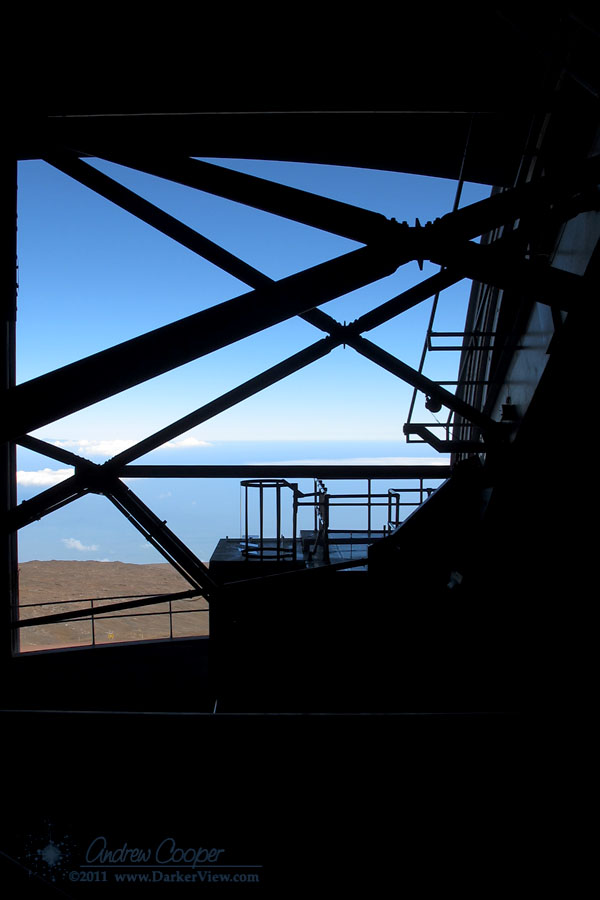
Normally we do not open the shutters during the day. As any kid who has used a magnifying glass in the sun knows, direct sunlight and optics are a powerful combination. The amount of sunlight a 10 meter mirror could gather would result in something a bit more powerful than a child’s toy.
Occasionally it is necessary to do maintenance on the shutters, in the process opening the shutters during the day. It is a careful operation, turning the dome away from the Sun and positioning the telescope away from the opening. Still, it is an odd situation, daylight streaming into the dome, a place normally only lit by starlight or the dome florescents. Then there is the view…
Keck in Motion Scene Guide
I have been getting a few questions about the video. To answer a few of them I have compiled a guide to the scenes. Some quick explanations to what you are seeing, information on the camera used as well as the exposure information.
The video is a combination of two techniques. Many scenes were filmed as standard video then accelerated during editing to allow the motion to become clear. Examples of this are scenes of telescopes slewing and the interferometer delay lines moving.
Slower subjects, such as clouds or the stars moving across the sky, were photographed as time lapse. Here a large number of still images were taken. These are then processed and converted to video using Photoshop CS5 before loading into the video editing software, Adobe Premiere Elements. To construct the time lapse sequences sometimes required thousands of separate images, quickly filling memory cards and exhausting batteries. After dark it is long exposure time lapse that is used, with individual exposures often 15 seconds to one minute long.
The Moon and Saturn
Saturn will be about 7.5° from the Moon when they rise tonight. A 73% illuminated Moon will rise about 22:28, followed by Saturn at 22:58HST. The Moon will also be quite close to the bright star Spica, less than two degrees away from the 1st magnitude star.
SB 2104 on Electronic Harrasment
This has been the year for internet legislation in the Hawaii legislature. First there was the terrible HB 2288 that would require complete records of all personal internet activity to be kept for two years. This bill has been deferred, and is hopefully dead, after active opposition in the press, social media and pressure from internet service providers. The measure received nationwide media attention, overwhelmingly negative attention, when it was first proposed.
The current focus of attention is on SB2104, which attempts to address online harassment. The bill defines electronic harassment as follows…
(g) Makes any form of electronic communication, as defined in section 711-1111(2), including electronic mail transmissions, that is directed at a specific person and causes emotional distress to that person and serves no legitimate purpose. SB2104 as of 10Jan2011
Other island bloggers have posted on this measure. Interestingly with opposite takes on the issue. Tiffany has come out in wholehearted support of SB2104, while Damon has come out in opposition, citing free speech issues.
I usually side with free speech, even in the face of offensive speech. I am particularly sensitive to anything that threatens our use of electronic communications, a tool that is increasingly important in our society. It is the net that has facilitated true social opposition and organization to counterbalance the abuse of governmental or corporate economic power. It was the stunningly rapid response on social websites and blogs that halted the SOPA and PIPA legislation in the US Congress. A clear example of the power available to our communities through these new media.
With that in mind I have some real problems with the language on this one. I can all to easily imagine this sort of legislation being used to stifle legitimate comment and opinion. While I applaud the intention, to limit cyberbullying, I am not sure if this can be addressed like this without impinging on freedom of speech.
Keck in Motion
Keeping the telescopes on-sky every night is the task of the Keck Observatory Operations and Infrastructure Department. A great crew of guys that I am honored to work alongside. This video is dedicated to the guys of the Keck daycrew who make it all possible.