The Morning Commute

When heading to Waimea this time of year, I am driving right at sunrise. Sometimes you just have to stop and take the photo, or in this case a full set of photos for a panorama, even if I risk being late for the truck to the summit… (Click image to view properly)

Mauna Kea Sunrise Panorama
Sunrise behind Mauna Kea from the Mamalahoa Hwy, near Waimea

Keck Lecture at Kahilu February 9th

Tom Soifer
Seeing the Invisible Universe

Kahilu Theater
Thursday, February 9
7:00pm

Astronomy is enjoying a golden age and the W M Keck Observatory is a world leader in cosmic exploration. With generous support from Rob and Terry Ryan, Keck Observatory invites you to take a journey beyond this world to the frontiers of discovery. Your guides are Keck’s astronomers. They will bring you a rich and varied Universe and an evening filled with beauty, drama, mystery and surprise.

Tom Soifer is professor of physics at the California Institute of Technology and the Director of the Spitzer Science Center. He is also the Chair of the Division of Physics, Mathematics and Astronomy at Caltech and a member of the Board of Directors of the W. M. Keck Observatory. The Spitzer Space Telescope is NASA’s latest Great Observatory, designed to explore the infrared portion of the electromagnetic spectrum. Spitzer was launched in August of 2003. In his talk, Soifer will describe some of the most exciting results from the Spitzer mission, among its many discoveries have been measuring the thermal emission and spectra from hot Jupiters orbiting other stars, finding “Fullerene (buckyball)” molecules in space, observing prebiotic molecules in galaxies seen less than 3 billion years after the big bang, and measuring the masses of the most distant and youngest galaxies known.

There is no charge for admission to any events in the Makana series.

Presented by W.M. Keck Observatory.

The Moon and Pleiades

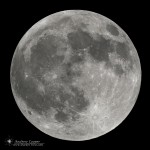
Tonight a bright gibbous Moon will be just under 5° from the Pleiades star cluster. The Moon will be 62% illuminated, bright, but the cluster is bright enough to be seen even against a bright Moon. As the Pleiades move to the west over coming months there will be a few more lunar conjunctions, with increasingly smaller crescents.

Astronomy Basics, So Far…

I have completed the first set of the Astronomy Basics posts I intended to do. I really wanted to get these posted as support material for the astro-events posts.

As I finished these I realize I should probably continue and hit a few more subjects. Look forward to a few more Astronomy Basics posts in the coming months.

Degrees, Arc-Minutes and Arc-Seconds

How do we measure things in the sky?

Throughout the descriptions of astro-happenings here on Darker View, I use the terms degrees, arc-minutes, and arc-seconds. This is how astronomers measure size and separation of objects in the sky.

The degrees used by astronomers are the same as those you learned in high school geometry, the same as marked on that old school protractor forgotten in the back of the desk drawer. 360 degrees mark a circle, 360 degrees reach once around the sky.

Degrees measure rotation, and just about everything in astronomy rotates… As the Earth rotates on is axis, the sky goes wheeling overhead. When we move a telescope from one point in the sky to another we rotate the telescope about its axis. How far does it rotate? That is measured in degrees.

Continue reading “Degrees, Arc-Minutes and Arc-Seconds”

Counting Whales

It is that time again! Time for Ocean Count 2012… A morning spent spotting and counting whales for the Hawaiian Islands Humpback Whale National Marine Sanctuary.

The sanctuary staff recruits teams to crew sites all around the islands. All together, 61 teams with over 950 volunteers observed whales from Kauai to Hawai’i today. Twenty one teams set up to cover the Big Island from South Point to Opolu Point. The procedure is to observe whales from 8am to noon, recording the behavior in half hour time slots. Every blow, dive, breach or other activity is recorded. The technique is to work in teams of two, one person spotting, binoculars in hand, the other writing as the whale activity is called out.

Counting Whales
Deb Cooper counting whales north of Kawaihae

A bluff overlooking Pelekane Bay has been our site for the last three years. Mile Marker 7 is a perfect place to observe whales. A bluff well above the water. A rocky knoll covered with lawn chairs, coolers, and well over twenty observers peering through binoculars.

This year was much like the last several years. We counted dozens upon dozens of whales from the MM7 site, while other sites around the island are lucky to see a handful. There are some sites that did not see a whale all day. We count as fast as we can write, activity everywhere.

Continue reading “Counting Whales”

Polishing an 8m Mirror

My friend Dean Ketelsen has posted another great bit of video from the Steward Mirror Lab where he works. This time it is time lapse of polishing one of the eight meter GMT mirrors.

Somehow the video does not do justice to the sheer size of an eight meter mirror, it looks smaller than it really is. Be sure to read his description for all of the technical details.

The Moon and Venus

This evening a nice crescent Moon will join Venus in the dusky sky. The pair will be reasonably close, about 8° apart. Venus is currently shining very brightly at about -4.1 magnitude, contrasting nicely with a 9% illuminated Moon. The two will still be close tomorrow, about 9° apart with the Moon 15% illuminated.