Today at 12:19HST will be Lāhainā Noon in Waimea on the Big Island, the moment when shadows disappear.
The exact date and time varies significantly across the islands and from year to year. The table below shows the time of Lāhainā Noon for various cities in 2019.
Our next club dark sky star party will be June 1st at the usual Kaʻohe site.
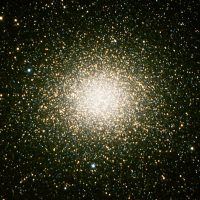
Omega Centauri, NGC5139
For the evening I have again assembled an observing list for those who want to explore some of the more interesting objects available in the sky this month.
These are all visible in the early evening, all suitable for average telescopes of at least 6-8″ aperture.
M5 RA: 15h 18′ Dec: 2° 4’N Mag: 5.8 Globular cluster in Ser A nice bright globular, about 15′ in diameter
Iota Cnc RA: 8h 46′ Dec: 28° 46’N Binary star in Cnc A pretty yellow and white pair, 4.0 and 6.6 separated by 30″
V Hya RA: 10h 52′ Dec: 21° 15’S Mag: 8 Carbon star Reddest carbon star known variable from 6.5-12 magnitude with a period of 533 days
M92 RA: 17h 17′ Dec: 43° 8’N Mag: 6.5 Globular cluster in Her This nice globular cluster is often overlooked in favor of its more famous neighbor M13, but M92 is also worth the stop.
NGC6207 RA: 16h 43′ Dec:36° 50’N Mag: 11.6 Galaxy in Her Just 28′ north of M13 this faint 11th magnitude galaxy is a nice challenge object for eight inch or larger optics.
NGC5846 RA: 15h 6′ 29.3″ Dec: 1° 36′ 20″N Mag: 10.2 Galaxy in Vir A bright elliptical, those with larger aperture may note a small companion galaxy on the south edge of the halo
M99 Coma Pinwheel Galaxy RA: 12h 18′ 49.7″ Dec: 14° 24′ 59″N Mag: 9.8 Galaxy in Com A nice spiral galaxy, larger aperture will show some of the spiral structure
NGC5128 Centaurus A RA: 13h 25′ Dec: 43° 1’S Mag: 7 Galaxy in Cen A large bright galaxy with an obvious dust lane
Proxima Cen RA: 14h 29′ 43″ Dec:62° 40′ 46″S Red dwarf star The closest star outside our solar system, a challenge object to be sure, you will want good charts to find this one. The coordinates given above are from the Gaia mission data release 2 and are recent enough to be accurate, this high proper motion star moves about 4 arcseconds each year.
NGC5286 RA: 13h 46′ Dec: 51° 22’S Mag:7.6 Globular in Cen Another nice, but oft overlooked globular star cluster
Keep in mind that this list is assembled for the usual West Hawaii Astronomy Club observing site at Kaʻohe, on the side of Mauna Kea at 20N latitude. It may include southern objects out of reach for anyone much further north.
Today will be Lāhainā Noon in Hilo and Kailua-Kona, the moment when shadows disappear.
The event will occur at 12:17HST in Hilo, and three minutes later further west in Kailua-Kona at 12:20HST.
The exact date and time varies significantly across the islands and from year to year. The table below shows the time of Lāhainā Noon for various cities in 2019.
Living with an eruption of our local volcano through much of last year often brought to mind previous memories. The 2019 Kilauea eruption was the second eruption of my life, the first being the 1980 eruptions of Mt. St. Helens.
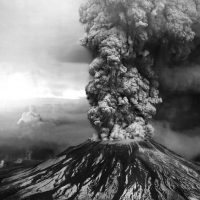
The eruption of Mt. St. Helens taken on the morning of May 18th, 1980, photo credit USGS
St. Helens was just another of the pretty mountains that dotted the horizon through much of my childhood. I could see it from my bedroom window, at least in the winter when the leaves were off the trees.
When the mountian started rumbling in the early months of 1980 everyone wondered if it will erupt. No one expected it to do what it did.
We did not hear the eruption, somehow the sound skipped over those nearer the volcano. It was the television news that first alerted us.
Seeing the reporting I ran out of the house and down the street a little bit to where I could see past the maple trees. There was nothing to be seen of that pretty mountain, just a dark line in the sky rising from where the mountain stood. West of the line it was a cloudy NW sky, east of the line is was just black.
After the eruption we could no longer see the mountain on the horizon, with 1,500ft gone from the top it no longer stood above the ridgelines.
This evening look for the Moon rising in the east just as the Sun sets in the west. Across the Big Island this can often lead to moonbows as the low elevation moonlight interacts with fog and clouds.
Lāhainā Noon is that moment when the Sun is directly overhead. At the moment of Lāhainā Noon shadows disappear.
As the islands lie south of the Tropic of Cancer there is a day when the Sun will pass directly overhead as the summer solstice approaches, generally in late May. There is a second noon as the Sun’s position moves south again in July.
The term Lāhainā Noon is unique to the islands, being adopted by the Bishop Museum in the 1990’s to describe this event. The Hawaiian term lā hainā translates roughly as cruel Sun.
The exact date and time varies significantly across the islands and from year to year. The table below shows the time of Lāhainā Noon for various cities in 2019.
The project that has consumed my weekends for several months is complete. The wall is finished. I poured the last bags of concrete this weekend, I stacked the last rocks into place.
Fitted local stone makes up a small retaining wall,
It is done!
Thus I have spent many a weekend digging, more digging, hauling soil and rock, then pouring concrete. I found that about ten bags of concrete was a good work session, about as much as I could do in one go. It is also as much as I wanted to load in the vehicle, 600 pounds a heavy while safe load for the Explorer.
Other work sessions were simply fitting rocks. Selecting likely rocks, spinning them about and finding reasonable fits, tossing aside those that did not fit. With a single layer added to ten or twenty feet of wall I could then spend the next work session pouring concrete and cementing that layer of fitted stone into place. Rinse and repeat.
There will be protests, that much is clear. Beyond that certainty there is no certainty. When? How big? How long? We just do not know, it is likely no one does.
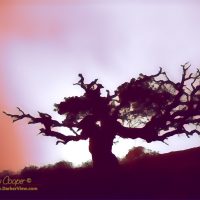
A mamane tree in the fog atop Mauna Kea
As we prepare for the restart of construction of the Thirty Meter Telescope, those of us whose lives revolve around the mauna can only guess and prepare best we can.
While there is news of plans at the state and county level to deal with the protests, there is little information on the details in those plans. Both sides are keeping their cards close. We are given to understand that the county will be the lead agency it is clear that there will be state support.