
Vana Swirl
When you want to see the stars, find someplace dark

So I pressed the conversation longer than I really should have. But I did discover a number of motivations behind the obstinate adherence to an easily disproved view of the world. It took more conversation, but his motivations did become clearer.

To no surprise part of the reason is religion. When he began to quote bible verses in support of his claims of a “immovable” Earth one can begin to see where he is starting from.
Our flat, enclosed, immovable earth is absolute proof of a creator. God is real. We don’t have to believe in Him anymore. We can know it to be true.
Adam Asing in a Facebook Comment
Flat earth absolutely destroys the atheist/humanist worldview. Just like that.
If one begins with the belief that the Earth is flat, it is easy to reinforce that idea in this modern internet age. A thriving community of flerfs form one of the clearest examples of an echo chamber to be found on the net, a cult really. Circulating photos and YouTube videos reinforce the worldview, ridicule the “globe heads”, cement a community together in a belief of “true knowledge”.
Continue reading “Arguing with a Flerf pt. 2”
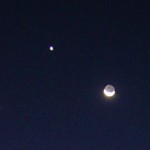
This evening will feature a very slim crescent Moon 4° from Mars. Look for a bright orange object a few degrees below and to the north of the Moon to spot the planet.
The Moon will be only 11% illuminated, while the planet will be shining at 1.7 magnitude.
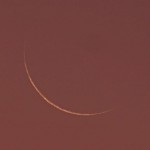
New Moon will occur today at 12:45HST.
Tonight will be the best observing weekend of the month. Get out and enjoy the dark!
Continue reading “New Moon”What is a flerf?
Flerf is simply short for a flat earth fanatic, a little easier to type than the whole thing. Some may consider this derogatory, I do not particularly see it as so. Well? Maybe a little. But considering what I have been called by flerfs, I have no regrets.
Our local flerf goes by the screen name of Adam Asing. That might even be his real name as there is a local musician of the same name. We have occasionally identified other screen names he uses, probably because he has been blocked under his primary alias in so many media outlets.
I would probably not normally notice Mr. Asing, except he routinely attacks the telescopes in just about any media he still has access to. As such he intentionally makes himself a target. As such I sometimes respond… It can be so much fun!
Continue reading “Arguing with a Flerf”The early hours of dawn on May 6th will see the peak of the η-Aquariid meteor shower. This is a reliable shower that produces anywhere from 30-80 meteors each hour near peak. Known for fast moving meteors that have a tendency to leave glowing, persistent trains, the η-Aquariid meteors may be one of the best bets for island observers in 2019.
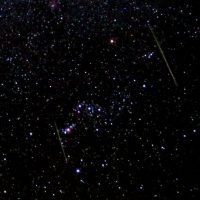
Resulting from debris left behind by Comet 1P/Halley this shower approaches the Earth from the direction of the constellation Aquarius. As this constellation is quite low in the sky during the shower the meteors are entering the atmosphere at a low angle, this often results in meteors with long trains crossing much of the sky. A good shower that produces great fireballs.
Continue reading “Eta-Aquariid Meteor Shower”In Hawaiʻi May first is lei day…


Two earthquakes of the same magnitude strike our island a month apart. Two events that are quite interesting to us at the observatory. Both about the same magnitude, both occurring deep in the island, one was far more forceful at the telescopes causing some minor damage, the second caused no damage that we have found despite a thorough inspection.
Any strong earthquake is a concern for the telescopes. We need to know immediately just how strong the quake was, how much potential for damage occurred.
The telescopes are precision instruments with many delicate parts. On the other hand earthquakes are common on this volcanic island and we have learned how to deal with the shaking.
When attempting to measure the possible damage to the telescope it is not earthquake magnitude that is interesting. Rather we want to know the peak ground accelerations that occur at the summit facility. The actual forces that could potentially cause damage. These are measured by means of a logging accelerometer mounted in the basement of the observatory.
Continue reading “A Tale of Two Earthquakes”