When shopping for a focuser you face a lot of choices. From the cheap eBay Chinese options to the top-of-the-line Moonlights and Feather Touch. I once again perused these options when buying a new focuser for the Cave Astrola.
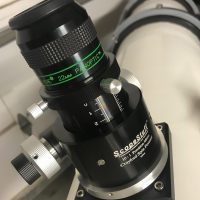
The ScopeStuff 2″ Crayford Focuser mounted to the 8″ Cave AstrolaIt has been a while since I looked at what was out there. So I spent some time shopping and wandering website re-educating myself on what the options were.
I considered the cheapest end of the market, a few options found on eBay, and again at the top-of-the-line, machined works of art that cost as much as some telescopes. This time I was limiting the budget for restoring the Astrola, not wanting to spend much more than a hundred on the focuser to keep the cost of the whole effort down.
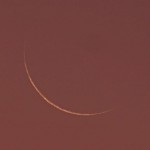
A very young moon over WaikoloaNew Moon will occur today at 11:05HST.
During this new Moon a partial solar eclipse will sweep across much of Antarctica and the southern tip of South America. At maximum the Moon will cover about 60% of the Sun.
I do enjoy a nice project I can work on, get my hands dirty, and use my skills. A classic telescope in need of restoration? Just the thing.
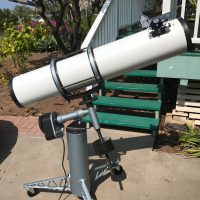
A restored Cave Astrola 8″ f/6 Lightweight Deluxe
This telescope was literally rescued from the trash. Matt, the owner of the excellent Mountain Road Cycles in Waimea found the telescope at the transfer station.
Matt put a message into the folks at the observatory, who represent more than a few of his customers. The info was quickly forwarded to me, as everyone here knows I build and restore telescopes for fun.
This one is weird. This one is also an example of the strange maneuvers used by our state legislators to pass laws, particularly laws that face substantial opposition. Of these maneuvers, gut and replace is probably the most despicable, the wholesale replacing of a bill’s contents with different text of totally different intent.
The MKSS snowplow crews remove snow from the roads atop Mauna KeaThe latest example? SB757 is today’s subject. This bill once addressed the university’s ability to issue bonds. As of the latest version the bill calls for an audit of the agencies charged with the management of Mauna Kea… Yes, the bill is a now a nearly identical copy of SB2325, the same audit bill I addressed last week here on Darker View.
Why another bill with the same language? The first bill, SB2325 is still active and making it’s way through the process.
Restoring the 8″ Cave Astrola has me again looking at these classic telescopes. Reading the history of Tomas Cave and Cave Optical. Looking at the old advertisements and remembering things long thought forgotten. I may never have owned one before, but the Astrolas still had an impact upon me years ago.
My Astrola is now operational, with final assembly and collimation completed a week ago. So far I have used it for several evening sessions of observing from the driveway. The result is several pages of notes in the observing log, wandering through nebulae, clusters, and binary stars in Orion, Canis Major, and Puppis.
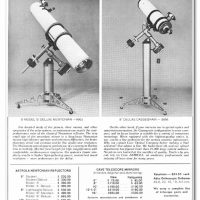
Cave Optical Advertisement 1970, from Phil HarringtonWhen I was just starting my journey in astronomy the Cave Optical advertisement in each month’s Sky and Telescope was something to inspire dreams in a young teenager. In many ways those dreams have never been forgotten.
Another proposed bill that has been carried over from the 2017 legislative session is HB1565. The purpose of this bill is to create a conservation district sub-zone category specifically geared to supporting research and technology facilities. The astronomy precinct atop Mauna Kea is identified as such a sub-zone along with seven other sites such as NELHA and the facilities atop Haleakalā.
A crowd of mountain visitors watch sunset around UKIRT
The legislature further finds that research activity brings in millions of dollars that help diversify and stabilize the State’s economy that is heavily dependent on tourism, which is a cyclical industry. A study of research expenditures in the University of Hawaii system alone, not including private or non-university funded federal projects, showed that research activity had an economic impact on business sales of $760,000,000, state taxes of $45,000,000, employee earnings of $275,000,000, and the generation of about seven thousand jobs. – Excerpt from HB1565 proposed legislation for the 2018 Hawaii legislature
The bill would designate specific lands to be used for science and technology facilities. More interestingly the bill specifies a set of rules by which these lands are to be administered and subleases are to be negotiated.
The bill simplifies and streamlines the land use decision process. In the case of opposition to development within a science and technology sub-zone the method of dispute is designated as mediation rather than a contested case hearing.
This bill is certain to be a lightning rod for opponents of astronomy on Mauna Kea and Hakeakula. The opposition will be vehement to say the least. Indeed, it will be interesting to read the opposition commentary.
An ancient ahu (shrine) atop Mauna Kea with the summit in the backgroundThere is much to consider in this bill… Creating a sub-zone specifically for research facilities is probably a good thing. This recognizes a very specific land use that should have equally specific rules governing the use.
But there remains a question… Does the process specified in this particular bill to manage this new type of sub-zone excessively curtail public participation in the land management process? Where is the balance between sensible development and protection of the environment?
We currently have a situation in which a small and vocal minority can completely derail the process, that even reasonable development is blocked. A situation where only extraordinarily well funded organizations can accomplish anything. Then only with a stunning amount of wasted resources and effort along the way.