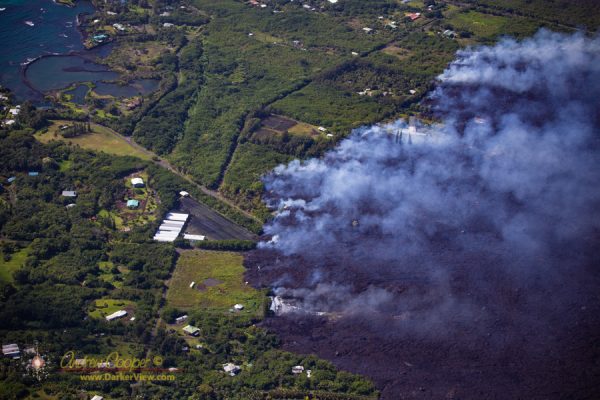
Kapoho is Doomed
When you want to see the stars, find someplace dark

One of the most poignant scenes we witnessed was the many farms destroyed by the lava
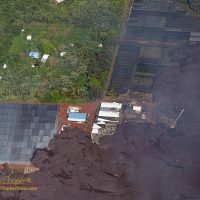
Houses are bad enough, seeing the farms in front of the lava flow was worse. I found myself looking through the telephoto lens at the neat greenhouses, the orchards green in the morning sunlight. The wide flow front was in the process of destroying so many farms, remorselessly moving through the neat rows of papaya trees.
How to get a good look at this eruption? Not a trivial question. The neighborhoods involved are under mandatory evacuation orders enforced by police and National Guard checkpoints. Quite a few people have been arrested and cited while trying to get closer to the lava.
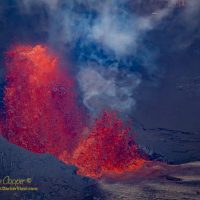
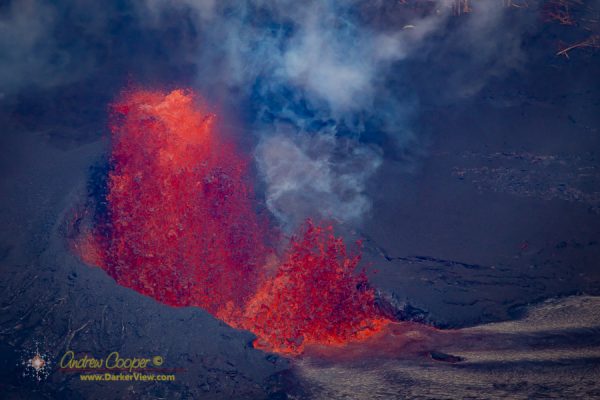
This is the first major change in the eruptions of Kilauea in decades. This eruption features phenomena seen in the old documentaries, lava fountains hundreds of feet high, huge flows cutting through the rainforest. Things I have always wanted to see.
As much as I would like to visit, we have simply not tried to get into lower Puna. It is just not pono to interfere with residents frantically trying to salvage whatever they can ahead of the flows, or emergency services already overburdened with the ongoing situation.
Two legal ways exist for visitors to get a closer look… Fly or float. Either take a helicopter ride over the eruption, or take one of the lava boats to an ocean entry.
The boats have resumed tours, but active ocean entries have been sporadic, running for a week, then stopping. As of Monday morning the lava has re-entered the ocean at Kapoho Bay, and is again view-able from the water. The boat runs also involve a fairly long run all the way from Hilo harbor. The boat ramp the tours once used at Pohoiki now cut off by the flows.
Continue reading “To See The Eruption”While much of the attention is on the lava flows and burning homes in lower Puna, there have been dramatic events at the summit of Kīlauea. The pit crater of Halemaʻumʻau that has been the subject of untold thousands of tourist photos has become almost unrecognizable.
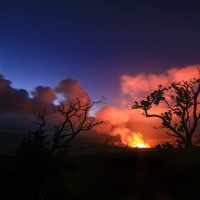
Step outside and you can smell the sulfur… In Waikoloa!
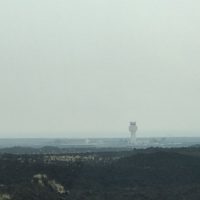
Deb and I drove to Kona this afternoon. The usually pretty drive was simply gray, gray with a tinge of yellow-brown. No views of the mauna, no views of the ocean. You could barely see the airport from the highway as we passed.
The vog has been the subject of conversation everywhere, online in social media, and in every single casual conversation you happen into today. The volcano, so devastating to those in lower Puna, has reached out to touch us all.
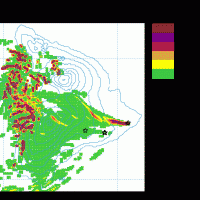
Things could be worse. An explosion at the caldera today showered surrounding communities with ash and Pele’s hair. Plus, there is much to be said about not having a lava flow, or three, flowing though your neighborhood.
The ground beneath us is one constant in life you just expect to never change. Solid and unyielding, we build our lives upon the firm foundations of the Earth. When this constant betrays us it is truly disconcerting. The world loses some of its comforting stability.
Last Friday was a day when our islands were reminded of the instability of our world in a rather abrupt fashion.
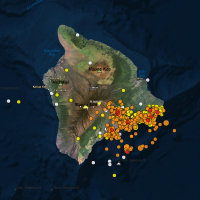
The tiltmeters indicated that pressure in the caldera and Puʻu Oʻo had been building steadily. At the same time the activity in the 61g lava had been waning. Where was the magma going?
While speculation was rife, no one really knew what was coming. Three decades of eruptions from Puʻu Oʻo has become somewhat routine. People forget that Kilauea can be, and usually is much more unpredictable. That destruction can appear anywhere on her flanks.
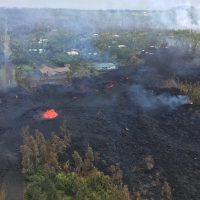
We worried about the homes in the neighborhood and the people we knew who lived in the area. We compared notes, recalling who lived exactly where, fearing the lava flows would quickly spread. This was looking like a worst case scenario, a repeat of 1955 with more people and homes in the way.
Despite the outbreaks of lava in the rift zone the previous afternoon, we expected a routine Friday atop Mauna Kea. I had a list of tasks to complete… Inspect the K1 azimuth wrap, drill some anchor points to allow installation of the new ice monitor receiver on the roof, look for some spare parts for an encoder.
It should be an easy day on the summit… It was not.
Friday became a day I will remember for a long time to come.
The volcano is up to something.
This morning began with a series of strong earthquakes along the eastern rift zone of Kilauea. The island was buzzing about it, the local news, social media, it was the main subject of conversation in our trucks headed to the summit. By this evening there have been over 250 earthquakes, including many of 3rd and 4th magnitude, along the rift zone, a clear sign of lava moving underground.
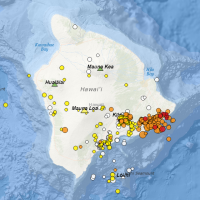
The increasing pressure has raised the level of the lava lake at Halemaʻumaʻu to the point of overflowing into the larger crater multiple times over the last week. This alone can be spectacular as it is easily viewed from the viewpoint at the Jaggar Museum in Hawaii Volcanos National Park.
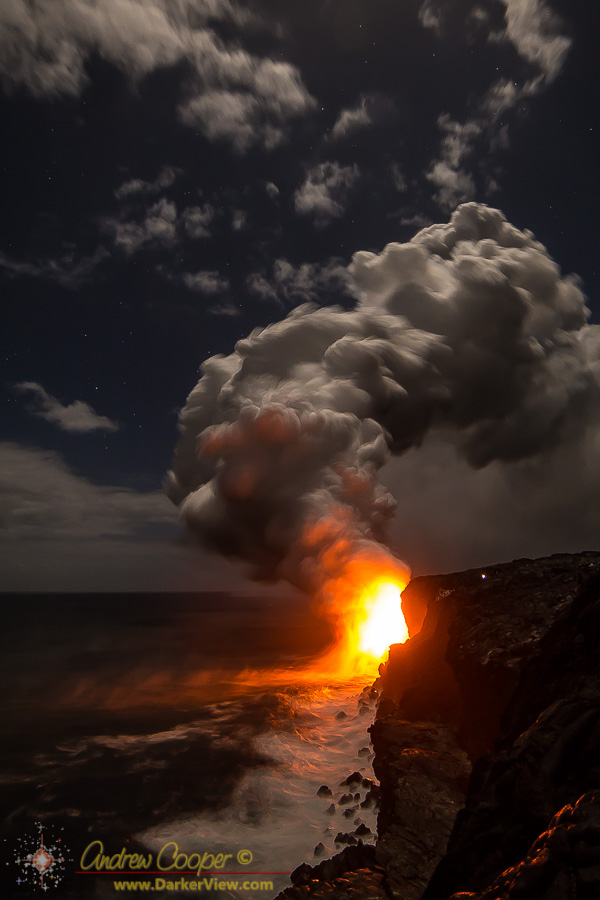
61G lava flow this morning, first time I have been out since the shelf collapse, what a difference, it just pours out of the tube. There is a small fragment of the old shelf, it continues to collapse, heard and watched a couple truck sized chunks fall out of it and into the surf.
Did another dawn attack, arriving at the flow about 2am, staying until after sunrise. The new rope line is stupidly far back, so far back no one was honoring it. I stayed about 200-300 yards away, but saw folks on the top of the cliff over the tube where I had seen glowing globs land just half an hour before.
