Yes, it is three in the afternoon and I am just waking up. That was the plan.
A night spent under dark Mauna Kea skies with a telescope. It has been much too long since I had a good night out with the ‘scope, it was time. A few items conspired to make it happen… Good weather, a note from the HR department that I was at maximum on accumulated vacation time, use it or lose it! Additionally, my friend and co-worker, Olivier Martin, was looking for a night of observing as well.
With a couple days of approved vacation I headed for the mountain.
A partly cloudy sky greeted us on arrival, high and heavy cirrus hid much of the blue. The forecast was for this to clear off during the first part of the night, not yet time to panic. Not wanting to deal with the crowd at the Mauna Kea VIS we hid out in a spot I found on one of the nearby back roads, a place where we would not be disturbed by any visitors through the night, a place that is completely dark.
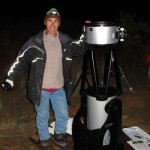
Olivier beside his new telescope, a 12" Orion DobsonianOlivier brought his new 12″ Orion Dobsonian. And I do mean new, it was not yet fully assembled! The usual troubles of life had conspired to rob him of any time in the few days since the telescope arrived. He had assembled the main parts, the base and OTA, but had yet to install the elevation bearings, handles, encoders or the primary mirror. Thus we spent the first two hours finishing the telescope, no problem as final assembly gave the heavy cirrus clouds time to clear out.
I was determined to get out and use the telescope during the March new Moon, but had planned to go observing with the guys at Hale Pohaku on Mauna Kea. At the last minute I decided to accept an invitation from the Hilo group to observe from Mauna Loa instead. The guys planned on running a Messier Marathon, something I have enjoyed many times before.
Our usual observing location is Hale Pohaku, at 9,000ft on the south side of Mauna Kea. Hale Pohaku is a great observing site, high enough to be above the clouds, but well below the summit where thin air, wind and frigid temperatures can be miserable. It is impossible to do a complete Messier Marathon from Hale Pohaku, the bulk of Mauna Kea blocks too much of the northern sky making a few objects, most notably M52, difficult to impossible.
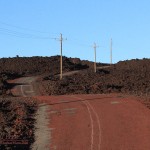
The Mauna Loa access road, carved through the lava and paved with red cinder asphaltThe road and climate research station on Mauna Loa sit on the northern face of the mountain, offering a perfect vantage point for the Messier catalog objects given our 20° latutude. The only issue is the road. While Hale Pohaku is reached by six miles of quite nice state highway, Mauna Loa requires navigating an 18 mile drive up a single land paved road. Use of the word “paved” is somewhat casual, as is the maintenance on the road. The first few miles feature new pavement. Beyond that? Not so much, the road becomes a pothole obstacle course. Driving the road with a delicate telescope in the back is rather nerve-wracking.
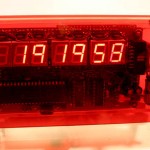
A hand made GPS clock for the observing tableFor years, when observing, I found myself wanting a clock on my observing table when recording observations. I have used either a wrist watch or a cell phone, but looking at these was uncomfortable as these modern devices use bright backlit LCD displays, not a nice night-vision friendly red. The cell phone also has the additional problem of using up its battery quite quickly when out of range of a digital cell tower at some remote observing site. I needed a simple desk clock for my observing setup.
Accuracy was also a question, accurate time is always important when observing. Asteroid occultations, lunar and solar eclipses, iridium flares, twilight, jovian moon transits, the list of things where accurate time is useful is long in astronomy.
The Specs
Of course being a electrical engineer makes designing and building a clock a fairly trivial exercise. But why stop there? Why not build in a few extra features…
Use red 7-segment LED’s and build in some type of selectable dimming mechanism.
Why bother setting the clock each time you set it up? Make the clock self setting and very accurate.
Since the clock is accurate add a serial port to allow the clock to supply accurate time to a laptop when taking astrophotos.
Watching meteors is one of the simplest forms of astronomical observing. Just about anyone can enjoy meteor watching, from just about anywhere in the world. Enjoying the show takes only a couple things… A dark sky and a comfortable place from which to watch.
A pair of Leonid meteors streak through OrionMeteors are simply small bits of debris hitting the Earth’s atmosphere at very high speed, typically tens of thousands miles per hour. Our solar system is rich with this debris. Most of these bits are quite small, about the size of mote of dust or a grain of sand. Something the size of a pea would create a spectacular fireball that lights up the whole sky. While they often seem close, they are actually quite high, 60 miles (100km) above the ground when they flare into short lived fireworks.
The mechanism for the show is simple. When something hits the very thin air high in our atmosphere at very high speed it compresses the air in front of it. This compression also heats the air, causing it to glow white hot. Heated enough, the air becomes a plasma, the molecules shredded and electrons freed from the atoms. It is not the meteor itself that you see, but the glowing plasma around it.
There are a number of questions many people ask about meteor observing. You can find many of the answers below. Watching a meteor shower takes no special equipment, expert knowledge or extravagant preparation. This is an activity nearly anyone can enjoy, one of the spectacles of nature available to all.
-4.9 magnitude? Inferior conjunction? Maximum elongation? 3.4° separation? To explain many of the basic terms I use to describe sky events I really need to post some explanation. Something I can link to in order to explain myself. Using the magic of hypertext as it was originally meant to be used.
I have written a couple more astronomy basics posts to go along with the sky events postings. I have copied over a few more posts from the old DV blog, updating and refreshing them as I did so. Expect to see a series of astronomy basics posts through the month as I get everything setup in the new blog.
A supernova, a comet, a new camera and a dark night.
I have had the Canon 60D for a while now. Since April in fact. It was my main carry camera in Alaska this summer. This was the camera used to produce the laser shots and videos that were published far and wide. But I have never used the camera on a telescope. A new Moon observing weekend is an opportunity to change that.
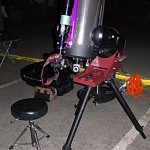
The NexStar 11″, the TV76mm and a Canon 60D setup for astrophotography at the MKVISI have recently re-assembled my astrophotography rig in the garage. But that rig has some technical issues that need to be solved before it is ready to use. Instead I packed up the NexStar 11″ scope, a scope usually used for public observing, but also a nice photographic platform. Piggyback the TeleVue 76mm atop the larger scope, attach the 60D and I am ready to shoot. Well? Maybe a bit more work than that. With alignments, focusing and more it was an hour before the first exposure.
While my camera was busy shooting sequences, I wandered around and visited with the other folks enjoying the night. A few peeks through other scopes at favorite objects was about all the visual observing I did. There were a couple groups using cameras without telescopes to shoot stars capes under the dark sky. We traded hints as multiple cameras worked the night.
An orange glow in the clouds betrayed new lava flows on Kilauea. Even thirty miles away we could make out bits of a channelized a’a flow. The pair of binoculars I had brought became one of the most popular optical instruments around.
I was using the rig without any autoguiding, as a result guiding errors spoiled a number of exposures. I kept the exposures short, and shot bright objects. I have sequences to process of a lot of old favorites… M31, M42, a few open clusters like M11 and M38, the Pleiades and more. Just before dawn I even shot a sequence of the Tarantula Nebula skimming the slope of Mauna Loa. Two 8Gb SD cards filled and part of a third. I will be some time processing the many images taken through the night. There is even some video of Jupiter and Mars to process into high resolution planetary images.
There were three telescopes still operating when dawn appeared. Maureen, Cliff and myself watched as the sky grew bright and a thin crescent Moon rose above the slopes. Even then we spent a little time observing and photographing the Moon or Mars as the stars disappeared. We were still breaking down gear as sunlight swept the hillsides around us. Tired and yet elated we greeted the Sun.
The usual suspects setting up gear for a great night of observing on Mauna Kea...
Planning a night of observing is a challenge. There is the choice of equipment, setting up observing lists of objects to target. And then there is deciding where to go.
Finding a dark spot can be a challenge in Hawai’i. Almost every bit of land is gated and tied up in bureaucratic rules. We often use the area around the Mauna Kea VIS to observe. Located at 9,000ft on the south side of Mauna Kea the area has much to recommend it for amateur astronomy. This land is under the administrative control of OMKM, who actively support astronomy, both professional and amateur. But the area does have a number of lights, and there is regular vehicle traffic, even in the middle of the night. Thus I have been actively looking for other places.
The 18″ setup at 9000ft on the side of Mauna KeaThe area around the MK VIS is state land, under the control of the State of Hawaii Department of Land and Natural Resources. Just below the VIS is the start of a back road that almost entirely circles the mountain, R-1, also part of the Na Ala Hele trial system, a road designated for public access. Perfect! All I need is a place just enough out of the way to avoid any lights or activity in the night.
State land is an interesting issue in Hawai’i. No camping is allowed outside of designated sites, period. But, according to the DLNR administrative rules it is not camping unless you are… “in possession of a backpack, tents, blankets, tarpaulins, or other obvious camping paraphernalia, any time after one hour after sundown until sunrise in a forest reserve” (Section §13-104-2 Hawai’i Division of Forestry and Wildlife). I made certain I had no “camping paraphernalia” with me. I am merely picnicking… in the middle of the night.
Last night was the sort of evening we love, and the reason we volunteer at the Mauna Kea Visitor Information Station. One of those nights where the stars seem close enough to touch, we bring them within reach of those who came to the mountain to learn about the universe.
The Mauna Kea VIS at night with a crowd at the telescopesConditions were near perfect, a dark, clear sky with no Moon, it would rise later. Not only was it dark, but the air was steady, allowing nice high magnification views of Jupiter and other objects. The air was still, it was cold, but without the wind that can make conditions miserable at 9,200ft. The result was a beautiful night that everyone cold enjoy to the fullest.
Joining us were visitors from around the world, I met people speaking German, Spanish and Czech, a British family living in Japan, and more. About fifty people were to be found on the patio when I did the evening star talk. Not only did they come, but they came with curious minds and a will to learn. The questions came from all sides, fast and furious, a constant stream of information.
With such beautiful sights in the telescope to see, the questions just come naturally. I used a C-14 on the Astro-Physics mount to jump from object to object, the Swan Nebula, the globular cluster of M22, the Andromeda Galaxy, the Wild Duck Cluster, the Ring Nebula, the Dumbell Nebula, Alberio. Everything looked so nice that even as jaded observer, I found myself lingering at the eyepiece to enjoy the view.
The evening was a series of personal conversations with one group or family. I would try to use little vignettes to put the knowledge in context, the shape and size of our galaxy, or the story of star birth and death. Trying to convey, in a few minutes, a little glimpse of a bigger picture and not just a mess of gee-whiz information. Sometimes this works, and you are rewarded with a moment of connection, where your audience suddenly understands.
With the first cold weather of the year I planned a trip to Sentinel, one of our favorite winter observing sites. The site features dark skies and good company. The forecast was for clear skies, so Saturday afternoon I packed up my big dob and headed down the freeway.
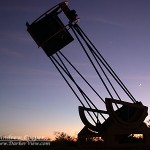
Steve Dillinger’s 20″ Dob awaiting full dark at Sentinel, AZ with Venus and the Moon shining behindThe sky started a little rough, with high cirrus and contrails scarring the blue lit by the the glow of sunset. The thin crescent Moon and Venus were gorgeous among the bright gold wisps. Shortly after dark these annoyances quickly cleared leaving a clean sky. Seeing was soft all night, transparency was decent, but poor at low altitude as views into Fornax or lower demonstrated.
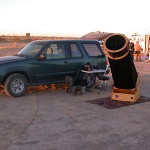
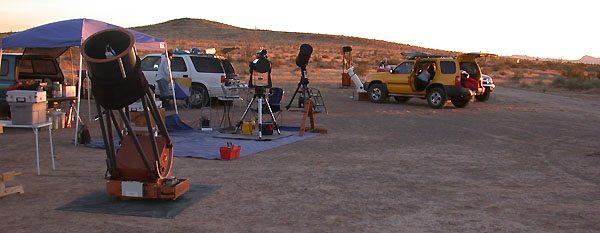
The author’s setup awaiting a dark December sky with Deep VioletI counted over 20 vehicles a little before sunset, but a least 10 more rolled in at sunset or just after. After a few hours there was a steady rate of departure as the cold night took its toll on Arizona observers.
I spent the first half of the night touring old friends and a couple new objects, but was basically killing time waiting for H400 objects to rise. After midnight the objects I had been waiting for had risen high enough to appreciate properly and I started to work, cleaning out Pyx, Lyn and Pup of a few remaining H400 objects as well as chewing on western UMa a little. It looks like I have 28 objects left, almost all in UMa, the end is in sight!
Around 0300 the breeze had become a steady cold biting wind and I finally packed it up and pulled out. I had already had around nine hours of good observing so I can call it a success. I wasn’t the last, there were at least two observers still going when I pulled out.
The telescope line at Sentinel for the 2005 Sentinel-Schwaar Star Gaze