Author: Andrew
Aʻa Garden
Climbing the Right Puʻu
Another weekend, another puʻu… So last week I climbed the wrong puʻu. This weekend I climbed the right puʻu.

Reaching this hill one travels a couple miles down the R-1 road, the Ka Aliali Trail. A couple of miles of 4WD road to bounce over. The road is not that bad, but I would recommend a true 4WD vehicle. DLNR requires a 4WD vehicle based on the signs, not that everyone reads the signage at the start of the road.
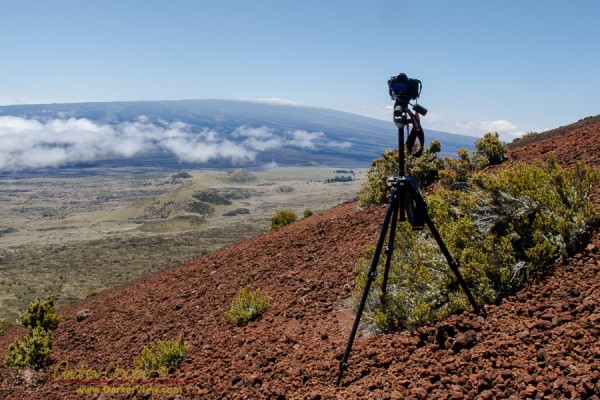
Unlike last weekend there was no heavy fog to obscure the landscape as I reached the area. My goal was obvious… the big red puʻu just downslope from the road. There is a short secondary road, signed R-2 that leads into the area between the two hills. After about a quarter mile this road fades at the edge of an aʻa flow. After parking I got out and sat on a rock outcropping for a while with a snack. The area is just pretty, the jagged black lava and native plants. I finished a bag of chips, downed a water bottle and simply enjoyed the view.
Puʻu Kole is notably harder to ascend than Puʻu Palaolelo. I suspected I was on the wrong puʻu last weekend when it was too easy, reaching the top after a quick stroll in the fog. Puʻu Kole is nearly twice as high, as least when approaching from the upslope side.
Puako Turtles
Puako is a very popular place with divers and sea turtles. No surprise, it is a really great reef here. Patti and Mark spent a day with the turtles recently, and Mark has produced another video…
The Aqua Safari Back in the Water
Engine trouble. Bad enough that the boat has spent a couple months on shore, one engine replaced and the other rebuilt. Thus it has been a while since I have been out diving, since late October! Had the weather been better shore diving may have been a higher priority. The winter weather has been rough, with high surf warnings a common item in the morning news.

Arriving in the Makalawena area we found a dozen boats milling about. Only one thing would attract that may boats… Dolphins. The shallow water here is a good place to find dolphins and whales. Sure enough, there were dozens of dolphins about and pods of humans snorkeling between the boats in an attempt to see the dolphins in the water. The dolphins seemed intrigued by the boats and swimmers. A group came over to check us out and surf in our wake.
Climbing the Wrong Puʻu
The original plan had been to hike Puʻu Kole, a dramatically red cinder cone visible from the summit access road. The red coloration leads to the name, Kole, which translates as red.
What actually happened is that I climbed the wrong puʻu.

As I traversed the R1 4WD road the side of Mauna Kea was enveloped in heavy fog, thick enough that you could not see a hundred yards, sometimes less. I was pretty sure I was in the vicinity of the target, and sure enough the shadow of a large puʻu was visible in the mist. So I parked the vehicle and climbed it.
It was when I reached the top and looked downhill that I noted there was another puʻu hiding in the fog. It was then I realized that I might just be on the wrong hill. Checking the maps I realized that I had climbed Puʻu Palaolelo.
Wrong? Perhaps this is the wrong word, there was no particular reason I needed to be on the right puʻu other than my desire to explore a place I had seen so often while ascending or descending the summit road. The error was fortuitous in that my original target hill was enveloped in thick fog all morning, while Puʻu Palaolelo, a little higher on the mountain, was alternately in the fog and in the sunlight.

Standing atop the puʻu I could not miss the beauty of the morning. Still early the low sunlight was rich in color. Across the saddle you could see Mauna Loa, capped in vivid white, quite a contrast to her black lava flows. A chill wind swept fog over the summit, at times I was spattered with droplets. As the fog and light played across the landscape my camera memory card quickly filled. It was a satisfying hike, resulting in some pretty photos. My original goal of climbing Puʻu Kole lies unfulfilled, an excuse for another walk on the mountain.
Total Lunar Eclipse
Early on the morning of April 4th a total lunar eclipse will be visible across the Pacific. Sky watchers in Hawaiʻi will be able to observe this event from beginning to end.

Maximum totality will occur at 12:02UT or about 02:02HST. First contact will occur at 11:01HST on the evening of the 3rd, with umbral first contact a little after midnight at 00:15HST. It is this umbral contact that will be the first obvious effect of the eclipse to a visual observer, a notable notch out of the Moon.
Observing a total lunar eclipse requires no special equipment, simply the desire to look up. The most useful piece of equipment will be a reclining chair or some other method of staying comfortable while watching the sky. A pair of binoculars or small telescope can provide beautiful views of the Moon during an eclipse. Photography is somewhat more challenging, but not that difficult. Focal lengths of around 1000mm will fill the field of most DSLR cameras allowing photos like that shown here.
| Penumbral Eclipse Begins | 11:01 HST | 09:01 UT |
| Partial Eclipse Begins | 00:15 HST | 10:15 UT |
| Total Eclipse Begins | 01:57 HST | 11:57 UT |
| Greatest Eclipse | 02:01 HST | 12:01 UT |
| Total Eclipse Ends | 02:02 HST | 12:02 UT |
| Partial Eclipse Ends | 03:44 HST | 13:44 UT |
| Penumbral Eclipse Ends | 04:58 HST | 14:58 UT |
The Moon and Venus

A Fogbow, A Glory and the Spectre of the Brocken
When doing a dawn hike on Mauna Kea it is important to choose your altitude with care. You really want to be right at the top of the cloud layer. There, where the fog drifts over in alternating shifts with the sunlight, there is where the magic happens. Mamane in the fog, puʻu appearing and disappearing, and fogbows. Add fog and you have all the ingredients for some good photography.
The plan had been to spend the morning on the summit doing some testing. When that got cancelled I quickly dropped into plan B… Go hiking. I got the altitude right.
The spectre of the brocken was a nice treat. At the center of the fogbow you can see a glory, and in the center of the glory is my shadow looming large in the mist. That is the spectre.

Unusual Asteroid Suspected of Spinning to Explosion
W. M Keck Observatory press release…
A team led by astronomers from the Jagiellonian University in Krakow, Poland, recently used the W. M. Keck Observatory in Hawaii to observe and measure a rare class of “active asteroids” that spontaneously emit dust and have been confounding scientists for years. The team was able to measure the rotational speed of one of these objects, suggesting the asteroid spun so fast it burst, ejecting dust and newly discovered fragments in a trail behind it. The findings are being published in Astrophysical Journal Letters on March 20, 2015.

Then in 2010 a new type of active asteroid was discovered, which ejected dust like a shot without an obvious reason. Scientist gravitated around two possible hypotheses. One states the explosion is a result of a hypervelocity collision with another minor object. The second popular explanation describes it as a consequence of “rotational disruption”, a process of launching dust and fragments by spinning so fast, the large centrifugal forces produced exceed the object’s own gravity, causing it to break apart. Rotational disruption is the expected final state of what is called the YORP effect – a slow evolution of the rotation rate due to asymmetric emission of heat.
Continue reading “Unusual Asteroid Suspected of Spinning to Explosion”