
Author: Andrew
An electrical engineer, amateur astronomer, and diver, living and working on the island of Hawaiʻi.
Keck Open House
I suppose I should do a write-up of Keck Week. It has been a week since the event wound down. But… That was a massive whirlwind of activity, way too much to do, I am just now exiting decompression mode.
I am not the only one attempting to recover. I stopped by Debbie Goodwin’s office Monday. Her desk is piled with follow-up work, her usually neat office a bit of a wreck. The same story everywhere around headquarters, the remains of open house litter the complex, slowly disappearing as folks clean up and put away. At least the conference room had tables and chairs for Tuesday’s AO Team meeting.
We are still awaiting the numbers, visitors to open house, donations, etc. But even without data I think we can call the event a total success. It was huge in any case, turnout for open house was somewhere in the 1,500 to 2,000 visitor range as expected. What I do know was the reaction I got as I walked about the events.. A lot of happy folks! Everyone was having a good time.


It is a lot of fun, and a lot of work. It is a real treat for the community. With the enormous effort we will not be doing this every year. The last open house was three years ago, it will probably be that long before we do it again.
A Programmable Current Source
The usual engineering minutia takes up much of my week… Paperwork, documentation, purchase orders, meetings, etc. There are the occasional chances to just have a little electronic fun. Thus I greeted a request from a couple of our support astronomers with some enthusiasm. They needed a variable intensity light source for calibration of the OSIRIS spectrograph. This source sits inside an integrating sphere on the AO bench along with four spectral sources, small tubes of neon, argon, xenon and krypton.
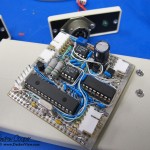
I set aside a bit of time each day to design and build the source. The last couple hours of the afternoon are best, at this point I have had quite enough paperwork. A chance to practice my trade sketching out the circuit, or simply sitting at the bench and soldering… Perfect.
Substation Observing Site
Another site that allows an amateur astronomer to take advantage of the pristine skies of Mauna Kea is located next to an electrical substation just a couple hundred yards east of the Mauna Kea Visitor Information Station. Here you can enjoy a truly spectacular sky above the tropical haze and VOG of lower elevation Hawaiian locations. Far from the modest lights of Kona or Hilo there is almost no light pollution and the tropical inversion layer often keeps the clouds and rain well below this mountain site. While the site may see some early evening use by sunset watchers and possibly a tour van doing a star tour for their guests the majority of the night will offer an escape from the crowds across the road leaving the observer alone to enjoy the universe.
View Larger Map
The Substation site has some advantages and some disadvantages…
- A dark site away from the lights and crowds if the VIS, but still nearby if you are to need access to the VIS bathrooms.
- An open cinder area with enough room for twenty or more vehicles and telescopes.
- The site is occasionally used by one or two of the summit tours to allow their guests a look through a telescope. This will usually take less than an hour before they pack up and leave.
- Sunset viewing guests from the VIS cross the area to access the pu’u to the south where sunset may be viewed with a clear view of the western horizon.
- The small pu’u to the south will block some of the southern sky.
- If there is a east or west wind it can come through the saddle across the site making conditions less than ideal.
- The site lies on DLNR administered land and is subject to DLNR rules. Camping is not permitted, where camping is defined as possession of “camping paraphernila” after dark. Make sure you do not have a tent, sleeping bag or other obvious camping gear along. In practice this has never been enforced at this site.
The VIS is more sheltered as it is below the small ridge and offers a somewhat better southern horizon.
The site is easily found by turning off the main road just below and opposite the entrance to the Mauna Kea VIS. A break in the guard rails provides access to a short gravel road that proceeds straight up the hill to the saddle and the substation.
Lava
Vernal Equinox
The vernal or spring equinox occurs today at 01:02HST. Today there will be little difference between the length of the night when counted against the number of daylight hours. This is the first day of spring as marked by many cultures in the northern hemisphere.
| 2013 Solstices and Equinoxes | ||||
|---|---|---|---|---|
| UT | HST | |||
| Perihelion | Jan 2 | 00:59UT | Jan 1 | 14:59HST |
| Spring Equinox | Mar 20 | 11:02UT | Mar 20 | 01:02HST |
| Summer Solstice | Jun 21 | 05:04UT | Jun 20 | 19:04HST |
| Apehelion | Jul 5 | 18:59UT | Jul 5 | 08:59HST |
| Fall Equinox | Sep 22 | 20:44UT | Sep 22 | 10:44HST |
| Winter Solstice | Dec 21 | 17:11UT | Dec 21 | 07:11HST |
| Source: NASA Sky Calendar | ||||
Postcard from the Summit – Ice

Comet C/2011 L4 Pan-STARRS
The weather finally broke, leaving a clear western sky and a chance to photograph the comet. I set up and managed just a few shots before the comet set into the top of a tree across the street.
At least I was able to get on-sky. Much more than can be said about our ‘scopes on the mountain. Observing was cancelled earlier this afternoon, there is too much ice on the domes to operate safely. At least the ice was pretty, and photogenic.

Moon and Jupiter
This evening will see the Moon and Jupiter quite close, about 2° apart at sunset. Look for the bright pair high in the western sky as the sky grows dark. The Moon will be about 36% illuminated and Jupiter will be quite bright at -2.2 magnitude.
Postcard from the Summit – An Empty K2 Dome
