A Venus Transit is a truly rare event. Transits occur in pairs eight years apart, with the next pair not occurring for another 120 years. The first event of the current pair occurred in 2004. Thus the next event will happen in June 2012. Considering the century long period between events, this is the last chance to witness a Venus transit during our lifetimes.
The 2012 event will be visible from the west coast of North America to Japan, China, Australia and Central Asia. For those wanting to observe the entire event from start to finish the choices narrow quite a bit. You have the choice of the Central Pacific, Japan, as well as Eastern China and Eastern Australia. This, of course, includes here in the Hawaiian Islands.
Many sky-watchers from North America will see only one choice if they wish to observe the event… the Big Island. The only place easily accessible by air, featuring excellent visitor accommodation, and an observing site that sits above the clouds that could so easily interfere with carefully laid plans. For the serious observer there is one obvious choice… Mauna Kea.
We saw the first signs of this well over a year ago. The tour companies that specialize in astronomy related travel, the folks that feature solar eclipse tours and similar events, began scouting Mauna Kea as a destination. Then the ads appeared, in Sky & Telescope magazine, Astronomy magazine, etc., “See the transit from Mauna Kea!” We had fair warning that this event was not going to pass peacefully.
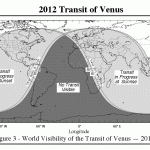
Visibility chart for the 2012 Venus transit, image credit: Fred Espenak/NASA
Some folks seem to think the crowd will be huge, a thousand people or more. I am not so certain, this does not have the general appeal of a total solar eclipse. The transit is something that will be of interest to amateur astronomers and some interested segments of the public. I personally expect hundreds of people coming to Mauna Kea to view the transit, not thousands.
However many folks do ascend the mountain for this event, we have begun putting plans in place to handle it. Various groups have met to do a bit of planning. Most significantly, those in charge of managing the mountain, The Office of Mauna Kea Management, are putting a few measures in place. As usual, expect to stop at the Mauna Kea Visitor Information Station on the day of the transit. But this day there will be a few differences…
- All available MKSS staff will be on duty. All of the Mauna Kea rangers and visitor station staff will be helping make sure assistance is available to visitors when traveling to the high altitude environment of the summit.
- Access to the mountain will be controlled for the day, a gate at the VIS allowing access for official vehicles only.
- A free shuttle will run from the VIS to the summit. The Mauna Kea tour companies providing the vehicles and drivers.
- Solar telescopes and video monitors will be set up at the VIS to allow safe viewing. Staff will be available to answer questions and assists with the equipment.
- Several other locations on the island will be setup for viewing the transit with solar telescopes and staff. Expect these to include ‘Imiloa, Keck HQ in Waimea, and some possible other locations.
All of these plans are somewhat preliminary, details may change as the date approaches and final arrangements are made. I will attempt to post what I know here on Darker View.
Myself? I plan to observe the event from the summit. Set up behind Keck with a solar telescope to photograph the transit. We plan to set up a live feed of the transit for use by other sites, and available to viewers across the internet.