The lava burst forth from the crater wall just before Christmas. After two years of quiet the volcano has again erupted. Within hours the lake of water that had been slowly growing had been boiled away in a huge plume of steam.
Gazing into creation at Kilauea Caldera with the stars of Crux and Alpha Centauri above
I knew within minutes that an eruption had begun, tapped into the island grapevine. While I considered making a midnight run across island I had to bow to the needs of life and regretfully went to bed.
Now well into the new year I finally had a chance to photograph the new lava lake.
I rolled the telescope out of the garage to view and photograph the conjunction of Jupiter and Saturn. It is impressive to see the two gas giants side by side like that. The photos were less of a success, with soft seeing they are not great. OK, the photos suck.
The Moon was a different story, high in the sky the seeing was much better. Since I had the camera on the telescope I shot a few photos of the first quarter Moon.
Look closely along the terminator and you can find the Lunar X, the V, and the Vallis Alpes…
We are now in the year 2021 by the Gregorian calendar used for much of the world. The celebrations are done, with the scars left by fireworks in our street now fading. We look forward to another year after the the stressful and destructive times of the last twelve months, a year that will loom large in memory for the remainder of our lives.
Point Retreat Lighthouse on the north end of Admiralty Island, Alaska
While the calendar now reads 2021, somehow 2020 seems to drag on. I feel that the remnants of 2020 will not truly be gone until January 20th, and maybe not even then. Perhaps later in the spring when vaccination programs end the viral rampage through our communities.
As we rebuild our lives and try to recover some sense of normality we might look back and try to understand the lessons taught by the year 2020. These lessons are both small and personal or large enough to threaten the foundations of our civilization. We have seen into ourselves and into those around us, the true nature of so much revealed by stress and argument.
Will these lessons be learned? Will things change? While we might be able to change ourselves for the better more easily than we can change our country, both need to be done.
While we plan for the coming year and move forward we rely on experience, something that 2020 was rich in. May you live in interesting times… The old curse that seems so applicable to the moment.
It is a bit redundant at this point to remark on how troublesome the year 2020 has been. Looking back at the year in photos I can note that I did not get out much. No big trip, mostly staying home, a few photos taken on local hikes just to get out of the house.
This pig was one of the two I am trying to catch, all that remains of the original eight in the group. One big white pig and one young black, they have evaded my trap for over a month, sometimes stopping by, but hesitating to step into the wire cage.
A bit of a surprise… Contrary to my assumption big white was female.
While she had been quite shy of going into the trap, a bait tray loaded with banana peels, pineapple scraps, and sweet potato peelings had proven irresistible. The trap slammed shut just after 4am. Lightly dozing I heard the plywood door drop and knew immediately that I had caught another pig. Oddly this pig was silent, no squealing to wake the neighbors.
This time I had help loading the pig, my parents are visiting for the holiday. Trapping and handling a feral pig is another story to tell when they get back home.
There is only one pig left of this pack, a mid-sized black that is the last of the litter mates. He was hanging around when we removed the older female this morning, is still hanging out in the area. Got the trap right back into position and baited in case.
As an evening pastime in these COVID restricted days I have been delving into the past again. Again reading the work of an amateur astronomer from long ago.
Frontspiece of Bedford Catalogue, 1844, Capt. William Henry Smyth
I had previously read through the work of Rev. Thomas Webb, a vicar and amateur astronomer active in the late 1800’s. Webb frequently refers to the work of a yet earlier observer, Capt. William Henry Smyth.
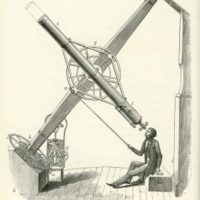
Retired British Navy Captain Smyth was a backyard observer, gazing at the stars with a 150mm refractor from a garden behind his home in Bedford England. His telescope was quite good for the time, made by Tully of London, the best money could buy. This telescope was eventually purchased by the British Government to be used in the 1874 transit of Venus expedition to Egypt and the 1882 Venus transit in Jamaica. It now sits in the collection of the Science Museum, London.
Capt. William Henry Smyth’s Telescope at Bedford
Smyth published two volumes on astronomy in 1844 under the title A Cycle of Celestial Objects . Volume II of this set, commonly called The Bedford Catalogue or The Bedford Cycle, contains descriptions of more than 850 double stars, clusters, and nebulae, serving as a guide to what may be observed with a small telescope. The Bedford Catalogue became the standard at-the-telescope reference for other amateur observers for many decades until it was generally replaced by Webb’s Objects for Common Telescopes.
After going almost two weeks without catching anything I get two pigs in two nights. As usual the pigs came in to check on my compost pile. The sliced up apple proved too much a temptation and into the trap he went.
I have been been using apples from the sales rack our local village market. There is a shelf at the back where spoiled produce is placed at cut rate prices. A bag of bruised apples for a dollar makes good pig bait.
As you can see there is another pig outside the trap in the video below. Actually I think there are three more remaining in the neighborhood after this one. One big white spotted and two more smaller black pigs. The trap will be reset and ready tonight!