Spam, not the canned meat product, you cannot find that anywhere in the islands right now, or if you do you are limited to a purchase of two cans per household. Life in Hawaii.
My ISP spam folder on April 6th, 2020
Rather I refer to the e-mail type of spam. I had cause to check my spam folder on my ISP this evening. I did not find the message I was looking for, but I did notice something curious instead.
Usually the majority of spam in my folder is trying to sell something sexual, from pills to meet-ups. These types of messages have almost completely disappeared in the last couple weeks.
Instead the majority of messages are attempting to sell non-contact IR thermometers. Useful in these COVID-19 times, not that I would buy one from some spam e-mail. Just another sign of the times.
After two weeks of being stuck at home I really wanted to get out and stretch my legs. A hike is in order.
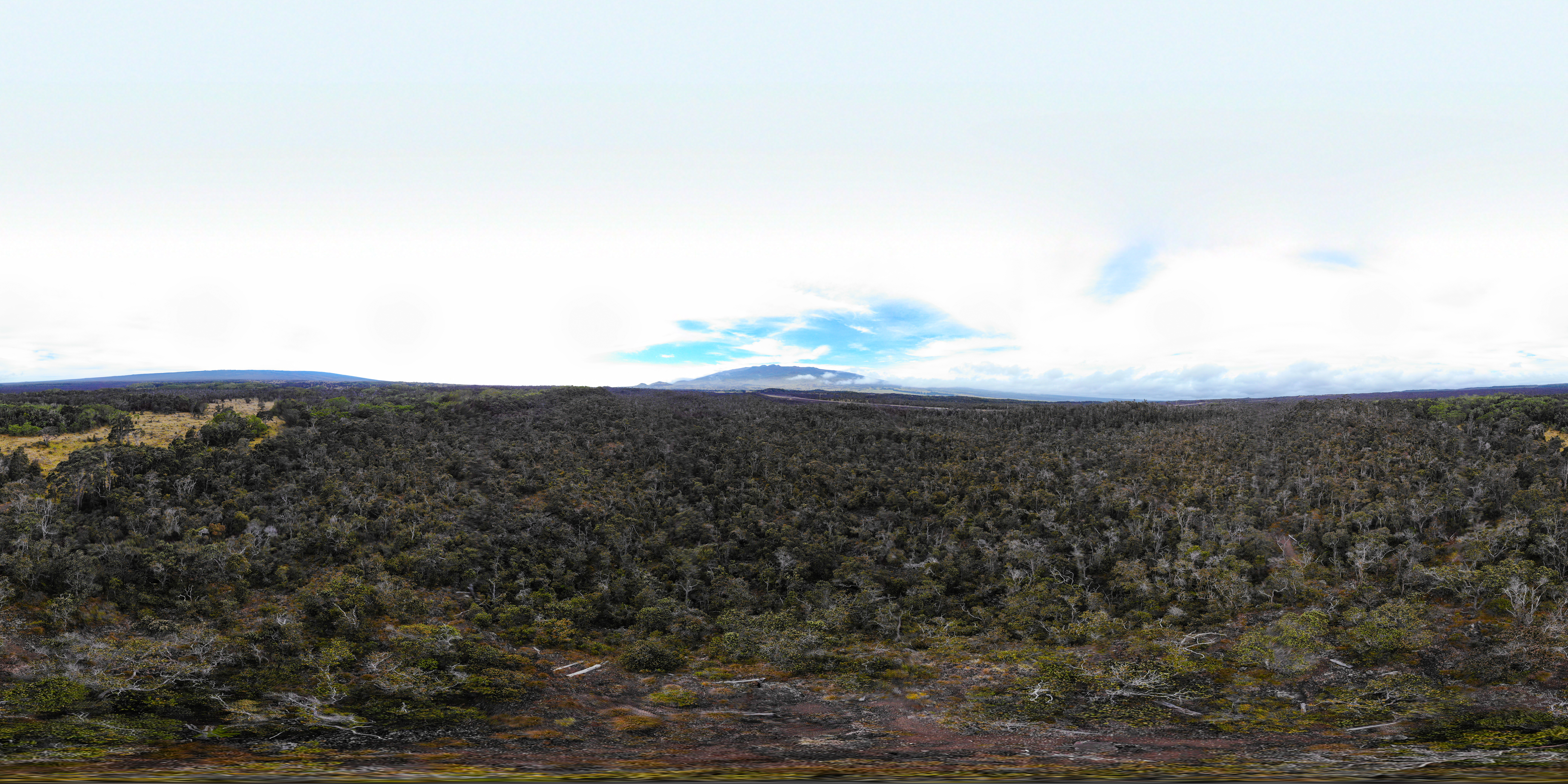
Puʻu Hinai sits 200ft above the surrounding plains
The governor specifically allows outdoor exercise in his stay-at-home order, including “surfing, swimming and walking pets”. I took that to cover a local hike near home. Just outside Waikoloa Village are quite a few rough roads that allow access to big areas of land, much of which belongs to the village association.
Puʻu Hinai would be my destination, a prominent landmark that sits 200 feet above the surrounding plains, a feature that I have seen on every commute for 13 years and wondered what was out there. A short walk of about a mile off of Waikoloa Road it was an easy target.
A large part of the puʻu has been carved away by a cinder mining operation. A decade ago trucks carrying cinder were a common sight on Waikoloa Road, no longer, the quarry lies abandoned. The side of the puʻu that faces the road is mostly untouched. The far side? It appears much is gone, I wanted to see just how much.
Social media is currently full of advice on what to do while stuck at home waiting out a pandemic. I find I need no advice… A dark sky and a telescope? No problem.
The observing notebook fills with notes beside the telescope
Awake at 4am this morning I pulled the Astrola from the garage and observed until the dawn lit the sky.
Once the evening clouds dissipated I again pulled out the telescope and observed for another two hours this evening.
Following the advice of staying at home I have been observing alone from our driveway. This weekend would have been our normal club dark-of-the-moon star party at Kaʻohe, getting together with other observers. Obviously this was cancelled.
This period of social isolation is measured in pages of notes on stars and nebulae, measured in the light-years I cross while peering into the universe.
Being home for a while has let me finish up the ongoing landscaping project in the back yard. The last earth moving is in process with the area taking on the final configuration, just stacking rocks and some more planting to do.
Also need to get more mulch from the county green waste facility, at least three trailer loads.
New landscaping in the back yard begins to look complete…
Governor Ige signed the new public access rules, drones would be illegal on the summit in ten more days.
Keck and Subaru in the snow atop the summit of Mauna Kea
With a deadline looming much sooner than I had contemplated there was a narrow window of opportunity. While I had wanted to fly the summit for a long time, I now had a few short days in which to do so. On January 23, 2020 the new rules would take effect.
The Office of Mauna Kea Management has attempted to restrict drone use on the summit by posting signs that drones are not allowed. Problem, they did this with no legal authority to do so. In conversations with OMKM staff I had pointed this out and received a quiet admission that it was true.
The new public access rules would change this… Flying a drone would be specifically prohibited on the science reserve, a civil offence with steep fines involved. With the governor’s signature those rules would be in force.
Today is February 29th, that odd date that only occurs every four years.
The reason for a leap day inserted into the calendar, the existence of February 29th, is ultimately astronomical. Perhaps a little explanation is in order…
We originally defined days as the time it takes the Earth to rotate. While we define years as the time it takes the Earth to orbit once around the Sun. The problem is that these values do not divide evenly into one another.
Sunrise seen from the summit of Mauna Kea
The Earth takes about 365.24219 days to obit the Sun, when measured by the Sun’s position in the sky, what is called a tropical year. There are different ways to measure a year, but if one is concerned with keeping the seasons in sync with your calendar, then you are interested in tropical years.
It is that bunch of decimals, the 0.24219 etc., that is the problem, every four years the count drifts out of sync by roughly one day. The insertion of an extra day every four years helps bring the calendar back into synchronization with the orbit of the Earth and with the seasons.
Even leap years do not quite fix the problem as 0.24219 is close, but not quite 0.25 or one quarter of a day. Thus additional corrections are needed… Enter leap centuries.
Our current calendar was instituted by Pope Gregory XIII in 1582, setting up a standard set of corrections for the fractional difference between the length of a year and the length of a day. Scholars knew that errors had been accumulating in the calendar for centuries, resulting in a drift of several days.
Religious authorities were concerned that this drift had displaced important celebrations in the church calendar, in particular the celebration of Easter. After much argument it was decided to reform the calendar. The current solution was devised by a number of astronomers, including Aloysius Lilius, the primary author of the new system.
The Gregorian Calendar uses an extra day in February every four years, unless the year is divisible by 100, then there is no leap leap day that year. However, if the year is divisible by 400, then it is a leap year. While this may sound odd, it does create a correction much closer to the ideal value of 365.24219 days per year.
I am a geek, so let us put that into code…
1
2
3
4
5
6
7
8
9
10
if(year modulo4=0)then
if(year modulo100=0)then
if(year modulo400=0)then
leap=True
else
leap=False
else
leap=True
else
leap=False
Even this is not perfectly precise. The correction is close but will drift given enough time. The length of a tropical year also changes slowly over time. We will eventually have to add another correction to keep the calendar and the seasons in sync. But not for a few millennia, good enough, for now.
As 2020 is divisible by four and not divisible by 100, there will be a leap day added to the end of this February… Today.
Along with the sway bar links there was an EGR valve in that box of parts that arrived a couple weeks ago. This weekend that valve was replaced.
Replacing an EGR valve on the 2006 Explorer
Again I hit the YouTube auto manual before doing the job in order to size up exactly what would be needed. Ouch! That does not look fun. Indeed the videos made it look like a real knuckle buster to get out.
In one video the mechanic has to pound away with a mallet and breaks a 10mm socket in the process of removing the valve body bolts.