Trickle
When you want to see the stars, find someplace dark

It was more of an event than I expected, and a much larger crowd. There were two bands, multiple food trucks and stands, performances by a dojo and a hālau, and of course a bunch of telescopes provided by Keck and the West Hawaii Astronomy Club.
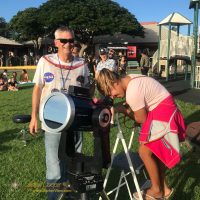
Maggie , the school librarian had contacted Keck to see if we could provide a speaker and a few telescopes for viewing. Given the telescopes part the request got passed along to me to get the club’s assistance with the telescopes side.
As usual the club members volunteered quickly, no problem getting enough people and telescopes into place to do the event. As long as the weather held over Waikoloa this would be a good event.
Continue reading “Picnic on the Green”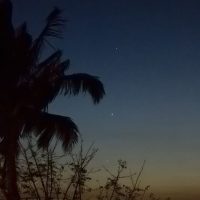
Today Mercury is passing through maximum elongation, the furthest it will rise above the setting Sun in the evening sky. After today the planet will slide back into the Sun’s glare headed for inferior conjunction on November 11th.
This is a good apparition, with the planet over 24° from the Sun at maximum.
Continue reading “Mercury at Maximum Elongation”We were just setting up the telescopes when I looked up and spotted it.
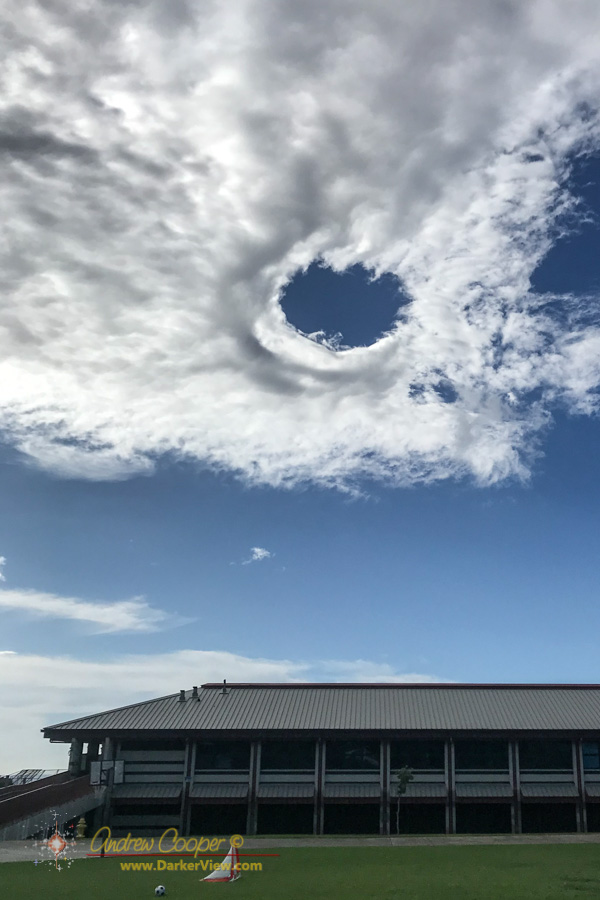
Waikoloa School was hosting a community picnic, a couple bands, food, performances by a karate club and a halau, plus a few telescopes provided by Keck and the West Hawaii Astronomy Club. It promised to be a fun evening.
What I spotted was a hole-punch cloud above the school. OK, that was unexpected. A high thin layer of altocumulus perforated by a neat circular hole.
The hole had a thickened edge as if something had pushed the cloud layer aside. Otherwise it was completely clear in the center and nearly perfectly circular.
Hole punch clouds are often formed when something passes through a cloud layer, such as an aircraft, disturbing and destabilizing it. This does not appear to be the case here, rather I would guess that an updraft from below pushed its way into this particular cloud from below.
The hole was short lived, fading in about 15-20 minutes as the cloud layer reformed.

With the big wall completed along the driveway, and a bit of a break over a hot muggy summer, I am again building walls.

This is not the sort of wall between people, I detest those, but rather a real rock wall, terracing the backyard to make the space available for landscaping and other projects. This puts into action a plan that has been brewing for years.
Part of the impetus is that I have a source of rock secured, a very large pile of very nice rock found in a Waimea backyard. One of my co-workers casually mentioned he needed to rid himself of a pile of rock, to which I quickly asked… How much rock?
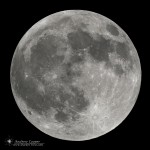
Continue reading “Building More Walls”Full Moon will occur today at 11:08HST.
This evening look for the Moon rising in the east just as the Sun sets in the west. Across the Big Island this can often lead to moonbows as the low elevation moonlight interacts with fog and clouds.
Continue reading “Full Moon”
I do enjoy doing school star parties, one of the best parts about running our little astronomy club is arranging these events.
The school in this case is Mauna Loa School, a Hilo charter school. This did not entail a two hour drive to Hilo as they came to our side of the island. Much of the student body was camping out at Spencer Beach Park after a day spent visiting nearby sites including Anna’s Ranch.
The school had reserved the entire camping area of the park, along with the large pavilion. About 40 students, staff, and parents. We arrived to a small tent city and the smells of Mexican beans being prepared for dinner.
Invited for dinner we had burritos with the students while the sun set over the ocean. A classic Hawaiian evening with the beach and palm trees, a gentle sea breeze and a glowing sunset.
Early in the evening we were troubled by clouds, with nice views of the Moon through the gaps every few minutes. As usual for this coast the clouds slowly dissipated as daytime heat faded leaving a mostly clear sky towards the end.
The timing was perfect, with a crescent Moon, Jupiter, and Saturn all high and available for viewing. Four telescopes were available for viewing keeping lines a bit shorter at the ‘scopes, with many eager eyes.
As usual when viewing Saturn somebody jokingly accuses me of faking the image… A slide, a sticker, that has has to be fake. Yet there is was, encircled with those beautiful rings, the large moon Titan just above the planet.
Our deadline was 9pm, when the gate above the park would be locked. I gave everyone a 20 minute warning to break down and head out. After a few last looks at Saturn and profuse thanks from the students and staff we just made it, park security locking the gate behind us.
Next week it is Waikoloa School.