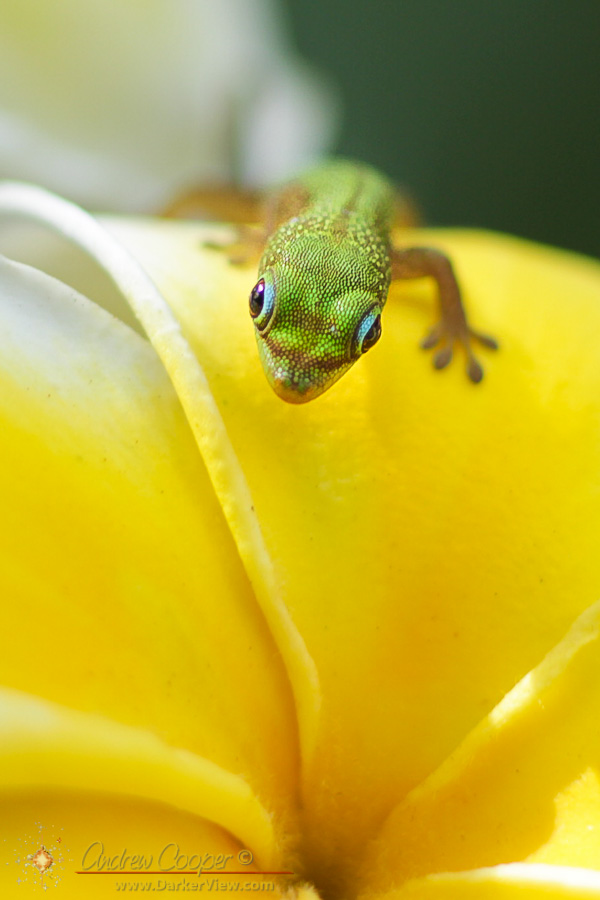
This little guy was not afraid of me in the least. Indeed he had no problem hopping on and off my fingers as I sought to pose him on the flower. It was a warm afternoon and he was quite active, more interested in the ants on the flowers than in sitting still for a portrait.
Shot with an old Canon 100 f/2.8 FD lens (manual focus) and a 25mm extension tube on the Canon EOS-M camera. I got the focus right by simply rocking back and forth through focus while rapidly taking images in servo. This was not with the focus ring, but simply leaning back and forward slowly.
A gold dust day gecko (Phelsuma laticauda) on a plumeria blossom
You never frame a photo properly when taken. This is a lesson I learned long ago… In the sometimes frantic process of shooting the photo, you rarely have a chance to frame the subject correctly. That moment when the whale surfaces, or the bear looks right at you, there is little time to adjust the photo for best impact, you just shoot.
The moon setting over the NASA Infrared Telescope Facility (IRTF), note how the imposing feeling is created by placing the telescope high in the imageThe lesson that you take from this, and hopefully apply when shooting, is to shoot a bit wide in order to allow yourself flexibility in the processing. Zoom out a little, knowing that you will crop away some of the image in processing. A wise photographer understands this, the hard lessons one learns along the way. It is much later when you sit at the computer and can truly look at the photo that you can evaluate how best to arrange the subject.
Rotation is also an issue, many photos are taken handheld, often hastily in the moment. These will have small errors in rotation. Do not even mention shots taken from a pitching boat! A modest crop of the photo will also allow correction on the image rotation.
The choice of crop is critical, it is the first step in my processing of the photo. Either the crop works, or move on to the next photo in the folder. Almost all photos can be improved by cropping in a little, to cut away the extraneous areas and to concentrate the viewer’s attention on the primary subject. Much of the time I will throw away 10-25% of the photo, not cropping a lot, just tightening up the composition.
Adobe LightRoom acknowledges this fact of photography, the crop and rotate tool is on top, first on the left of the processing tools. Crop it in, perhaps straighten the rotation, then you know if the photo is worth any further effort.
The art is in choosing the crop… How much to crop. How to position the major elements. This decision is an aesthetic choice of the photographer, and as with many such choices, there is no single best answer. There are some rules that can help. These are rules that can help, but are not ironclad, they can be broken if the composition calls for it.
A photographer needs a guide around Keck for the night? Setup time-lapse cameras throughout the facility? Sounds like fun… Sign me up.
Two AO lasers aimed at the galactic center with a large red glow coming from KilaueaThus I meet local photographer Jason Chu at Keck in the afternoon and help him drag a mountain of camera gear into the summit facility. We loaded quite a pile onto the cart, eight full DSLR cameras and a stack of tripods. The plan is to set them up in the domes for the night then re-collect the cameras in the morning. Six cameras in the domes and a couple more to carry through the night.
Two lasers, both aimed at the galactic center were on the schedule for the second half of the night. Andrea Ghez and her team having time on both telescopes. The weather looked a bit problematic, thick cirrus covered the sky, but the forecast called for clearing after midnight.
Jason came with a carefully drafted plan, where to set and aim each camera, timer settings, lens choice, all carefully considered. A pretty good plan too, only a few details needed changing as we placed each camera. Four cameras in Keck 1, another two in Keck 2. One camera placement was my idea… Clamped to the Keck 1 dome where it would track with the telescope. I had spent a few minutes in the machine shop putting together a solid camera clamp.
Unfortunately the clouds did not clear as predicted, thin cirrus hanging on through the night. It was clear just to the west, but stubbornly would not give us the clear skies we needed overhead. Several times it looked to clear, but the clouds would thicken again. We did have both lasers on sky for a few minutes, just enough for a few photos and not long enough to do any science.
With high hopes for some dual laser time-lapse I was ready to set up my own camera, but ended up with only a few still photos. Jason got a few nice shots during that short time, having eight cameras helped make the most of those few minutes. I did get a nice video clip of the telescope shot by rotating the dome with a camera.
Jason is working on a personal project and will be out shooting more images in the dark. I will certainly feature the results of his effort here on DarkerView when he finishes. For myself? I will have to schedule another opportunity to go up and shoot some laser time-lapse. There is an intriguing night at the beginning of July on the schedule with both Keck lasers. I also need to mail Jason a camera remote, an accomplishment that only one bit of camera gear got left behind.
Once you descend below a few feet underwater photographs begin to be all greens and blue. The reason is that water absorbs the red light, leaving a very skewed color balance in the images. Thus bringing a light source with you becomes important to allow the underwater world to be seen in vivid color.
The Sola Photo 800 mounted beside the Ikelight strobeI routinely use a strobe on my camera, resulting in very nice still images. But the strobe is useless for video. Thus my interest in a light that can be used as a main dive light and as a video light underwater.
Enter the Sola Photo 800 by Light and Motion… The Sola offers a nice flood with an even field of illumination for video. Several of my dive buddies use Sola lights, Thus I have had a chance to check out the lights firsthand before putting down a few hundred dollars. I was particularly noting the build quality and the control setup, both are excellent. With dozens of dives on the lights they still work well. Perhaps I should consider one of these little units?
There are several models available, but it is the photo version I was looking at. The light provides 800 lumens of white in an evenly illuminated, large field. The photo version also offers a red mode for framing and focusing that purportedly does not change the behavior of the subject. Deep red light is not seen by many marine critters as there is little to no red light at depth to be seen.
A coincidence of decent sales on the Sola lights occurring on my birthday resulted in a package appearing on my lanai. I ordered light with both the hand grip mount and with a ball mount that will allow attachment to my camera rigs.
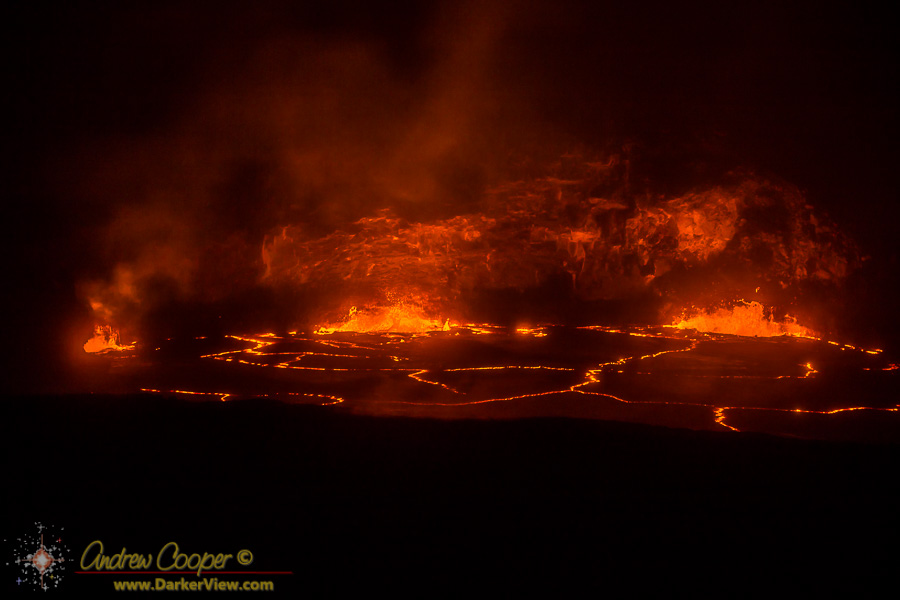
Processing photos of the Halemaʻumaʻu lava lake presents quite the challenge. The very bright lava fountains are difficult to properly expose while showing anything of the surrounding scene. Yet another try is shown here. This version uses very heavy tonal editing to compress the dynamic range of the lava fountains while expanding the low end of the histogram to show detail in the rock walls. The result is interesting, but quite different than seen in person…
The lava lake at Halemaʻumaʻu sport several fountains of lava along the far rim, May 2, 2015.
Watching the fantastic scene below me it was the famous lines from a play that came to me…
The lava lake at Halemaʻumaʻu on the morning of April 27, 2015
This cauldron is roughly 500ft (200m) across and filled not with a witches brew, but a seething pool of lava. And while a line from Shakespeare might begin the description, it can not fully capture the reality… A churning pool of lava, mostly crusted over with thin sheets of dark material broken by brilliant red cracks. Along the edges bright fountains are powered by gasses escaping from deep below. In the night the brilliance of the lava lake was startling, illuminating the plumes of gasses and the low clouds over Kilauea Caldera.
To see this cauldron I had gotten up well before three in the morning for the nearly two hour drive across island. I traveled over Saddle Road and then up the volcano highway to Kilauea. Why the effort? The lava lake that has been present in the Halemaʻumaʻu crater was visible for the first time, at least from any publicly accessible place in the park. Normally the surface of this lava lake has been several hundred feet below the crater floor, hidden from direct view. An unprecedented surge of pressure in the Kilauea magma chamber has pushed the lake level to new heights, almost spilling out onto the floor of the crater.
Driving into the park revealed the first surprise. I was part of a little convoy of half a dozen vehicles, a bit unexpected at 4am. Arrival at the Jagger Museum parking lot I encountered an almost full parking lot, just a few spaces left in a very large lot. There were several hundred visitors already on the large terrace viewing area. A huge crowd, all here to see the lava.
I work at the summit of a nearly 14,000ft mountain that sits atop a pretty tropical island. That alone is good enough reason to carry a camera at all times. You never know when you will need that camera, beauty appears when you least expect it.
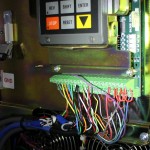
The control wiring for a Keck 1 dome VFD motor controllerThere are other reasons to carry a camera in my life. I often use the camera to document my work. There is a camera, the little EOS-M, in my backpack alongside the rest of my tools. Wire cutters, screwdrivers, allen wrenches, a multimeter, all the useful tools I need every day, along with a camera, memory cards and spare batteries.
The advent of digital cameras where the cost of each photo is negligible has made this possible. This would not have been practical in the days of film. Yes, I remember those days, counting out every frame of a 36 exposure roll, deciding if the shot was worth it. In this digital age I usually have a dedicated camera along and never worry about shooting. If that camera is out of reach there is always the iPhone in my pocket.
The equipment I work on is often unique, there may be only one copy in the world. Two if we have one installed on both Keck 1 and Keck 2. The documentation can be of varying quality, some is good, some is abysmal, some is just plain wrong. Some of this gear was professionally built by engineers, some of it was built by graduate students who would never need to fix it years later.
When doing a dawn hike on Mauna Kea it is important to choose your altitude with care. You really want to be right at the top of the cloud layer. There, where the fog drifts over in alternating shifts with the sunlight, there is where the magic happens. Mamane in the fog, puʻu appearing and disappearing, and fogbows. Add fog and you have all the ingredients for some good photography.
The plan had been to spend the morning on the summit doing some testing. When that got cancelled I quickly dropped into plan B… Go hiking. I got the altitude right.
The spectre of the brocken was a nice treat. At the center of the fogbow you can see a glory, and in the center of the glory is my shadow looming large in the mist. That is the spectre.
A beautiful fogbow, a glory and the spectre of the brocken on Puʻu Palaolelo