Focus is one of the most frustrating problems when shooting in the dark. The number of astrophotos ruined by poor focus is legion. Worse, the problem is often not found until afterwards, when hours of effort have been wasted. Very slight errors in focus can spoil an otherwise great photo.
Taking photos in the dark creates a situation where the normal solutions do not work… Autofocus simply will not operate without enough light. Taking the lens off and attaching the camera to a telescope results in a completely manual focus. Simply focusing through the viewfinder is not accurate enough.
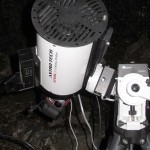
A Bahtinov focusing mask in use on the front of the AT6RC telescopeThe simplest method of focusing in the dark is to use the live view feature of the camera. By placing a bright star or distant streetlight in the view and magnifying you can achieve a reasonably good focus much of the time. This is not perfect, even the magnified image is a little mushy near ideal focus, making perfect focus difficult to judge. If you find yourself in an after-dark situation, without any special equipment along, this is the method to use.
Do remember to switch off the autofocus feature of your lens. Once you get focus set correctly you do not want to lose it the moment you touch the shutter button. Not that I have ever done that… Never? Well, perhaps maybe.
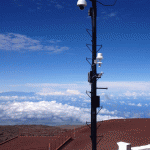
A high quality pan-tilt-zoom camera on the roof of the observatory at an altitude of 13,630ft? Just too much fun. I have found myself logging into the camera at sunset to enjoy the view, or keeping the video in the corner of my screen through a Hawaiian blizzard. I have even forwarded images to a local television station when they requested views of a white Christmas in Hawaiʻi. Yes, they used them for the evening news!
The Keck weather mast with a sonic anemometer at top, MastCam, and the housings for the temperature, humidity and barometric pressure sensors.This camera can do more… The camera is an Axis Q6044-E dome style security camera. The camera contains a small Linux computer with a huge array of scripting and control options. Combined with a 720p HD camera, reasonably decent optics, and an accurate PTZ mechanism the camera is quite capable.
To make the best of this wonderful toy I need some tools. To that end several Python programs have been written, including a camera scheduler. This program takes a text file with a schedule and captures images at the programmed time and date. All of this was easy to implement in Python, all of the necessary ‘net protocol support is available in the libraries.
The schedule file can contain any number of separate schedules for multiple sequences. At the specified time the program insures the camera is set properly, moves the camera to the correct position and captures the image. Each sequence is saved to a unique directory and given a sequential name suitable for compiling time lapse video. Add a simple GUI to allow images and status to be monitored and the program becomes a very useful tool.
There are now multiple sequences running… Photos of the summit ridge at each sunset, the shadow of the GPS antenna every day at noon, the Kohala mountain every day mid-morning, the TMT construction site several times a day, and more.
When diving with a camera you understand the situation… It is not a question of if you flood the camera, it is a question of when you flood the camera.
The author diving the intake pipes at OTEC, photo by Pete TuckerYes, I flooded a camera this weekend.
Just 15-20ft down on a dive off the old Kona airport, I went to turn the camera on and saw something that made my heart miss a beat. The camera case was half full of water. Nooooo!
As we were just starting the dive I popped to the surface and drained the case. I knew that the damage was already done, salt water and electro-optics simply do not mix. Re-seating the rear hatch I dive again, the leak has stopped.
Continuing the dive without a camera was painful. I dive to shoot, not being able to take photos takes the color out of the dive. At least nothing special wandered by, no 14ft tiger shark or underwater humpback sighting, that would have been excruciating.
The leak appeared to be on the rear hatch, I could see a trickle originating on the top right corner. Some small debris in the seal? A slight kink in seating the seal. Later examination shows nothing wrong, I will probably never know.
The memory card appears to be just fine, I read out the few shots that were on it. This includes the photo of the folks drying coffee on the old runway. I simply marked the card so I know which one it was in case there are questions about the reliability later. The camera battery also appears to have survived the immersion, need to use it a through a couple cycles to be sure.
Otherwise the camera is an expensive desk ornament.
As Pete said after the dive… “Insert $400 to play again.”
Fortunately there is EBay… Inserting a mere $200 has a used G12 on it’s way for me to play again. It appears the the G12 is old enough that used cameras are very available and the prices are falling. I may want to pick up another one. This is why I use a few hundred dollar camera underwater, not a few thousand dollar camera, it will happen again. In the meantime Pete is currently assembling a Canon 5D MkII underwater rig. Not me.
One of the real advantages of the mirrorless cameras, like my little EOS-M, is the ability to mount just about any lens. The small cameras have very shallow back focus requirements, the distance from the lens mount to the sensor. With the correct adapter they can mount the old Canon FD, Nikon, Leica, anything! I find myself unpacking my old photo gear, and wondering about the possibilities.
I do have some really good old Canon and Nikon primes around, lenses from the manual focus days. When I assembled an EOS-M to FD adapter, an extension tube, and a 50mm f/1.4 lens onto the front of the camera it resulted in a rather odd looking setup. Odd looking, but it works, providing an impressive macro capability. With better than 1:1 magnification I was able to keep a reasonable depth of field in the test shots. I need try some tests with the 100mm f/2.8 lens, for even higher magnification.
Aside from the FD to EOS-M adapter this is all gear I had sitting about unused. I never used it much in my film days. Digital is different, the ability to examine the result immediately and the elimination of per frame costs enables an ease of experimentation that was not there before. I am going to play with this a bit!
Testing a macro setup that uses a Canon 50mm f/1.4 lens, and a 50mm extension tube mounted to the EOS-M.
Through trial and error my friend Dean Ketelsen has worked out a perfect place and the correct dates to observe the Sun setting behind the telescopes of Kitt Peak National Observatory. The site is along the Mt. Lemmon Highway above Tucson, over 50 miles away from the observatories. The correct alignment occurs just a few days before and after the solstice. It has become a bit of a holiday tradition for the members of the local astronomy club to join Dean at the correct spot in an attempt to get just the right photo. This year the weather treated them well…
I have looked for a similar alignment on Mauna Kea. Unfortunately the telescopes are not highly visible from sites east and west of the summit where the Sun will rise or set behind. The full Moon might be possible, but much tougher to predict.
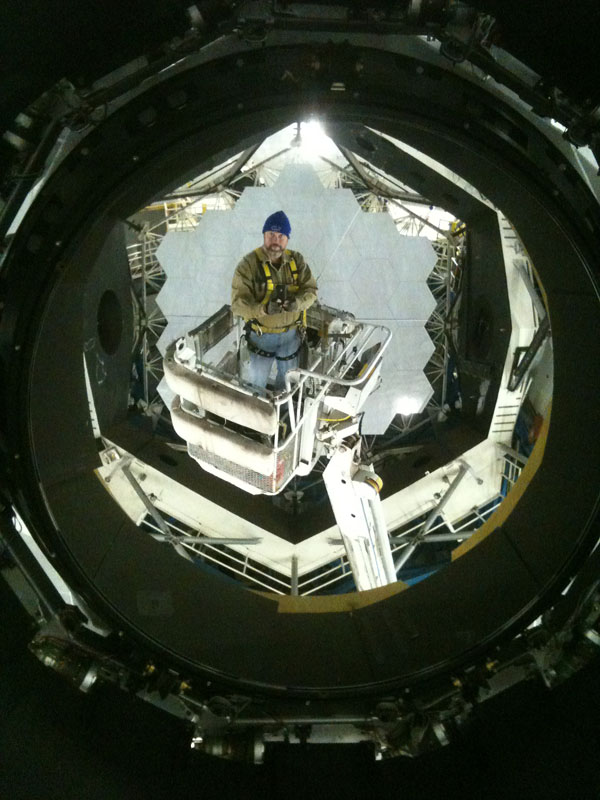
I am kicking myself that I only had the iPhone along in the basket. This has to be one of the most epic selfies. In a quick web survey of epic selfies, I find I am a distant second to one taken by Aki Hoshide.
A self shot looking into the Keck 1 secondary, at a reflection of the primary.
Last night was the company Christmas party. We did something different this year, a casino night. A full set of dealers and tables awaited us at the Mauna Lani clubhouse for the evening. Signing in at the door everyone received a stack of play money and the fun began.
It was fun in two ways… Playing the games! Everyone seemed to have a great time, particularly with no real money at stake. I noted that we were all quite conservative at the start, as the evening progressed the bets became risky and the money began to really fly about.
It was also fun because I thought to bring the new camera. I know of no real casino that would let me take pictures of the games like this. Alas, this was not real. There was the added advantage that everyone knows me and knows how I use the camera. I did get good photos of more than a few people. Photos I will have to process up and distribute over the next few days.
A full frame camera with a fast lens was just what was needed for the evening. I only brought the one lens… A 50mm f/1.8 prime, the nifty fifty. It turned out to be the perfect lens for the evening. The lighting was dim, to be expected, but it was also very hard. Small quartz spots illuminated most of the gaming tables resulting in bright areas and dark backgrounds.
To the hard lighting I added the very shallow depth-of-field that comes with a fast lens and large sensor camera. The result was perfect, very moody shots of the game with fantastic bokeh…
Again! Not an auspicious start to the hand, Canon 6D and 50mm f/1.8 lens
Blackjack! The hand you really want to see more often, Canon 6D and 50mm f/1.8 lens
Bets are placed across the roulette table, Canon 6D and 50mm f/1.8 lens
The dealer collect the bets from across the table, Canon 6D and 50mm f/1.8 lens
Bets are placed across the roulette table, Canon 6D and 50mm f/1.8 lens
Chips and cards move across the table as the game continues, Canon 6D and 50mm f/1.8 lens
Collecting the chips at the end of the night, Canon 6D and 50mm f/1.8 lens
Collecting the chips at the end of the night, Canon 6D and 50mm f/1.8 lens
A pile of play money at the end of the evening, Canon 6D and 50mm f/1.8 lens
All sky-watchers are hoping that comet ISON is spectacular when it emerges from the solar glare. there is no guarantee on this, we just do not know. But it could be as pretty as comet Ikeya-Seki or comet McNaught, both of which became far brighter after perihelion passage.
An ohia tree silhouetted against the dawn in the SaddleIf this does happen the question is where to go to photograph the comet. A week ago I found that ISON was slightly behind the ridge from the Mauna Kea VIS. Not badly, but enough to delay when I could acquire the comet and start taking photos.
This recent Saturday I only went partway up the Mauna Kea access road, just high enough to be clear of the clouds and haze. There is a turnoff on the east side of the road just above the cattle guard at about 8,000 ft, one mile below Hale Pohaku. Plenty of room to park a vehicle or two and plenty of level ground to take photos from.