This one is weird. This one is also an example of the strange maneuvers used by our state legislators to pass laws, particularly laws that face substantial opposition. Of these maneuvers, gut and replace is probably the most despicable, the wholesale replacing of a bill’s contents with different text of totally different intent.
The MKSS snowplow crews remove snow from the roads atop Mauna KeaThe latest example? SB757 is today’s subject. This bill once addressed the university’s ability to issue bonds. As of the latest version the bill calls for an audit of the agencies charged with the management of Mauna Kea… Yes, the bill is a now a nearly identical copy of SB2325, the same audit bill I addressed last week here on Darker View.
Why another bill with the same language? The first bill, SB2325 is still active and making it’s way through the process.
Another proposed bill that has been carried over from the 2017 legislative session is HB1565. The purpose of this bill is to create a conservation district sub-zone category specifically geared to supporting research and technology facilities. The astronomy precinct atop Mauna Kea is identified as such a sub-zone along with seven other sites such as NELHA and the facilities atop Haleakalā.
A crowd of mountain visitors watch sunset around UKIRT
The legislature further finds that research activity brings in millions of dollars that help diversify and stabilize the State’s economy that is heavily dependent on tourism, which is a cyclical industry. A study of research expenditures in the University of Hawaii system alone, not including private or non-university funded federal projects, showed that research activity had an economic impact on business sales of $760,000,000, state taxes of $45,000,000, employee earnings of $275,000,000, and the generation of about seven thousand jobs. – Excerpt from HB1565 proposed legislation for the 2018 Hawaii legislature
The bill would designate specific lands to be used for science and technology facilities. More interestingly the bill specifies a set of rules by which these lands are to be administered and subleases are to be negotiated.
The bill simplifies and streamlines the land use decision process. In the case of opposition to development within a science and technology sub-zone the method of dispute is designated as mediation rather than a contested case hearing.
This bill is certain to be a lightning rod for opponents of astronomy on Mauna Kea and Hakeakula. The opposition will be vehement to say the least. Indeed, it will be interesting to read the opposition commentary.
An ancient ahu (shrine) atop Mauna Kea with the summit in the backgroundThere is much to consider in this bill… Creating a sub-zone specifically for research facilities is probably a good thing. This recognizes a very specific land use that should have equally specific rules governing the use.
But there remains a question… Does the process specified in this particular bill to manage this new type of sub-zone excessively curtail public participation in the land management process? Where is the balance between sensible development and protection of the environment?
We currently have a situation in which a small and vocal minority can completely derail the process, that even reasonable development is blocked. A situation where only extraordinarily well funded organizations can accomplish anything. Then only with a stunning amount of wasted resources and effort along the way.
As we continue an examination of the proposed legislation concerning Mauna Kea we come to the next bill SB2325. This bill advanced for the 2018 legislative session would require a “forensic financial audit” of the organizations that manage Mauna Kea.
Gemini and the UH88 under moonlightThere is very little text to the actual bill, it is quite short, a single page. Notably there is no explanatory justification as is customarily found in the first section most bills. No explanation as to why this legislation is being proposed or why it is needed.
What is there is a laundry list of organizations to be audited starting with the University of Hawaii and the Department of Land and Natural Resources. The list specifically includes the Hawaii Island New Knowledge Fund charity set up to allow observatory contributions to the educational needs of Hawaii Island students.
Light pollution, a subject near and dear to any sky-gazers heart. It seems we are always struggling to educate our fellow citizens that more is not better, it can be far worse, particularly when it comes to the subject of artificial light. We are at odds with the child inside all of us that delights in the creation of light, a magic that never seems to lose its charm.
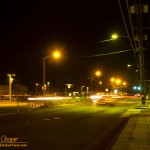
Downtown Waimea with new LED streetlights and old LPSUnfortunately artificial light has a price, and it can be steep, a hidden cost that many do not see. Light at night consumes a lot of energy, megawatts that are simply wasted illuminating places where no one sees it. Or worse, mega watts that are shone into the sky where it has no benefit at all.
Artificial light harms many species that live near our cities and towns, birds, sea-turtles, and more lured to their doom by the lights. The light also harm us, disturbing circadian rhythms and other natural cycles necessary for good health.
Light pollution also obscures the stars, drowning out the universe that would otherwise shine brightly overhead. Besides being a subject we should all care about, the night skies have a real economic impact here in Hawaii, a state largely dependent on a healthy environment and the tourists that come to enjoy that environment.
Found among the recent legislation proposed for the 2018 session is HB1767 Related to Motor Vehicles. The bill caught my attention when searching for proposed legislation affecting Mauna Kea. As the issues that swirl about our mauna are high profile there is no surprise that there are multiple bills that turned up in my search.
The back road around Puʻu Hau ʻOki to the summit of Mauna KeaThe bill does two things.. . It requires tour operators to operate with a state issued permit on two road ways, the roadway descending to the floor of Waipio Valley, and the access road to the summit of Mauna Kea. It also requires any vehicle on these same two roads to be only a “low gear four-wheel drive vehicle”.
It is this second provision that really caught my attention. This is something to look twice at and wonder what the effects of this particular legislation might be.
There are quite a few different bills proposed for this session of the Hawaii legislature that address astronomy and Mauna Kea. Of the more interesting there are proposals for an independant manangement body for the mauna, 4WD drive access to Mauna Kea and Waipio valley, addressing light pollution, and an audit of OMKM.
Sunrise over Mauna Kea greets me on the morning commute.As some of these proposals have a direct effect on the mauna and upon me personally I intend to address each of these proposals in blog posts. I also intend to submit testimony on these bills, reading and blogging on them will help.
As usual for the Hawaii legislature there is occasionally both a house and senate version some of the bills. These must be reconciled in the end as they wend through the rather interesting process our state lege uses. Several of these have passed first reading, the first weeding out of bills in the process for this session.
So… The Office of Hawaiian Affairs filed a lawsuit against the University of Hawaii challenging the lease for the summit of Mauna Kea. This is news across the state, press conferences were held, a big media deal.
Screenshot of the OHA website with a stolen image from Darker ViewIn the process OHA stole two images of mine for their website to illustrate their press releases. Yes, OHA, a state agency, is currently in violation of federal copyright law.
As one Facebook friend already noted “At least they credited you!” That does not make the infringement go away, it is still infringement. They even left my watermarks and copyright symbol on the image, there is simply no excuse.
Interestingly it appears that OHA, a state agency, does not host their website on a state server. Rather they use Google Cloud Services to host the website. Thus it makes filing a DMCA take-down notice much easier.
I have done just that.
This is not my first DMCA takedown action, or even my third, done this a few times, it works fairly well. The notice goes to the hosting service, if they do not take action, they become legally liable. As a result service providers take DMCA notices fairly seriously.
A legal notice has been served and should be addressed in the next few days. We shall see what the OHA webmasters do with that. Either they remove the material, or the entire website goes poof.
This island is a small community, anything that happens is likely to involve someone you know, or a friend of theirs. There are often only a one to three degrees of separation between you and nearly every event that makes the local news.
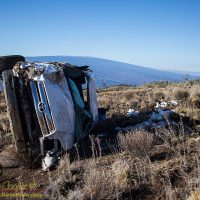
A wrecked Toyota pickup truck about a mile below Hale PohakuEven someone who has not grown up here seems to become quickly enmeshed in the community… One day I hear news of a body being discovered on a remote Kohala coastline by kayakers. The next day at work I ask Peggi about her husband’s kayak trip… As you guessed, they found the body. This may seem unusual, but here these sort of linked events are commonplace, amplified by the small community effect.
It is amazing how fast information moves from mauka to makai, the grapevine is very well connected on this island. This connectedness is accelerated by social media. Where once you would have to wait hours or days for official confirmation, or a newspaper report, we now know immediately.
There are specific places everyone goes for this type of informations. Two notable Facebook groups cover island happenings, Big Island Thieves and Big Island Popo Alert.
Having recently viewed a total solar eclipse I have been thinking about the experience. What it was like to observe first hand a truly incredible spectacle of nature? A total solar eclipse is about as dramatic an event our world can produce.
The 2017 total solar eclipse as photographed from central OregonThis is not my first total solar eclipse, but that first eclipse was back in 1979, occurring 38 years ago, my memories dimmed by the passage of time. This event is still bright in my mind, the memories bolstered by numerous photographs and a couple video records.
The experience was astonishing. For the first thirty seconds or so I simply sat in amazement, observing the eclipse and the world around me. Despite old memories and numerous photos I was still amazed by the sight. I knew what was coming, but I was to some extent unprepared for the sight before me. Eventually I gathered my thoughts and took some photos before the fleeting moments of totality expired.
In these modern times we rarely encounter a natural phenomena we are completely unprepared for. Prior to the event we have seen photographs or video, read descriptions from others. We generally know what we are about to encounter beforehand, or at least have a name and a cause we can understand when caught by surprise.
Imagine if that was not the case, consider seeing a total solar eclipse when you have never seen one, never even heard of such a thing, and do not know something is about to happen.
In this ever complex world in which we live the rules are always changing, and usually getting more complex. A modern, information society has many rules that govern who owns what. Copy a photograph from the web and you are probably breaking the laws concerning copyrights. There is a complex and sometimes contradictory set of laws that governs all manner of ownership in this technological age.
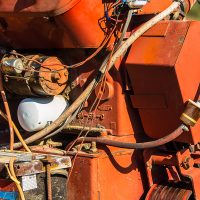
The engine on a hay baler offers a view of mechanical paraphernaliaDo you know the rules?
Buy a CD with your favorite tunes… Can you copy the tracks onto your phone? Can you create a video with the music and post it to YouTube? What about that expensive photo software package? Can you put it on your laptop and desktop? The rules are often complex, and often the answer is not clear cut.
Increasingly we do not actually own what we buy. At least that is what many corporations will tell us.
You would think that the answer is easier if the thing we are talking about is a physical object. If you buy a car, can you re-paint it, install a new stereo, or ignition system. Of course you can do that. Can you? Sometimes the answer is no.
Increasingly corporations attempt to maintain control of a product after the sale. They use many tools to do this. One is intellectual property, copyrights and copy protection on the software that is now embedded into many of the things we buy.