Comet C/2011 L4 Pan-STARRS

Like so many other amateur astronomers, I am eagerly awaiting the appearance of Comet C/2011 L4 Pan-STARRS.

The comet was discovered in June of 2011, by the Pan-STARRS survey telescope atop Haleakala, Maui. The comet will pass closest to earth on March 5th, at a distance of 1.09 au. Perihelion, the comet’s closest approach to the Sun, occurs early on March 10th UT.

Comet 2011 L4 Perihelion
C/2011 L4 (PanSTARRS) positions in the sunset as it passes through perihelion, chart for march 10th
For northern hemisphere observers the comet is still quite low, just rising out of the Sun’s glare. Over the next week it will rise above the sunset, and will be 12° above the horizon at sunset on Saturday, March 9th.

Initial predictions were quite optimistic with this comet, indicating a possible -1 magnitude for the comet. Reality seems to be somewhat more restrained, with a peak somewhere between magnitude one and two being more likely. Reports indicate that the comet has brightened to about 2nd magnitude, bright enough to be easily seen without optical aid.

Even more convenient, the comet will be well placed for observation this coming weekend. With new moon occurring on March 11th, this will be the prime weekend for a telescope outing. Amateur astronomers everywhere are already planing for this weekend. Our local club is no exception, expect a good crowd of telescopes to be at the Mauna Kea VIS this weekend. Myself? I will probably setup at the Substation site, just across the road from the VIS. The site offers a much better western horizon, which is blocked from the VIS by a line of pu’u, old cinder cones.

I will be taking photo gear, looking to get a decent photo of the comet. Stay tuned to Darker View to see the results if I meet with any success.

The latest orbital elements from the MPC

Another interesting opportunity will come on March 12th, when a slim crescent Moon will join the comet in the sky. A 1.4 day old moon, about 2% illuminated will be about 4° north (to the right) of the comet.

New Moon Saturday

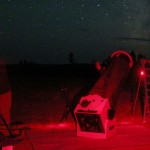
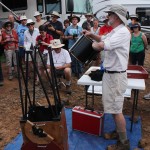
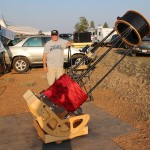
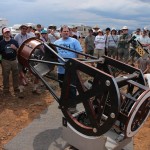
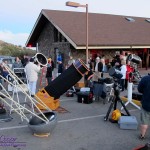
A line of big telescopes greeted the crowd. Mike had his 20″, Cliff his 24″, my 18″ Deep Violet, later in the evening Olivier set up his 18″ Priscilla. All of this large glass was open to the public, we each had long line of folks waiting a turn at the eyepiece. It was a huge Saturday night crowd, several hundred people awaited darkness. Yes, I had made the decision to observe from the VIS, knowing that there would be a crowd, but wow!
Observing at the VIS
A line of big ‘scopes to greet a huge Saturday crowd at the MKVIS
Lots of folks wondered why there were so many telescopes. Over and over we explained that they were lucky, having chosen the right night to visit the mountain. A Saturday night close to the new moon, with local amateurs bringing their own telescopes to share.

Showpiece objects, the Andromeda Galaxy, The Pleiades and Jupiter were available for viewing. I was stuck on the Orion Nebula all evening long. I changed targets once, to meet a chorus of request to move back to the nebula. I have to admit it was a pretty view, even to me, who has seen this sight more times than I remember. I put the 35mm eyepiece in place, creating a bright low power view that had visitors waiting through line a few times for second and third looks.

In addition to the big dobs there were quite a few smaller ‘scopes present. Maureen had her C-11 setup, Larry brought his nice Stellarvue 102mm refractor, Mike had an 8″ SCT beside his 20″ for use by a friend. Dan didn’t bring a ‘scope, but he did bring pizza! We met Woody, an Alaskan Airlines pilot flying the Anchorage to Kona run. Out of a couple carry-on sized bags he produced more telescope than we would have thought fit in airline luggage…. A neat collapsible pier arrangement with an alt-az mount and a very nice WO 110mm APO.

Continue reading “New Moon Saturday”

Database Work

I have spent quite a few hours lately revamping my observation database. The whole thing had been quite neglected as of late, never being properly updated since I changed over to WordPress on the main blog. The appearance had been left in a halfway state that didn’t match anything, never mind some serious bugs.

HCG88
Overlayed DSS image of HCG88. These overlays are generated on-the-fly using the object data.
In addition to adding all of my recent observations at the telescope, I have redone the style sheets. You can now select white-on-black, black-on-white, or night vision red, just look for the pull-down menu on the object page.

The printable version is still there, a clean black-on-white layout including inverted DSS images for printing. I took a cue from that printed version and kept the other new layouts very clean and uncluttered in appearance.

There is a nearby object section that picks up any close by objects for quick reference. Some attention has been paid to the search routines for better usability.

Those are just the visible changes, much of the work has gone into the back end to improve the quality of the underlying data. The whole thing uses Python and Tk on my local machine, this gets converted to SQL and PHP for the webserver. Most of the tools are automated at this point, and getting less buggy as I hunt down the little issues that I find with use.

I put the whole thing together for my own use, a place to organize my observing notes. But as it is online, anyone can use it. Let me know if you ever find it useful.

Night of The Dobs

Star parties at Hale Pohaku are very informal affairs. You never really know who is and who is not going to show up. We just don’t plan that much.

It had just been too long, I had not had a good night out with the telescope for months. This dark moon Saturday was not going to be missed, I packed up Deep Violet and headed for The Mountain. I knew a few folks would be there, certainly Cliff and Tony. The rest of the folks were a surprise to me. As the evening progressed more and more ‘scopes showed up, a few more familiar voices in the darkness.
All The Big Dobs
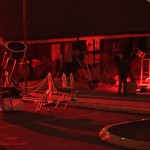
Almost all of the big dobsonian telescopes to be found on Hawai’i show up at the VIS for the night.
We had picked a decent night. The transparency was fairly good, and the seeing was great. We enjoyed views of Jupiter better than I had seen in quite a while, Probably years. There was the red spot, moon shadows, even the moon Io could be clearly seen transiting the disk.

The only real issue was the wind, it was annoying. A couple of us moved our telescopes into the patio area of the MKVIS, where the building offered some shelter at the expense of blocking some of the sky.

Continue reading “Night of The Dobs”

Atop Mt. Hamilton

The visitor directions on the website had specifically cautioned that the summit road was curvy, something I found to be a drastic understatement. From the very bottom it is curve after curve all the way up, with almost no straight sections. S-curves followed sharp bends leading to hairpins. Nearer the observatory the curve intensity only increases as the road narrows. Local history indicates that the horse-drawn wagons that transported heavy equipment up this road could not negotiate steep grades, the only solution was to follow the contour of the mountain, resulting in an incredibly curvy road.

On a sunny Saturday afternoon there were other users, the road is apparently popular with local cyclists. With the density of the sharp curves there was often little choice but to follow at bicycle speeds at times. I would much rather drive up Mauna Kea than this road again. Next time up Saddle to the summit I will recall Mt. Hamilton road and consider myself lucky.

The reason I was climbing this winding road was simply to be a tourist. Unlike the previous seven days, this day was to be fun. For much of the previous week there had been full day sessions of lectures and labs covering the intricacies of adaptive optics systems. Spending a full week in Santa Cruz might be considered a vacation, aside from the fact there had been very little open time to explore the surrounding area. There was only one open day in my travel plans, and I had specific plans for that day, a visit to an observatory.

The 36" refractor at Lick Observatory
The 36″ refractor at Lick Observatory
I arrived well ahead of my late afternoon tour appointment, no problem, just play tourist for a while. At the gift shop / information desk I met Lotus Baker, a longtime Mt. Hamilton resident. She was full of stories and information. We chatted for a while, until her turn to lead a tour of the classic 36″ Lick refractor. Lotus proved to be an excellent tour guide, providing an enjoyable tour of this beautiful telescope.

Continue reading “Atop Mt. Hamilton”

The Transit of Venus

We did the Transit of Venus right.

The plan was to stream the transit live from the summit. With access to the Keck facilities we had internet, a comfortable break room, and an excellent vantage point from which to view the entire transit. It sounded so easy at first, just put a camera on a telescope and connect it to the computer for the duration. Easy, in concept. The reality? Not so much.
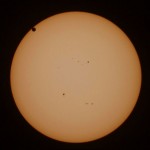
Venus Transit Second Contact
Transit of Venus 2012, second contact at 12:27pm

It was an incredible amount of work. I had spent several days during the preceding weeks preparing the gear for transit. I admit some of that was fun, an excuse to get the gear out in the day and look at the Sun, even photograph Venus quite near the Sun.

The webcast team consisted of three people, Larry O’Hanlon, the Keck PIO, Mark Senft, a volunteer from our astronomy club, and myself. Larry and I met a HQ to begin our drive up the mountain at 8am.

At Hale Pohaku we picked up Mark and enjoyed breakfast. Here we found a massive buildup in progress, a gathering of troops… Visitor center staff, Hawai’i County police and fire, and the Mauna Kea Rangers, all present in force. Stephanie Nagata, the director of the Office of Mauna Kea Management helped man the roadblock. Stewart Hunter, the head of Mauna Kea Support Services with her in an orange vest. Their preparations looked to be necessary, three hours prior to first contact the crowds of transit tourists were already growing.

Continue reading “The Transit of Venus”

Observing the Aureole of Venus

Black drop effect? Bah! I observed a beautiful aureole effect in the minutes leading up to second contact.

The famous black drop effect is seen when atmospheric distortion of the image is quite bad. The effect plagued the early observers attempting to do transit timings. The effect is not seen when the atmosphere allows sharp views of the transit.

Instead, if the seeing is truly good, it is possible to see something far more rare, the aureole of Venus. This is a faint ring of light that has been refracted and scattered through the atmosphere of the planet.

I had not expected to see this, the appearance of the arc of light a complete surprise. But there it was… Very thin, quite faint, a sharp arc of light completing the disk of Venus. The view was steady, with nearly perfect seeing the arc was visible continuously.

Analyzing the observation afterwards I realize it was two elements that allowed me to see the aureole, the excellent seeing offered by the summit of Mauna Kea and good equipment. I was looking through my TeleVue 76mm telescope, using an 8mm Radian eyepiece and a Baader solar film filter. Very good equipment indeed, the optical performance of the system was not going to be a problem.

In the confusion and effort of running the Keck Observatory web stream, I was so glad I managed to free up the few minutes necessary to properly observe second contact. The sight was one of the most beautiful and sublime of any I have witnessed through an eyepiece in my many years of looking through a telescope.

I have been through my photos, nothing captured the faint arc of the aureole, no matter how I stretch the exposure. The best I can do is to record a few drawings in my observing notebook, a poor substitute for the beauty of the real thing…

Transit Of Venus 2012 Aureole
The aureole visible on Venus during 2nd contact, 2012 transit

A Dark Night

Another new Moon weekend, another observing outing to Mauna Kea. With some shiny new astro equipment to play with I decided to load for photography instead of visual. Disassembling the photographic mount I realized it had not been taken apart in over two years, setup in the garage and used in the driveway. I did not expect to be alone, a few other local observers had indicated plans to get out this night.

Omega Centauri
Omega Centauri, NGC5139, sum of 31 x 1min exposures, AT6RC and Canon 60D
Worry on the drive up, the cloud deck seemed quite high. I was concerned that the Mauna Kea VIS, at 9,200ft, may be in the clouds. With wipers and headlights on, through the heavy fog I drove, not encouraging when you expect to use a telescope. The worry persisted until the last switchback, ascending through the last wisps of cloud just a few hundred feet below the VIS to behold a cloudless blue sky overhead.

As expected the Mauna Kea Visitor Information Station was a zoo. A dozen summit tour buses added to a heavy Saturday night crowd. The parking lot was full with even more cars parked along the road. Not a real problem, the tour buses use reserved spaces right in front of the building. They pull out about an hour before sunset, headed for the summit with their customers. We swoop in on the vacated parking spaces and set up our gear.

Astrophotography
A trio of telescopes set up for astrophtography at the Mauna Kea VIS
The crowd is an interesting experience. Well over a hundred folks waiting for dark and the evening program. There are the usual issues of headlights and camera flashes. It may not be all that dark for a while, but we gain a nice paved place to setup, and there is electrical power available. The crowd will slowly wane as the night progresses, mostly gone by 9pm, driven off by the cold. At 10pm the VIS closes and the remaining lights are turned off.

In addition to the VIS telescopes, there were quite a few local amateurs taking advantage of a moonless Saturday night. Cliff and Tony brought Cliff’s 24″ Dob, a two person job to move that ‘scope. Wayne brought photography gear. Mike was likewise set up for photography, planets instead of deep sky, using a Flea 3 and an ancient 10″ Celestron. Olivier brought his 19″ Pricilla, providing plenty of glass for visual astronomy while the cameras exposed for hours.

It was Malalo o Ka Po Lani, cultural night at the VIS, with a special lecture. This meant a large crowd, most of whom stayed to enjoy the perfect skies the mountain provided this night. They wandered around the telescopes asking lots of questions. While the photographic ‘scopes did not offer views through the eyepiece, there was still a lot of interest in the process. I chatted with many folks as I worked, fiddling with the complex equipment necessary to take photos of the sky.

It was quite the gathering of Losmandy G-11’s! Wayne brought two, Mike brought one to carry the old 10″ Celestron, I had mine setup for photography with the AT6RC. Add the three that the Mauna Kea VIS uses! A testament to these well-built mounts, some of which are two decades old.

The astrophoto gear was working nicely. There were a few issues to deal with at the beginning of the night, the usual new gear stuff. A few things I need to fix before next time… need to remount the guider so I can co-align it with the imaging ‘scope. I need to mount a real finder, and make it easier to hunt down the targets. But overall I was pleased, the new setup worked as I hoped it would.

SBIG ST-i Autoguider
The SBIG ST-i autoguider mounted to the top of the AT6RC telescope
I will write more about the SBIG ST-i later. The short version… Much easier to use than the ST-4, accurate, painless acquisition of guide stars, it just locked on and stayed there. The only real drawback is the inability to dispense with a computer. I recently re-built one of my older laptops for use as the astrophoto machine. But since the computer is going to be there, I may as well use it, time to integrate the DSLR with the computer and shoot tethered. I have the software, just that I had tried to keep it simple in the field.

Another pleasant surprise was the ease of focusing with the AT6RC with a Bahtinov mask. I have been wondering about the stock focuser on the new ‘scope, how well does it handle the heavy DSLR camera. One lesson is that it locks the focus quite well, I noticed no drift each time I checked focus. Indeed, at one point I pulled out the 60D, swapped the focal reducer and adapter onto the 20Da and checked focus again, it was still perfect.

While my camera took exposure after exposure, I took in the views that big glass can produce. Bouncing back and forth between Cliff 24″ and Olivier’s 19″. No surprise for a spring session, galaxies were in rich supply. We viewed a lot of the showpiece objects, from Ursa Major to Virgo and Corvus.

This night was the type of night we hope for when planning an observing outing… Not too cold, no strong wind, and no clouds. Just a dark sky to delight the imagination all night long.

Safe Transit Viewing

You have heard it before, but it really is true! Looking at the Sun for longer than a few brief moments with an unprotected eye can lead to permanent damage. Looking at the Sun with any sort of optical deceive that has not been properly filtered can lead to instantaneous eye damage.

Discussed below are the only safe methods I am aware of to view the Sun. There are some dodgy methods out there. Take chance with your irreplaceable eyesight? I think not. Be careful and do it right if you want a look.

For the unaided eye there are a couple options to view the Sun safely…

  • Solar Viewing Glasses Proper solar viewing filters are made from a thin plastic film, usually mylar, coated with metal to properly filter the Sun’s light for viewing with the unaided eye. These are widely available and quite cheap. Local astronomy organizations have been giving them away in preparation for the transit. Do not attempt to use these viewers in conjunction with binoculars or small telescopes, they do not provide sufficient filtering for optics!

  • Welding Glass Filters used for viewing welding offer much the same protection as solar filters. A shade 13 or darker welding filter can provide good protection for the unaided eye. Again, do not use a welding filter with any sort of optical device such as binoculars, they are not designed for such use and may not block enough light.

A much better view of the event can be seen if modest magnification is used. Do keep in mind that any soft of binoculars or telescope also concentrates much more light that the eye alone. Remember those childhood “experiments” involving a magnifying glass and ants? The best options here are the use of solar filters designed to be used on a telescope, or indirect means such as image projection.

Solar Filter
A solar filter mounted on a refracting telescope

  • Solar Filters for Telescopes Filters specifically designed for telescopes consist of either a plastic film, or a sheet of glass, coated with a thin layer of metal to block the Sun’s light. These filters pass about 1/1000 of one percent of the light. More importantly, they block the harmful infrared and ultraviolet light that could so easily cause damage. The filters can be purchased in many sizes as appropriate for various models of telescopes, costing between one hundred and several hundred dollars.

  • Image Projection One of the simplest methods of displaying a solar image is projection. A white screen placed a foot or two behind a telescope will produce a very nice image of the Sun that can be safely viewed by a number of people simultaneously.

    Keep in mind that the beam of light out of the eyepiece is quite intense, potentially hot enough to burn a careless finger placed near the exit from the telescope.

    The method works best with small optical systems, binoculars or the smallest of telescopes. You do not need big optics to project a very nice solar image.

    You do not have any optics? Use the simplest optical arrangement of all, the pinhole camera!

If you do not have a safe means of viewing the transit and do want a look, you can go to one of the many public events being organized. Here on the Big Island there are quite a few options, one should be close to you.
