Black drop effect? Bah! I observed a beautiful aureole effect in the minutes leading up to second contact.
The famous black drop effect is seen when atmospheric distortion of the image is quite bad. The effect plagued the early observers attempting to do transit timings. The effect is not seen when the atmosphere allows sharp views of the transit.
I had not expected to see this, the appearance of the arc of light a complete surprise. But there it was… Very thin, quite faint, a sharp arc of light completing the disk of Venus. The view was steady, with nearly perfect seeing the arc was visible continuously.
Analyzing the observation afterwards I realize it was two elements that allowed me to see the aureole, the excellent seeing offered by the summit of Mauna Kea and good equipment. I was looking through my TeleVue 76mm telescope, using an 8mm Radian eyepiece and a Baader solar film filter. Very good equipment indeed, the optical performance of the system was not going to be a problem.
In the confusion and effort of running the Keck Observatory web stream, I was so glad I managed to free up the few minutes necessary to properly observe second contact. The sight was one of the most beautiful and sublime of any I have witnessed through an eyepiece in my many years of looking through a telescope.
I have been through my photos, nothing captured the faint arc of the aureole, no matter how I stretch the exposure. The best I can do is to record a few drawings in my observing notebook, a poor substitute for the beauty of the real thing…
The aureole visible on Venus during 2nd contact, 2012 transit
Another new Moon weekend, another observing outing to Mauna Kea. With some shiny new astro equipment to play with I decided to load for photography instead of visual. Disassembling the photographic mount I realized it had not been taken apart in over two years, setup in the garage and used in the driveway. I did not expect to be alone, a few other local observers had indicated plans to get out this night.
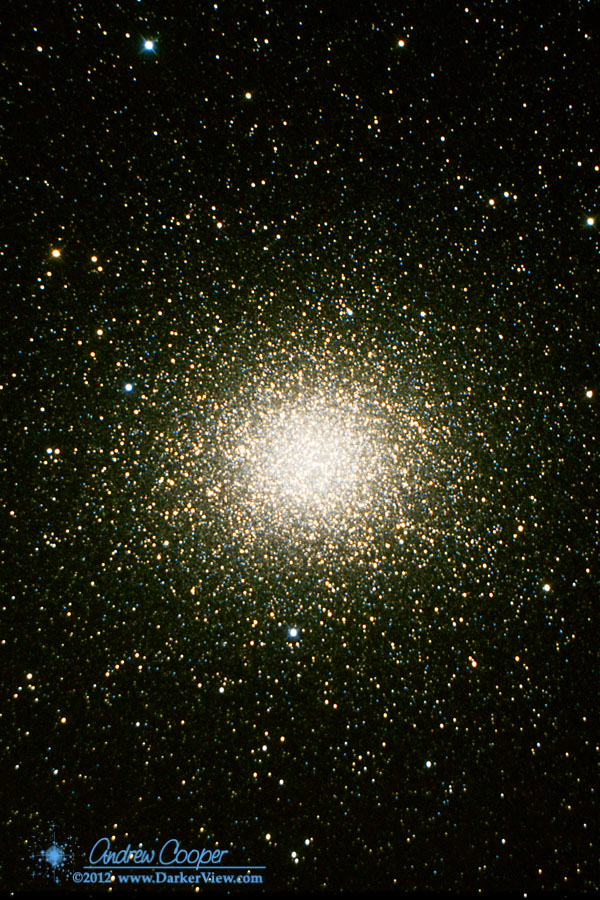
Omega Centauri, NGC5139, sum of 31 x 1min exposures, AT6RC and Canon 60DWorry on the drive up, the cloud deck seemed quite high. I was concerned that the Mauna Kea VIS, at 9,200ft, may be in the clouds. With wipers and headlights on, through the heavy fog I drove, not encouraging when you expect to use a telescope. The worry persisted until the last switchback, ascending through the last wisps of cloud just a few hundred feet below the VIS to behold a cloudless blue sky overhead.
As expected the Mauna Kea Visitor Information Station was a zoo. A dozen summit tour buses added to a heavy Saturday night crowd. The parking lot was full with even more cars parked along the road. Not a real problem, the tour buses use reserved spaces right in front of the building. They pull out about an hour before sunset, headed for the summit with their customers. We swoop in on the vacated parking spaces and set up our gear.
A trio of telescopes set up for astrophtography at the Mauna Kea VISThe crowd is an interesting experience. Well over a hundred folks waiting for dark and the evening program. There are the usual issues of headlights and camera flashes. It may not be all that dark for a while, but we gain a nice paved place to setup, and there is electrical power available. The crowd will slowly wane as the night progresses, mostly gone by 9pm, driven off by the cold. At 10pm the VIS closes and the remaining lights are turned off.
In addition to the VIS telescopes, there were quite a few local amateurs taking advantage of a moonless Saturday night. Cliff and Tony brought Cliff’s 24″ Dob, a two person job to move that ‘scope. Wayne brought photography gear. Mike was likewise set up for photography, planets instead of deep sky, using a Flea 3 and an ancient 10″ Celestron. Olivier brought his 19″ Pricilla, providing plenty of glass for visual astronomy while the cameras exposed for hours.
It was Malalo o Ka Po Lani, cultural night at the VIS, with a special lecture. This meant a large crowd, most of whom stayed to enjoy the perfect skies the mountain provided this night. They wandered around the telescopes asking lots of questions. While the photographic ‘scopes did not offer views through the eyepiece, there was still a lot of interest in the process. I chatted with many folks as I worked, fiddling with the complex equipment necessary to take photos of the sky.
It was quite the gathering of Losmandy G-11’s! Wayne brought two, Mike brought one to carry the old 10″ Celestron, I had mine setup for photography with the AT6RC. Add the three that the Mauna Kea VIS uses! A testament to these well-built mounts, some of which are two decades old.
The astrophoto gear was working nicely. There were a few issues to deal with at the beginning of the night, the usual new gear stuff. A few things I need to fix before next time… need to remount the guider so I can co-align it with the imaging ‘scope. I need to mount a real finder, and make it easier to hunt down the targets. But overall I was pleased, the new setup worked as I hoped it would.
The SBIG ST-i autoguider mounted to the top of the AT6RC telescopeI will write more about the SBIG ST-i later. The short version… Much easier to use than the ST-4, accurate, painless acquisition of guide stars, it just locked on and stayed there. The only real drawback is the inability to dispense with a computer. I recently re-built one of my older laptops for use as the astrophoto machine. But since the computer is going to be there, I may as well use it, time to integrate the DSLR with the computer and shoot tethered. I have the software, just that I had tried to keep it simple in the field.
Another pleasant surprise was the ease of focusing with the AT6RC with a Bahtinov mask. I have been wondering about the stock focuser on the new ‘scope, how well does it handle the heavy DSLR camera. One lesson is that it locks the focus quite well, I noticed no drift each time I checked focus. Indeed, at one point I pulled out the 60D, swapped the focal reducer and adapter onto the 20Da and checked focus again, it was still perfect.
While my camera took exposure after exposure, I took in the views that big glass can produce. Bouncing back and forth between Cliff 24″ and Olivier’s 19″. No surprise for a spring session, galaxies were in rich supply. We viewed a lot of the showpiece objects, from Ursa Major to Virgo and Corvus.
This night was the type of night we hope for when planning an observing outing… Not too cold, no strong wind, and no clouds. Just a dark sky to delight the imagination all night long.
You have heard it before, but it really is true! Looking at the Sun for longer than a few brief moments with an unprotected eye can lead to permanent damage. Looking at the Sun with any sort of optical deceive that has not been properly filtered can lead to instantaneous eye damage.
Discussed below are the only safe methods I am aware of to view the Sun. There are some dodgy methods out there. Take chance with your irreplaceable eyesight? I think not. Be careful and do it right if you want a look.
For the unaided eye there are a couple options to view the Sun safely…
Solar Viewing Glasses Proper solar viewing filters are made from a thin plastic film, usually mylar, coated with metal to properly filter the Sun’s light for viewing with the unaided eye. These are widely available and quite cheap. Local astronomy organizations have been giving them away in preparation for the transit. Do not attempt to use these viewers in conjunction with binoculars or small telescopes, they do not provide sufficient filtering for optics!
Welding Glass Filters used for viewing welding offer much the same protection as solar filters. A shade 13 or darker welding filter can provide good protection for the unaided eye. Again, do not use a welding filter with any sort of optical device such as binoculars, they are not designed for such use and may not block enough light.
A much better view of the event can be seen if modest magnification is used. Do keep in mind that any soft of binoculars or telescope also concentrates much more light that the eye alone. Remember those childhood “experiments” involving a magnifying glass and ants? The best options here are the use of solar filters designed to be used on a telescope, or indirect means such as image projection.
A solar filter mounted on a refracting telescope
Solar Filters for Telescopes Filters specifically designed for telescopes consist of either a plastic film, or a sheet of glass, coated with a thin layer of metal to block the Sun’s light. These filters pass about 1/1000 of one percent of the light. More importantly, they block the harmful infrared and ultraviolet light that could so easily cause damage. The filters can be purchased in many sizes as appropriate for various models of telescopes, costing between one hundred and several hundred dollars.
Image Projection One of the simplest methods of displaying a solar image is projection. A white screen placed a foot or two behind a telescope will produce a very nice image of the Sun that can be safely viewed by a number of people simultaneously.
Keep in mind that the beam of light out of the eyepiece is quite intense, potentially hot enough to burn a careless finger placed near the exit from the telescope.
The method works best with small optical systems, binoculars or the smallest of telescopes. You do not need big optics to project a very nice solar image.
You do not have any optics? Use the simplest optical arrangement of all, the pinhole camera!
If you do not have a safe means of viewing the transit and do want a look, you can go to one of the many public events being organized. Here on the Big Island there are quite a few options, one should be close to you.
Two telescopes set up on the side of Mauna Kea. Olivier’s 12″ and my 18″ Deep Violet. A full night of deep sky observing under very nice conditions.
The photo was taken with a red LED light swept over the area during the 20 seconds of exposure. The camera had other ideas, set for automatic white balance it attempted to correct the color, fairly successfully. Surprising given the monochromatic nature of the light source.
As usual, click on the image for a larger version…
Yes, it is three in the afternoon and I am just waking up. That was the plan.
A night spent under dark Mauna Kea skies with a telescope. It has been much too long since I had a good night out with the ‘scope, it was time. A few items conspired to make it happen… Good weather, a note from the HR department that I was at maximum on accumulated vacation time, use it or lose it! Additionally, my friend and co-worker, Olivier Martin, was looking for a night of observing as well.
With a couple days of approved vacation I headed for the mountain.
A partly cloudy sky greeted us on arrival, high and heavy cirrus hid much of the blue. The forecast was for this to clear off during the first part of the night, not yet time to panic. Not wanting to deal with the crowd at the Mauna Kea VIS we hid out in a spot I found on one of the nearby back roads, a place where we would not be disturbed by any visitors through the night, a place that is completely dark.
Olivier beside his new telescope, a 12" Orion DobsonianOlivier brought his new 12″ Orion Dobsonian. And I do mean new, it was not yet fully assembled! The usual troubles of life had conspired to rob him of any time in the few days since the telescope arrived. He had assembled the main parts, the base and OTA, but had yet to install the elevation bearings, handles, encoders or the primary mirror. Thus we spent the first two hours finishing the telescope, no problem as final assembly gave the heavy cirrus clouds time to clear out.
I was determined to get out and use the telescope during the March new Moon, but had planned to go observing with the guys at Hale Pohaku on Mauna Kea. At the last minute I decided to accept an invitation from the Hilo group to observe from Mauna Loa instead. The guys planned on running a Messier Marathon, something I have enjoyed many times before.
Our usual observing location is Hale Pohaku, at 9,000ft on the south side of Mauna Kea. Hale Pohaku is a great observing site, high enough to be above the clouds, but well below the summit where thin air, wind and frigid temperatures can be miserable. It is impossible to do a complete Messier Marathon from Hale Pohaku, the bulk of Mauna Kea blocks too much of the northern sky making a few objects, most notably M52, difficult to impossible.
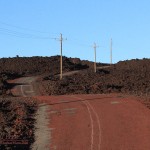
The Mauna Loa access road, carved through the lava and paved with red cinder asphaltThe road and climate research station on Mauna Loa sit on the northern face of the mountain, offering a perfect vantage point for the Messier catalog objects given our 20° latutude. The only issue is the road. While Hale Pohaku is reached by six miles of quite nice state highway, Mauna Loa requires navigating an 18 mile drive up a single land paved road. Use of the word “paved” is somewhat casual, as is the maintenance on the road. The first few miles feature new pavement. Beyond that? Not so much, the road becomes a pothole obstacle course. Driving the road with a delicate telescope in the back is rather nerve-wracking.
Plans for a summit run and some lunar eclipse photography. A midnight alarm clock and departure for the summit was the strategy. I planned to shoot time lapse of the eclipse setting over the Keck telescopes. But the best laid plans sometimes hit a snag…
I had noticed some minor power loss and roughness in the engine heading into work. Some condensation in the system? Perhaps just some bad gas? It was on the way home that the trouble became truly clear. A rhythmic stutter accompanied by a more severe power loss. As I limped home listening to the engine I realized that at least one cylinder of the six was not firing. A faint smell of gas when I got out of the vehicle just seemed to confirm the hypothesis.
That evening I spent a bit poking at the engine, inspecting for a loose connection or some other easy cause. I removed and cleaned the mass air sensor, a known trouble spot. Checked the air intake and ignition system. Removed battery power to allow the electronic engine controls a full reset to default settings. Still, when I started it up there was that rhythmic stutter.
Total lunar eclipse of 28 Aug 2007, photo is a 8sec exposure with a Canon 20Da on a 90mm f/12 APOI was not going eclipse chasing this night. No way was a partially crippled vehicle going to make it to the summit of a 14,000ft mountain.
Instead I simply set the alarm clock for a bit before totality and watched the eclipse from my front lanai. I made no attempt at photography, I do have quite a few decent eclipse photos. Instead I simply watched as the Moon ghosted through a thin layer of clouds. It was quite pretty, a bright Orion and Gemini were visible through an opening for a while. Much of mid totality was lost to the clouds, but it opened up again at the end allowing a nice view of the first touch of direct sunlight on the Moon.
As for the vehicle? I still was not certain what was the issue. This could be the result of something truly serious considering the engine has well over 180,000 miles on it. Plans for a replacement vehicle are under consideration, but I love this old truck. The first new vehicle I had ever owned, a veteran of hot dusty Arizona mining roads, of icy mountain passes, of rocky Hawaiian coastlines carrying scuba gear in the back. How many times has this vehicle waited through the night, telescope setup beside it, while I explored the sky from some remote and dark campsite? A trusted steed that has carried me to so many great places and always gotten me home.
The maintenance manual has a list of a dozen things that can cause misfires. May as well start with the easy (and cheap) stuff. I drove Deb’s car into Waimea to run a few errands and pick up a set of ignition cables and spark plugs.
A damaged spark plug cable shows why.It was the first cable I removed the revealed the trouble, a bad break in the cable where it had rubbed against a mounting bracket for the fuel line. Arced and blackened it was clear that my hunch was correct. A sense of relief, perhaps it was something this simple. I won’t know until I finish the job of replacing all six cables and plugs.
That would be almost two hours later, two hours of cursing the engine designers who would obviously not ever have to replace the plugs on this engine. Who puts a hard fuel line right in line with the spark plugs? I go back to the toolbox for the 3/8″ universal joint and spend a few minutes figuring out what combination of extensions will get me through which gap in the hoses and lines. Really? Is cylinder three’s plug under there? I will have to do it entirely by feel.
Finally! All plugs in place, cables neatly routed around the block, tools picked up from around the engine compartment, I have a chance to turn her over. A quick crank and she starts, idling with a smooth purr that is simply music to my ears. My old friend will be with me for a little longer.
This was the last total lunar eclipse for the next three years. I did watch it, remembering other total lunar eclipses across the years. An eclipse seen from among a stand of saguaro cacti in the Arizona desert, another eclipse watched from the Mauna Kea VIS just a couple years ago. A copper moon high over the broken walls and ruins of a 12th century priory. This eclipse will mark yet another memory, to be recalled when I again sit under a blood red Moon in the middle of the night.
We are going to get buzzed Tuesday. A reasonably large asteroid will pass quite close to the Earth, well inside lunar orbit. Asteroid 2005 YU55 will pass 325,000 km (202,000 mi) from the Earth. This is a good sized object, about 400m (1300ft) in diameter, large enough to create significant damage if it were to collide. We do know that the object will safely miss, this time. It is an object to track carefully. Data from this encounter and a future encounter with Venus in 2029 will set YU55 up for another encounter with Earth in 2041. Again we believe it will miss, but it will be close.
Keck 2 will be observing YU55 using adaptive optics and NIRC2 in an attempt to get high resolution imagery of the asteroid. It is quite convenient that this interesting asteroid is passing close to Earth, it will be in easy reach of our best astronomical instrumentation. I suspect I will be spending a little time in Keck 2 remote operations Tuesday night to get a look for myself.