Shattering the Silence

It has been over three months since the protest began. Three months of standoff with the protesters who would not see another telescope built on Mauna Kea.

Mauna Kea Observing
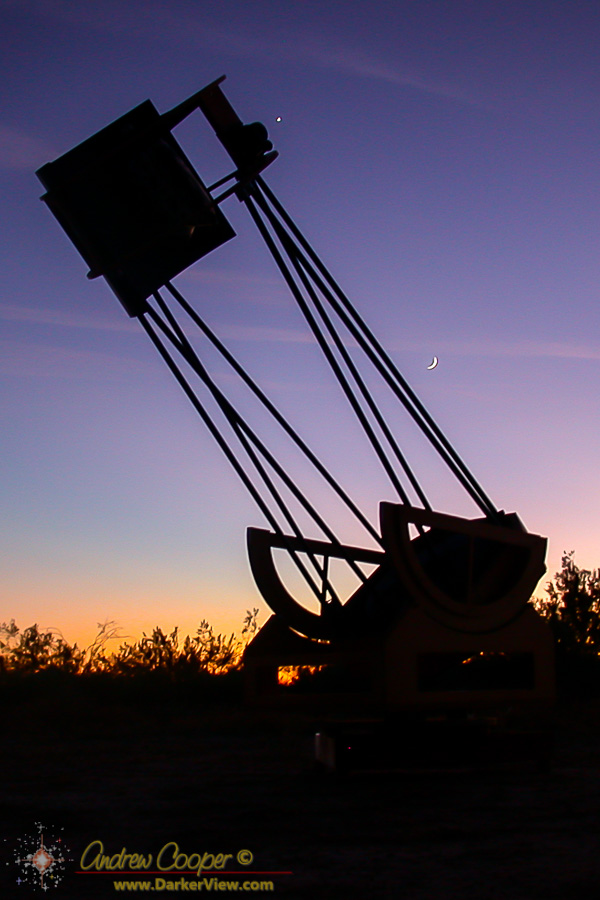
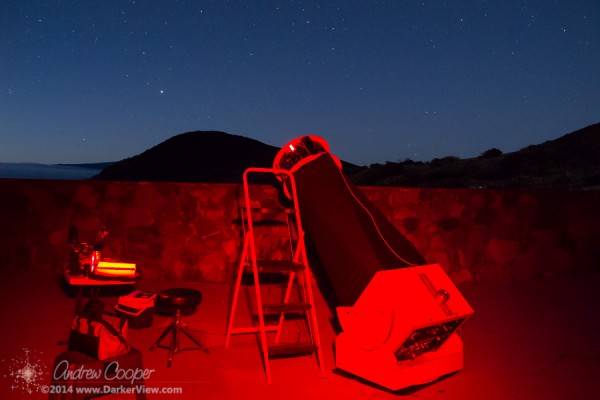
My 18″ telescope Deep violet set up under the stars at the MKVIS.
It has been my habit over the last eight years to spend a night under the stars, high on the mountain, each time the new Moon arrives. On the nights when there is no moonlight the sky is dark, truly dark. The stars shine undiminished, the universe is open to be explored. I have used binoculars, small telescopes, cameras, or simply my eyes.

It is with my handmade 18 inch telescope that I can truly gaze into the depths of space. This simple device of plywood and glass allows me to see galaxies millions of light years into the past. With this telescope I have seen hundreds of galaxies, giving me a glimpse of the indescribable vastness of space.

Often I would set up in the patio right at the Mauna Kea Visitor Information Station. The first couple hours spent talking with visitors, showing them the wonders our universe has to offer. After the VIS closes the visitors depart, driven back to their hotels by the cold mountain air. I have a heavy winter jacket, ski-pants, a thermos of hot tea, everything I need to be comfortable under the night sky. I would have the rest of the night to myself, just me, the mountain and the stars.

Continue reading “Shattering the Silence”

A Very Short Eclipse

We have been lucky in the islands lately when it comes to total lunar eclipses. A series of total eclipses have been visible from start to end from our vantage point in the middle of the Pacific. There is an average of one eclipse visible per year from any given place, but that is an average, you can go several years without an opportunity. Both 2012 and 2014 have given us two good eclipses and 2015 provides one.

Total Lunar Eclipse 4Apr2015
The sum of 699 exposures taken through the lunar eclipse of Apr 4, 2015
This eclipse would be a bit different however… Overall the eclipse lasted as long as is normal for a lunar eclipse, about three and a half hours. It was the total phase that was unusually short for this particular eclipse. It was only about four minutes that the moon would be entirely within the umbra, the darkest part of the Earth’s shadow. This usually lasts about an hour. The umbral magnitude of this eclipse was 1.0008, just barely over the threshold of one that designates a total lunar eclipse.

On Friday I did a quick interview with a reporter from the West Hawaii, Today, our local newspaper. He was looking for a little more information on the eclipse and a somewhat more local angle than a wire article on this eclipse. I chatted for a while, and got written up in the article…

Continue reading “A Very Short Eclipse”

Shooting a Comet

It has been a while since the last good photographic comet. Since comet ISON disintegrated at perihelion a year ago, we have had few opportunities to get a really nice comet photo. It is the surprise of comet C/2014 Q2 Lovejoy that changed this.

Better yet… The comet is well placed for photography in the late evening and early morning sky. While fellow sky watchers on the south side of our planet have been enjoying the comet as it has brightened, for most northern hemisphere observers it is still rather low. In the past couple weeks it has moved far enough north that it is now nicely positioned to observe from Hawaiʻi. I have been following the comet for a while, catching it in binoculars from the house. We showed it to students of Paʻauilo Elementary in club telescopes as they camped out at the Kilohana Girl Scout Camp earlier this week.

Unfortunately it is still low enough that my neighbor’s trees prevent me from photographing it from the driveway. Thus I took the opportunity to pack up the ‘scope and head for Hale Pohaku and the Mauna Kea Visitor Information Station for a night of photography.

The Mauna Kea VIS is busier than ever, the numbers of tourists coming to this free show just continued to increase. Parking is now a major issue, with even the lower gravel lots full of visitor vehicles. Fortunately, with some discussion and name dropping, the rangers allowed me and my vehicle past the barricades into the main lot so I could set up just off the patio. I would be entertaining guests at the telescope and answering questions all evening, becoming part of the show.

Continue reading “Shooting a Comet”

Geminids and a Comet

Stayed up late tonight to check on a few things in the sky. Firstly the Geminid meteor shower, which is peaking nicely. At least 100ZHR and bright enough to be nicely visible, even against the light of a bright gibbous moon.

The second item I wanted to see was comet C/2014 Q2 Lovejoy, now climbing higher in the sky as it swings northwards. It is currently somewhat low in Puppis, but getting higher each night as it moves nearly due north against the constellations. Currently it is an easy binocular object at around 7th magnitude. A quick sweep with my 9×50’s picked it up without effort halfway between Adhara and Canopus.

It is forecast to reach around 5th magnitude over the next month. Peak magnitude should occur near the new year while the comet is in Lepus. We placed and quite bright, I will be arranging to get a few photos of this comet through the new year!

A Dearth of Camelopardalids

A possible meteor shower, a dark. moonless night, the beautiful skies of Mauna Kea… Why not plan for a trip up the mountain? We all hoped that the new meteor shower would produce a show for us. If not, it would be a dark night with a late rising crescent moon. As I would be working the holiday on Monday, I took Friday off, did some chores around the house and packed my gear.

Meteor Photo Rig
The mount with four cameras mounted on top hoping for meteors. Photo by Raymond Lara.
I brought two bit of kits with which to enjoy the night. First was my old Losmandy mount to be used as a camera platform. Using a tracking mount would allow longer exposures and nice starfields against which to capture any possible meteors. I had along a long plate with five camera ball mounts, something Chris lent me. As expected, as soon as the others saw this there were plenty of volunteers looking for a spot on one of the mounts. Four cameras rode the mount for the evening, hoping to catch a few meteors.

The second bit of kit was Deep Violet, my 18″ telescope. As usual, setting up the big scope quickly gathered a crowd. The line did not dissipate until well after 10pm, a steady flow of visitors hoping to check out the view in the largest telescope present.

Continue reading “A Dearth of Camelopardalids”

A Night of Shooting in the Dark

The plan was to do some astrophotography Saturday night. The weather forecast forced a re-schedule, a winter storm arriving Saturday afternoon, Friday it was to be.

The Pleiades
The Pleiades, M45, with the Canon 6D and TV-76mm
The timing proved to be excellent, Mauna Kea providing glorious skies Friday night. Clouds hovered over the side of the mountain on arrival, but there was no worry. These were the sort of clouds that would vanish with the daylight. Anxious tourists wanting to see through the telescopes repeated the same question, will the clouds go away? I answered the questions with the relaxed assurance of experience of years on Mauna Kea, and continued to set up the gear. The clouds didn’t even last as long as I expected, dissipating as the sun settled into the horizon.

Setting up at the Mauna Kea VIS means a crowd of people. Hundreds of tourists that have come to enjoy a dark Mauna Kea Sky. I was joined by Raymond, a Hilo amateur also looking to take some photos. We setup side by side in a parking space just off the patio where the VIS was setting up their telescopes for the night. We would be in the center of the crowd for a while.

Continue reading “A Night of Shooting in the Dark”

Sunspots

Some unaided eye sunspots visible today and for the next few days. The huge group, AR1967 is probably another visitation of AR1944, which spawned a few large solar flares during the first week of January.

I took a few quick images using the AT6RC and a Canon 60D. A quick process is shown below, give me a bit I should be able to produce a better image.

Sun 30Jan2014
The Sun on 30Jan2014 including the large sunspot group AR1967

Naked Eye 100 Challenge

Amateur astronomers love lists… The Messier observing list, the Hershel 400, the Hershel II, and on. Some lists can be complete on a night or two, some lists may take years, or even a lifetime to accomplish. Amateur astronomy is not the only avocation to use lists like this. Birders attempt to see all of the birds known to occur in their home country. Aircraft spotters love to see each model of aircraft in the air. Divers keep lists of species seen underwater.

Rainbow Wheel
A rainbow and cloud shadows produce a rainbow wheel

Lists like these are not only fun, but allow the list chaser to sample the wonders our universe has to offer. The challenge of finding and observing each of the items is worthwhile. Each object is a lesson into the science, hunting each object allows skills to be practiced.

Most of the astronomy observing lists require a small telescope to accomplish, or at least a pair of binoculars. One list is a bit different, it does not require any optical aid at all… The Naked Eye 100.

Continue reading “Naked Eye 100 Challenge”

Three Comets in the Dawn

While comet C/2012 S1 ISON is getting all of the attention, it is not the only comet currently visible. There are a couple other good comets available to observe or photograph. On Sunday morning I tracked down and photographed three comets.

The Astrophoto Rig
The ZEQ25, TV-76mm and Canon 6D setup and taking photos of comet ISON
Comet ISON is sharing the stage with comet 2P/Encke and comet C/2013 R1 Lovejoy. All three are bright enough to be spotted in a small telescope. Encke was about magnitude 8, Lovejoy and ISON were both about magnitude 5 on Sunday morning.

Despite following comet ISON for the last year, I had never actually observed it myself. Attempts to change this repeatedly ran into problems, either work commitments or bad weather. Over the last month cloudy skies have been more common than clear, even the big ‘scopes on the mountain losing a large amount of time to poor conditions.

Continue reading “Three Comets in the Dawn”