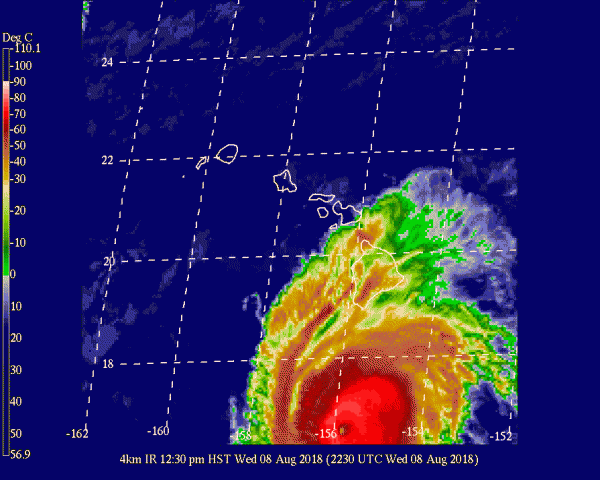
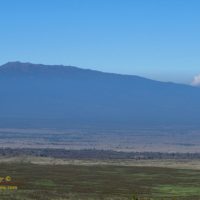
Hurricane Hector is just brushing past us with the center of the storm well south of the island. At this point the tropical storm watch and warnings have been cancelled. The only real effect on the island is some rain and high surf along the south shore.
Outside the weather is blustery and raining, but that could just be normal Waimea weather. At least it looks and feels a bit like a hurricane.
Hurricane Hector brushing past the islands as seen from GEOS-West on Aug 8th, 2018
When will this eruption end? The answer to that is a question many are asking on this island. Today we might just be seeing the answer.
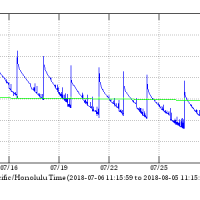
Tiltmeter data from the summit of Kilauea, as of 5 Aug, 2018 over the past monthReports and photographs from the eruption zone show a greatly diminished fissure 8, a mere shadow of the lava fountains visible a month ago. The once vigorous lava channel is now sluggish and crusting over in places.
Another interesting incident in culture popped up this week, one that illuminates where our society currently stands on the relationships between cultures. Living and working in Hawaiʻi, within Hawaiian culture made this event resonate on a personal level.
A Chicago based eatery has trademarked the name ‘Aloha Poke’. No issue there, simply a legal filing. What they failed to understand is that the word Aloha contains central concept in Hawaiian culture. Thus, when the lawyers for Aloha Poke sent out cease-and-desist letters to similarly named businesses around the country, including one in Hawaii, they were met with a firestorm of criticism.
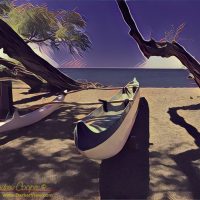
An outrigger canoe awaits another voyageAttempting claim ownership of such a word, even in a limited business context, is simply total fail. Legal? Yes. A good idea? Nope.
I suspect the owners of Aloha Poke are actually figuring that out. On the other hand the management at Aloha Poke has not withdrawn their legal assertions and have made a non-apology.
The missteps of Aloha Poke aside, what is more interesting is how some in the Hawaiian community have responded to the case. There have been statements from a number of community leaders. One of the most telling is from the head of the Office of Hawaiian Affairs, a state agency charged with administering state programs for the Hawaiian community.
Can we keep our natural disasters to one-at-a-time?
A large wildfire burning above Waikoloa VillageThis is getting to be just a bit much. We have an ongoing eruption on Kilauea that is larger than anything the volcano has put forth in centuries.
As a result of the eruption we are experiencing daily earthquakes of mag three to five. Not counting the hundreds of first and second magnitude earthquakes each day. The eruption also brings serious air quality issues, cracking highways, and more
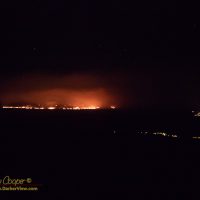
There is currently a large brush fire burning above Waikoloa Village and roads remain closed for a second day. Like most village residents we spent a nervous night wondering if the high winds would allow the fire to jump the firebreaks.
And to top it all off we now have Hurricane Hector bearing on a direct course for the island.
Just what is next? A plague of frogs? Oh yeah, we have that too.
It is the question everyone on the island would like an answer for… How long will this eruption last?
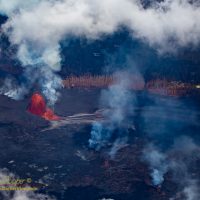
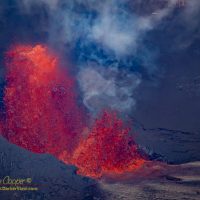
The lava fountain at fissure 8 rising about 250 feet as this Kiluaea eruption continues unabated.As I write this the eruption continues unabated in lower Puna, with fissure 8 producing somewhere between 50 to 150 cubic meters of lava every second.
This lava has covered much of the Kapoho area and built new land out almost a kilometer beyond the old shoreline into waters that were once over hundreds of meters deep. In the process well over 700 homes and farms have been destroyed and permanently altering the landscape of the Puna district.
Earthquakes have been a hot subject over the last couple months around here.
A seismic sensor made from three Honeywell QA-1400 accelerometersWe live on an island that regularly shakes a bit, the consequence of living with active volcanoes. Obviously this has implications for the great telescopes atop Mauna Kea, every once in a while we experience an earthquake with the potential to cause damage.
The ongoing collapse of the summit caldera on Kilauea has been generating a daily five point something earthquake. While not powerful enough to damage the facility, these events do show up in the data each night, bumping the telescope, disturbing the tracking, and occasionally ruining an exposure.
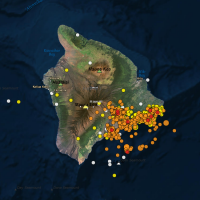
USGS Earthquake Map for May 6, 2018Along with at least one strong earthquake, there are well over five hundred small quakes occurring daily as the eruption continues and Kilauea Caldera continues to subside.
We are now more than two months into this new eruption from Kilauea. Two months ago the fissures opened in the Leilani Estates subdivision and homes began to burn.
The lava fountain at fissure 8 in Leilani Estates throwing lava hundreds of feet in the air on June 4th, 2018For two months this slow motion catastrophe has continued. While a major earthquake may be over in minutes, or a hurricane over in a few days, this eruption just goes on. For the folks in lower Puna the lava continues to destroy homes and disrupt lives.
For those of us outside the eruption zone things are not quite as immediate. We read the daily news, peruse images of helicopter overflights each morning, and wonder when it will be over.
The multiple county civil defense status reports and various emergency alerts that pop up on our phones each day provide current information… A bit of the Mamalahoa Highway has collapsed in Volcano Village with a one lane restriction, the road to Kalapana has re-opened, there is no tsunami threat from that last 5.4 magnitude earthquake.
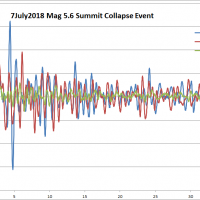
A plot of the July 7, 2018 summit collapse earthquake as recorded by an accelerometer in the Keck Observatory foundationEvery day is punctuated by a magnitude five point something earthquake. These summit collapse events have become very regular. You can guess when they will occur as the frequency of small quakes increase around the caldera.
For the most part these events pass unnoticed by much of the island. The volcano area gets shaken up pretty well, but these fifth magnitude quakes are often not felt very far beyond that.
On the summit of Mauna Kea these daily quakes often do disturb the telescopes at night, bumping the tracking and ruining exposures, but otherwise too weak to cause any damage to the facilities.
Hualālai peeks over a thick layer of volcanic smog, or vogThe most significant island wide impact has been the vog, wreathing the island in a sulfurous haze. Sulfur dioxide pours from the active vents, mixes with water in the air and forms a thick brown grey haze.
When the vog is bad you not only see it, you smell the sulfur, it irritates eyes and nasal passages. Fire and brimstone reaches out to touch us all.
While the vog makes for spectacular sunsets, the vog can also be thick enough to curtail outside activity. A day like today, with brisk trade-winds to clear it away, is a welcome relief.
The lava fountain at fissure 8 rising about 250 feet as this Kiluaea eruption continues unabated.Opportunities to legally witness this eruption are few, authorities have been enforcing the evacuation area increasingly strictly. Legal options are the fly or float to the eruption. Deb and I chose to fly a month ago, a helicopter flight I am sure we will remember for a lifetime.
I have not attempted to go to photograph the lava river, despite a very strong desire to do so. The county and state have repeatedly talked about opening a lava viewing area. while there is a great deal of pressure from the community, so far nothing has materialized.
We are so ready for this eruption to be over.
Given the collapse of the summit caldera and the enormous volume of lava emitted so far, it may be possible that when this is over there will be no further eruption for a while. It may take a while for the volcano to recharge, perhaps a year or two. Will we return to the pattern of intermittent eruptions that was seen through much of the 20th century?