Yesterday’s post stirred a blaze of comments over on Facebook, there are 50 shares and climbing fast. While there were those who took both sides of the sign, the majority seem to agree with the opinion I put forth in yesterday’s post. Most agree that the sign is inappropriate and quite possibly counterproductive.
Paul Hirst That sign annoys me, I think it’s ineffective at best, and very probably counterproductive. I too have hiked up there many times, but not since the sign appeared. Though to be honest and having given it more thought now, I don’t think the sign would stop me if I wanted to go again, though it may have dissuaded me in the past at times when I might otherwise have gone.
The sign asking for people to not hike to the true summit of Mauna KeaThe fundamental problem I have with it is that it’s completely un-enforceable, so it has the effect where now the people who do go are the ones who ignored the sign and thus perhaps less likely to respect other things like not disturbing things or leaving litter. Essentially, it reduces the number of people who go to the true summit and take care to have minimal impact on the land, and it has no impact on the number of people who will go up there and don’t care so much. So it just alienates the people who they ought to be befriending as allies in caring for the mountain.
Lynn Paul Richardson I respect cultural sites and always remain within designated walkways. This sign rings hollow to many people who would normally pause at that point.
A fair point was raised in considering the impact that foot traffic has on the summit… Erosion of the area could be an issue. Though I believe this could be mitigated with proper trail maintenance.
Matthew J D’Avella In my opinion people should stay off the true peak for several reasons. Erosion being my number one reason.
Quite a few have suggested that the sign be replaced with something that educates visitors to the importance of the site, request that the be respectful, and stay on the marked trail to minimize the impact to the area.
Chris Runnells Yeah I’m not sure I agree with that. The mountain is sacred to many people regardless of whether or not you’re of Hawaiian ancestry. It’s possible to go to the summit and be respectful without having Hawaiian blood. I think this sign should be replaced with a message to tread with care, pack out what you pack in, etc. I doubt it’s going to actually stop anyone.
I fully agree with different, better signage. This is an idea I should have thought of when writing yesterday’s post, my thanks to those who suggested it. I will probably compile the comments into a letter to Stuart at OMKM, maybe we can get the sign changed. My thanks to the many who commented on this, a productive discussion!
The kerfuffle has served to illustrate the issues that access to Mauna Kea exemplifies. This is a public land access issue. Do you set aside areas as off-limits to the public to appease a specific cultural group. Or should public land be open to everyone, the people of the State of Hawaii? Having had Hawaiian protesters yell at me “Get off our mountain!”, I have to push back. Mauna Kea belongs to all of us, we should care for it, but we can not close access to anyone like this.
The sign asking for people to not hike to the true summit of Mauna KeaNever mind that the trail to the true summit of Mauna Kea is nicely maintained and outlined in rock, the sign requests that you do not take this trail out of respect for the sacredness of the site.
How many people even pause when considering the message on the sign? The trail and the desire to stand atop the real summit of the mountain is substantial. As we pass the trail head and sign each day I usually see several people walking to or standing atop the summit.
Aloha
Maunakea is historically, culturally, and environmentally significant. Help preserve our cultural and natural landscape and show your respect by not hiking beyond this point to the summit.
I have walked this short trail to the summit several times over the years, though not since the sign appeared. There are no particularly sensitive archaeological sites at the summit. This is in contrast to Lake Waiau, which is ringed with shrines and offerings, is just as sacred, and has no such sign to deter the curious from taking the trail.
Personally I am troubled by this sign. Placing such a sign could very well be counter productive. People are going to ignore it, walking right past it to the summit of Mauna Kea. It simply teaches people to ignore boundaries that could protect sensitive sites.
The summit is public land, belonging to the people of Hawaiʻi. I have trouble with the idea that it should be accessible only to a few on the pretense of religious or cultural heritage. Certainly some might view the summit with less than ideal respect for a special place, simply a pile of rock to be conquered. I suspect most see the summit as more than that, a symbol, a place to sit and think about the world.
I am not a religious person, but still, there are places where I find myself stopping and taking a moment to contemplate our world. The summit is one of these places, a focal point of culture, history, and perhaps the future.
Update Oct 4th: Several folks have commented that a sign educating people about the significance of the place, asking them to be respectful, and asking them to stay within the marked trail would be far more appropriate and productive in terms of protecting the site. I have to agree.
Update Oct 5th: I have posted a follow up article. The response to this article has been impressive, with a lot of heartfelt comments. How we view and respect true summit of Mauna Kea is obviously a subject very important to may people.
The tour guides give the basic story behind the creation of Mauna Kea. The story given is simple… A hot spot in the mantle is the source for a plume of magma that punches through the oceanic crust and forms the Hawaiian volcanoes. As the pacific plate moves the islands are formed one by one, the latest being the Big Island of Hawaiʻi.
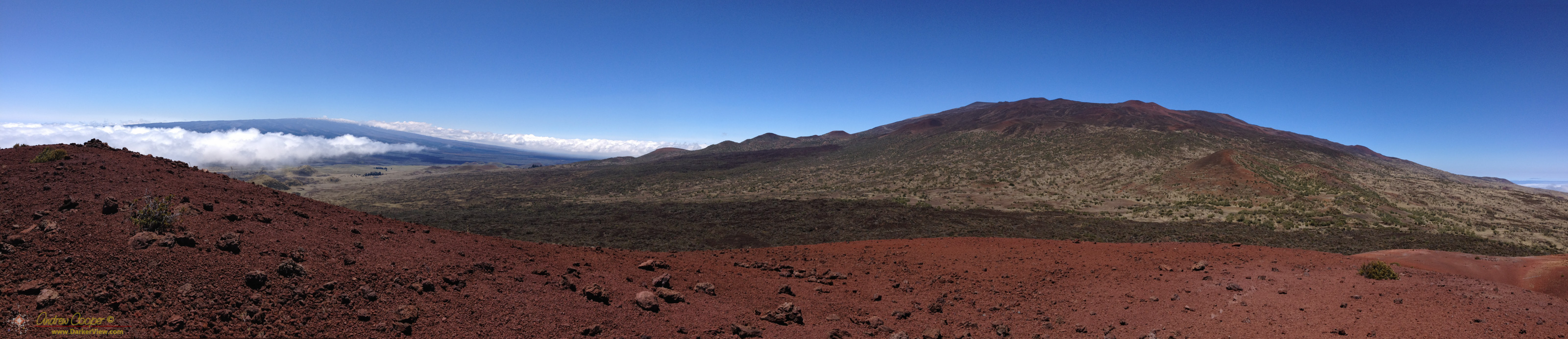
A panarama from atop Puʻu Kole showing Mauna Kea and a distant snow covered Mauna LoaThis is basically correct, but is also a vast simplification of the process. If you want to learn more about the formation of these impressive volcanoes you need to look further.
After this latest trip to see the lave I was recalling all of my previous effort to photograph the lava. It has resulted in quite a few beautiful photographs, many of which have appeared here on DarkerView…
An active pāhoehoe breakout at Kupapa’u
A very close view of advancing pāhoehoe lava
An active pāhoehoe breakout at Kamokuna
The plume at Halema’uma’u lit up at night as seen from the Mauna Kea VIS
Lava moves forward in the flow field at Kalapana
Cooling pahoehoe lava glows red at Kalapana
Lava from the Kilauea volcano enters the ocean at Kamokuna
A large breakout in the lava flow 61G
A skylight allows a view into an active lava tube near the top of lava flow 61G at Kilauea, photo by Deborah Cooper
Lava pours into the sea at Kupapa’u
An active pāhoehoe breakout at Kupapa’u
An active pāhoehoe breakout at Kupapa’u
An active pāhoehoe breakout at Kupapa’u
Pahoehoe lava breaks out to flow forward and form another pillow at Kalapana
A Paradise Helicopter doors off photo tour hovers over the ocean entry at Kamokuna
Lava from the Kilauea volcano enters the ocean at Kamokuna
The lava lake at Halemaʻumaʻu with several fountains of lava along the far rim, May 2, 2015.
A littoral cone formed at the end of a lava flow near Kalapana glows red under the stars, the planet Jupiter shines above the glowing plume
Lava from the Kilauea volcano enters the ocean at Kamokuna
An active pāhoehoe breakout at Kupapa’u
A pāhoehoe breakout near Kupapa’u
An active pāhoehoe breakout at Kupapaʻu
The 61G lava flow ocean entry at Kamokuna under the light of a full Moon
Lava from the Kilauea volcano enters the ocean at Kamokuna
An active pāhoehoe breakout at Kupapa’u
Lava from the Kilauea volcano enters the ocean at Kamokuna
A radio telescope of the Very Long Baseline Array stands in the background of an ancient ahu atop Mauna KeaThe construction of the Thirty Meter Telescope has become a symbol of the many issues that swirl in these islands. It is an argument that touches the fundamental question as to who we are and where we are going.
While many frame the argument as one between science and culture, others frame it as one of development versus culture. Their premise is that somehow building another telescope is destroying local culture. They overlook the opportunity the telescopes represent, that the right economic development can support a community, preserve a culture.
Supporters of TMT highlight the jobs that the telescope will bring… “It is not about the jobs!” is the reply from opponents. Of course it is. You cannot maintain a culture in poverty. You cannot maintain a culture when your keiki leave to seek opportunity elsewhere. Leave the island behind… Leave the culture behind. Economic struggle is the greatest single threat to a local culture, a threat that cannot be overstated.
The lack of economic opportunity has an enormous impact on a local community. The stress of struggling for a living, of getting by on a low paying service industry job can be destructive to families and individuals. Drugs use, family abuse, all of the social ills so often identified in low income areas are as destructive to the culture as they are to the person. The statistics tell the story… Hawai’i Island routinely tops rest of the state in numbers that are not good…. Lowest per capita income, highest number of children living in poverty, unemployment and more.
The AO system was broken, nothing really bad, but something I would need to go up and fix. Reading the nightlogs each morning there are occasionally surprises like this, a sudden re-planning of an otherwise lazy Sunday.
A workshop in the Mauna Kea adze quarry
I suspected that the fix would not take me long at all. But I would be on the mountain… What to do with the rest of the day? I load camera and hiking gear along with my backpack of tools. If I do complete the job quickly I will go hiking. The Mauna Kea adze quarry springs to mind as a likely spot to spend a few hours.
The ancient Hawaiians had no access to metal on these volcanic islands. What they did have was a source of very hard volcanic rock. High on Mauna Kea there were once glaciers, a place where the fury and heat of the volcano met ice. Cooling quickly in the icy realm the lava formed a dense, fine grained rock suitable for making tools.
The rock from this quarry could be shaped and ground into a number of tools, particularly adzes that could be used to cut wood or carve the great ocean going canoes. Tools made from this particular rock were so prized that they have been found in archaeological sites on distant islands across the Pacific.
I have known how extensive the adze quarry is for years. The numbers are abstract, number of find sites mapped, square kilometers of area, just numbers on paper. What I found was quite different than what I was expecting, nothing conveys the actuality of being there.
I was amazed at the sheer size of the piles of flakes. These are sites that were worked for centuries, each workshop accumulating many tons of waste rock flake to tumble down the slope. Having worked with my hands continually over my lifetime, I know how hard hand labor like this is. I stood amazed at the sheer amount of human effort it took to accumulate these piles.
I found I had another misconception to correct… Looking from a distance you see the caves with piles of waste rock spilling down. I had assumed that the caves and ledges are where the actual mining took place, where the basalt was pried from the mountain. Visiting one of the workshops I quickly see this is not the case.