Dark Secrets

Over the past months I have made a habit of reading opposition websites. Primarily in an effort to understand the cultural objections to astronomy on Mauna Kea. I have actually learned quite a bit, filling in my knowledge of Hawaiian culture and history. But I do learn other things, apparently this controversy has a very dark and secret element.

First Target of the Night
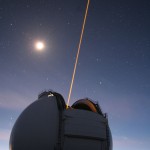
The Keck 2 laser acquires the first target of the night with the glow of sunset behind
There are local opponents who have a legitimate stake in this controversy. We have also seen other causes that have latched on this debate, often as a tool to forwarding their own agenda. Then there are people completely divorced from reality that seem to think that there is something more to the controversy on the mountain…

… was again soundly defeated atop the tallest mountain in the Pacific by native Hawaiians who understand that telescopes & astronomy have virtually nothing to do with the secret government’s attempt to take over the mountain. The secret government wants to use it for scalar military transmitters & to incorporate it into the Army’s Pohakuloa military base, scheduled eventually to become the largest military base in the Pacific. – Facebook posting by Krishna Davinci, chairman of the Bohemian Grove at Illuminati Network

Ummmm… OK.

Aside from some contradictory grammar, it seems that Mr Krishna has taken every conspiracy theory out there and combined them into a wild stew. This is actually quite common, once a person accepts one conspiracy theory, even wilder theories can easily take root. Take a look at his page, there is more, no theory too far fetched… Chemtrails? Check. Planet X Nibiru? Check. President Obama sacrificing babies at satanic ceremonies? Check. The entire page is so far out there I was first convinced it was all an elaborate satire. Does the Facebook feed need a Poe’s Law disclaimer? Unfortunately, the more I read the more I despaired that someone really believes it all.

Scalar military transmitters? I am an electrical engineer and I have no idea what he is talking about. We do have lasers, and those are cool. In all my visits to the other facilities on the summit I have never seen a scalar transmitter.

I have met a few folks and read more than a few Facebook postings that make all sorts of wild accusations of military use of the summit of Mauna Kea. For most of the past decades the amount of military involvement in Mauna Kea astronomy has been pretty much zero. Since Lockheed Martin has joined the partnership running UKIRT this sort of accusation seems to have gained momentum. Never mind that their stated use of the telescope is to track orbital targets and debris. A use that makes complete sense given the capabilities of the telescope and the need for this effort.

Krishna goes on to explain further…

Furthermore, telescopes are now relatively obsolete & primitive … as are rockets. NASA (Never A Straight Answer) continues to publicly promote them to the sheeple with make-believe projects, because NASA is just a cover for the secret government’s REAL space program ~ which now has at least 10 fleets well outside our solar system using antigrav & antimatter propulsion technology ~ not to mention innumerable interplanetary bases on the moon, Mars, the moons of Jupiter & Saturn … plus several more outside of our solar system. This has been ongoing for over a half century … & publicly hidden from the dumbed-down zombied-out sheeple. – Krishna Davinci

I suppose I am not qualified to cast any judgement here, about a quarter of my salary does come from NASA. On the other hand… Fleets outside our solar system? Bases on the moons of Jupiter and Saturn? Where the hell do I sign up for a transfer to that assignment? I would love to see Saturn up close! Do you suppose that base is on Hyperion? I have always loved that wild little moon.

If we really had these things the US military would celebrate them… Loudly! Why would you need to keep this all secret? Imagine the PR possibilities. With that sort of military power the need for secrecy would simply become an unnecessary annoyance. Besides, that many fleets and bases would need people to man them, you need to recruit a lot of folks. I can imagine the recruiting posters now.

If I disappear in the next few weeks just assume I got my transfer to the Hyperion moon base. In the meantime I need to head to the summit in order to continue fixing the mind control machine. It has been down for a couple weeks and you can see the trouble that has caused.

Pineapple

Sitting in front of the computer eating a little dessert before bed. In this case that is a little ice cream and pineapple. The nice part is that this the first pineapple we have grown. The pineapple has been a strikingly attractive ornamental plant in the corner of the lanai and now a source of a very nice fruit.

I understand there is chance for another fruit from the plant. Deb has also prepped the top for rooting. Perhaps another plant? There is plenty of room for another plant on the lanai.

Pineapple
A ripe pineapple ready for harvest.

TMT Construction Restarts

With the announcement the TMT will restart construction everything seems headed for a showdown on the mountain. The protesters are clearly preparing for action. The day is Wednesday. I was scheduled to do a training session for our crew this Wednesday, I have cancelled this. This sort of thing is common as the rest of the observatories consider how we will deal with a possible prolonged blockage of the road.

Protest Rock
The rock to build an ahu passes through Hale Pohaklu on Monday, photo by Dan Birchall, used with permission
First move was by the protesters. Alerted by a message from Dan Birchall that trucks of rock were headed up the mountain, I took a look with one of our cameras. The protesters were building an ahu (stone altar) right in the middle of the TMT access road. Women, children and guys clothed in nothing but malo hauling rock down the access road while security looked on.

Dan confirms that the rocks were rounded boulders in mixed sizes. Rounded rock, as one would find in a stream bed, is particularly desirable in the building of a proper sacred structure such as an ahu or heiau. According to legend that the rock to build the great heiau at Puʻu Kohala was hauled all the way from Waipio Valley by a chain of men across the island.

Obviously they are daring the construction crews to dismantle the structure, then to be able to claim desecration when that happens. Whatever happens our crews will have a first hand view from our site overlooking the TMT site.

I hope for more updates as the situation evolves. With Wednesday cancelled I still hope to go up Friday to complete a few things, whether I do attempt to go up is a bit indeterminate at the moment. Will wait and see.

WHAC Visits Subaru

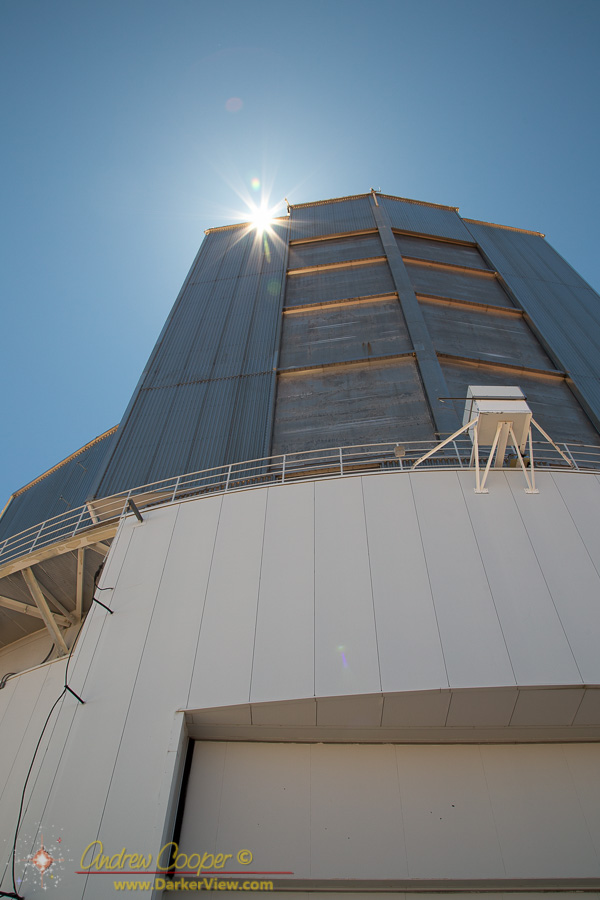
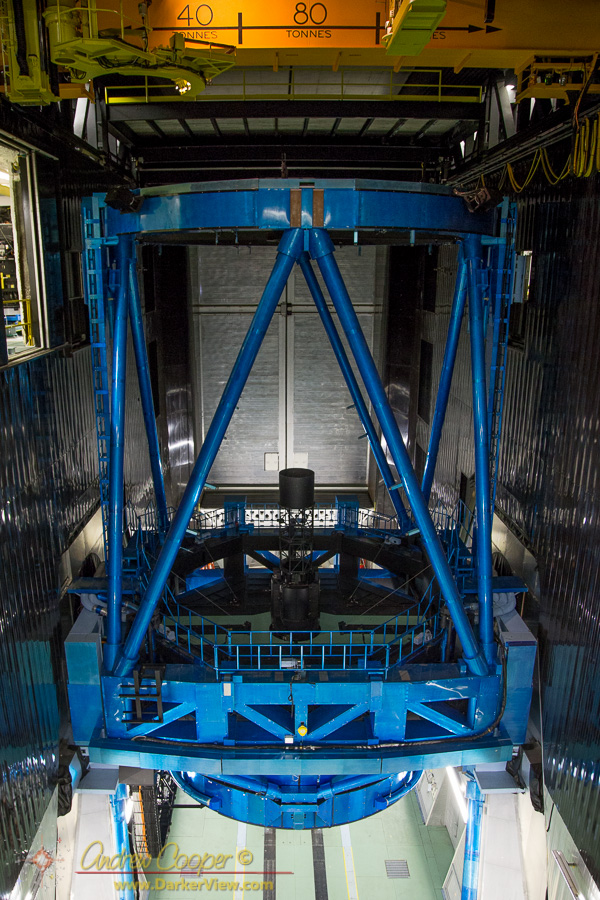
Over the past few years the West Hawaii Astronomy Club has visited nearly every telescope on Mauna Kea. One glaring exception to this is Subaru, the 8.2 meter telescope belonging to NAOJ.

Subaru Telescope
The sun glints over the tall Subaru telescope enclosure
Subaru… Check.

Subaru is the only telescope with an active tour program. By making reservations ahead of time you can visit the interior of the facility with a guide. This made making the arrangements for a tour quite simple, even when the observatories are worried about events on the mountain. We did quite well for tour guides, Rieko Murai and Josh Walawender made the tour a bit better than the usual tour. Josh is well known to the local amateur community, bringing his own small telescopes to observe at the VIS.

The limit for any group visiting the telescope is eight due to practical considerations such as safety. Thus I had set up two tours, using both the 10:30 and 11:30 slots. This allowed most of the club an opportunity to visit the telescope. This did mean we were unable to enjoy the experience together. While we waited for our later tour I led a short walk to some interesting geologic features and one of the ancient ahu that are near the road.

Continue reading “WHAC Visits Subaru”

Not a Bullet Hole

When the police reports hit the web we were all a bit worried. A bullet hole reported in a door at Subaru Observatory. The photos circulated shortly after the reports did not help, it really looked like a bullet hole in the door.

It looks Like a Bullet Hole
A hole in an exterior door at Subaru, mistaken for a bullet hole.
While the news circulated Sunday it was all conjecture and accusations flew everywhere. The threats made against the telescopes were discussed. Protesters protested their innocence, and claims of “false flags” and inside jobs were made on Twitter and Facebook. The national news picked up the story and reports could be found all across the web.

Arriving at the summit Monday morning we took the few minute walk over to Subaru to look at the door in question.

This was not a bullet hole.

Plumbing Fixture
The plumbing on the adjacent wall that made the hole at Subaru.
We had gotten word over the radio a few minutes before that it was not a bullet hole, but there was no explanation as to how that had been determined. A close look and I had to agree, the hole looked wrong to me. I do have a fair amount of practical experience in making real bullet holes. It was clear that the door had slammed against a bit of piping on the adjacent wall, possibly pushed by high winds.

Continue reading “Not a Bullet Hole”

Mango!

It is that time again… Mango season.

The fruit are just starting and I was only able to find enough for one dehydrator load. Over the next week there will be more fruit reaching that perfect ripeness. The fruit do not last long, there is only a few days for any given fruit before it spoils. Fortunately not all the fruit ripen at once, each visit to the tree finding a few more ready.

With this sort of bounty the fruit must be used quickly. I will give some away, taking them into work. Much of the harvest will go into the dehydrator, saved for later with a little processing.

Actually we get a couple mango seasons in our back yard. The trees I have are a different variety than the huge tree that overhangs our yard from the neighbor’s. It is just showing small starts right now, it will be later in the summer before those fruit are ready.

Mango!
A load of mango in the dehydrator.

Caltech Submillimeter Observatory in Hawaii to End Operations

We have known this was coming for some time. With ALMA coming online the Caltech Submillimeter Observatory is looking decidedly obsolete. It’s closure was announced a few years back as Caltech planned to reallocate the budget.

CSO
The Caltech Submillimeter Telescope (CSO) observing into the dawn
Still, we are sorry to see it go. This telescope has been truly groundbreaking in opening up the submillimeter part of the spectrum to the science of astronomy. Submillimeter is a region of the spectrum that has proven quite challenging to observe. Many of the technologies that make submillimeter science possible were first tested at CSO.

Last year I arranged a tour of CSO for the members of WHAC. It was great to get a good look at this facility before it becomes part of history.

CalTech press release…

After almost 29 years, the California Institute of Technology (Caltech) will end operations of the Caltech Submillimeter Observatory (CSO) in Hawaii in September, 2015. As previously announced, Caltech will begin the planning for the dismantling of the observatory. This process will be planned in close coordination with the Office of Mauna Kea Management, University of Hawaii at Hilo, to ensure that it is undertaken promptly and in a culturally and environmentally respectful manner. Caltech is sincerely grateful to the people of Hawaii Island for the use of Maunakea for nearly three decades, enabling superb research from this excellent astronomical site for the betterment of humanity. Caltech commits to the dismantling of the telescope and site restoration according to the Decommissioning Plan approved by the Board of Land and Natural Resources.

The CSO is a cutting-edge facility for astronomical research and instrumentation development. The CSO’s 10.4-meter radio telescope was designed and assembled in the 1980s by a team led by the late Robert Leighton, Caltech’s Valentine Professor of Physics. Under the leadership of CSO founding director Tom Phillips, the John D. MacArthur Professor of Physics, Emeritus, at Caltech, new instrumentation for the CSO was developed over the years by Caltech faculty, students, and staff; by staff scientists from NASA’s Jet Propulsion Laboratory (which is managed by Caltech); and by collaborators at institutions around the world.

Located near the summit of Mauna Kea, the CSO began operation in early 1987, under the management of Caltech by agreement with the University of Hawaii. For nearly three decades, astronomers from around the world have used the observatory to pursue research and to accomplish groundbreaking achievements in submillimeter and millimeter astronomy—the study of light emitted by atoms, molecules, and dust grains in the interstellar space where stars and planets form. Well over 100 students, from Caltech and other institutions, have used the CSO for their PhD research.

“The CSO has played a central role in the development of the science and instrumentation of submillimeter and millimeter astronomy over the last three decades,” says Sunil Golwala, current director of the CSO and a professor of physics at Caltech. “The CSO legacy of combining training in instrumentation development, hands-on observing, and science will live on via its former students and researchers as well as in new projects for which it has laid the foundation.”

“This has been a most exciting time in which the field of submillimeter astronomy has been developed, leading to an understanding of astrochemistry, star formation, and distant, dust-obscured galaxies,” says Phillips, now the CSO’s director emeritus. “We thank the National Science Foundation, which funded the CSO continuously from construction in 1984 to the end of 2012.”

“The CSO has been foundational in creating the thriving discipline of submillimeter astronomy,” says Tom Soifer (BS ’68), Kent and Joyce Kresa Leadership Chair of Caltech’s Division of Physics, Mathematics and Astronomy. “It is with a deep sense of gratitude to the people of Hawaii that we thank them for hosting this magnificent facility for all this time.”

CSO Scientific Achievements:

  • Development of superconducting-tunnel-junction detectors and spiderweb bolometers for radio astronomy, now commonly used on ground- and space-based radio observatories (ALMA, CARMA, Herschel, Planck), as well as the first astronomical demonstrations of an emerging new technology, kinetic inductance detectors
  • Determination of the role of atomic carbon in the interstellar medium
  • Detection of the submillimeter “line forest” using the line-survey technique, as well as of key hydride molecules, which has led to an improved understanding of interstellar chemistry
  • Discovery of a new phase of stellar evolution for red giant stars, which occurs just before they completely lose their envelope of gas during the formation of planetary nebulae
  • Mapping of the molecular gas of the radio galaxy Centaurus A, among others
  • Determination of the volatile composition of comets, including the first ground-based detection of HDO (heavy water) in a comet, leading to an improved understanding of the origin of comets and of terrestrial water
  • Discovery of ND3, a rare type of ammonia, with emission about 11 orders of magnitude stronger than initially presumed
  • Discovery of signs of intermittent turbulence in interstellar molecular clouds
  • Use of tools such as the Submillimeter High Angular Resolution Camera (SHARC) to image distant, dusty galaxies that are difficult to observe with optical telescopes
  • Spatially resolved imaging of nearby stellar debris disks, using SHARC, providing evidence for the presence of planets in these systems
  • Spectroscopy of distant and local galaxies using the Z-Spec spectrometer—developed at CSO—which has helped yield a better understanding of the processes of galaxy formation and provides a method for measuring galaxies that are too dusty to be seen with optical instruments
  • Mapping of the pressure in the gaseous component of massive galaxy clusters via its interaction with the cosmic microwave background (the thermal Sunyaev-Zel’dovich effect)
  • The first detection of the change in the cosmic microwave background caused by its interaction with the gaseous component of a high-speed subclump within a massive galaxy cluster (the kinetic Sunyaev-Zel’dovich effect)