
Caltech Submillimeter Telescope
When you want to see the stars, find someplace dark

Exploring the islands
A night on the summit and a stay at Hale Pōhaku offers an opportunity to explore the mountain. The plan had been to take a short hike in the Hale Pōhaku area to visit some interesting geologic features before heading down the mountain. A cold misting rain made that idea much less attractive. Instead I paid a visit to my friends at the Visitor Information Station and along the way visited the protest camp across the street. The experience of the day was a conversation I had with the occupants of the camp, a conversation both interesting and odd, I spent the entire drive back down the mountain and much of the day mulling over what I had seen and heard in that conversation.

The first to greet me as I came across the street was a gentleman I will call Mr. Sovereignty for his position on the matter. The argument atop Mauna Kea has become embroiled in a range of issues that have simmered in the islands for a long time. Among those who are against the construction of TMT are some who are simply against any further telescopes on Mauna Kea and also those who see the issue as wrapped up in questions on the legal status of the State of Hawaii. The main thrust of a common argument is that the Kingdom of Hawaii was illegally overthrown. Their goal is nothing less than the restoration of the kingdom as a sovereign entity.
Our mountain is home to a wide range of geologic features, Aside from the wide range of volcanic features expected on a shield volcano, there are also glacial features and a small lake. Indeed, one could teach a fairly thorough course in geology simply visiting places on Mauna Kea. It is the lake that seems completely out of place, Lake Waiau should not exist.
The lake is an anomaly. The cinder of Mauna Kea is highly permeable, water disappears into the ground at an impressive rate almost anywhere else on the summit. Something within the crater forms an impermeable layer that allows the water to persist at the surface.
The two most common theories are a layer of volcanic ash and/or clays, or a layer of permafrost beneath the surface. I prefer the ash and clay theory, there is suitable material present on several of the other cinder cones, most notably seen as yellow streaks down the side of Puʻu Poliʻahu and on the sides of Puʻu Waiau itself.

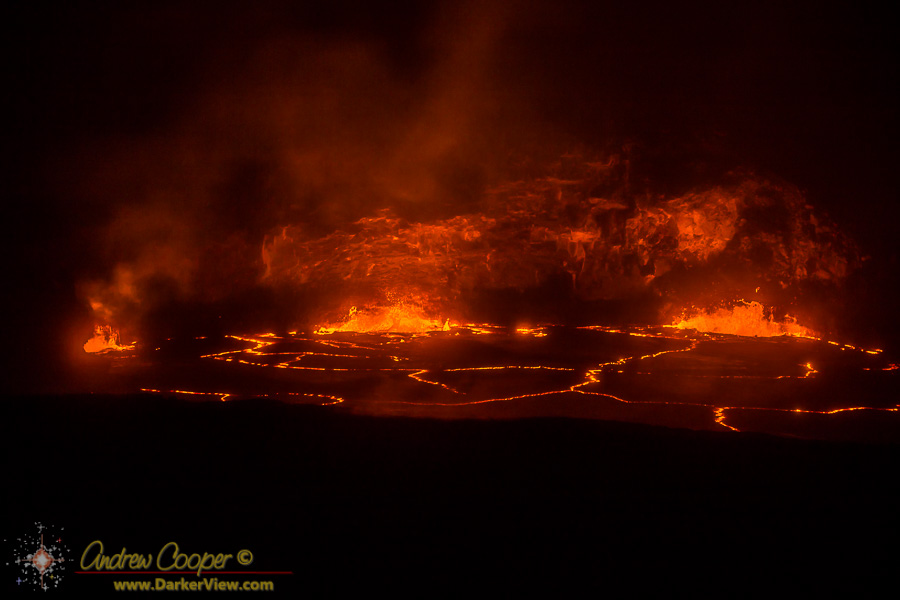
Processing photos of the Halemaʻumaʻu lava lake presents quite the challenge. The very bright lava fountains are difficult to properly expose while showing anything of the surrounding scene. Yet another try is shown here. This version uses very heavy tonal editing to compress the dynamic range of the lava fountains while expanding the low end of the histogram to show detail in the rock walls. The result is interesting, but quite different than seen in person…
Walking into the building I saw the first sign. A prominent message placed in the windshield of a car parked by the entrance… “TMT, Too Many Telescopes” The protesters were here. I had hoped they would not be, we had things to get done in this meeting. A disruption of the meeting by protesters would mean another delay.

To that end I had written a proposal for the new instruments with a description of exactly what we wished to do. Attached is an appendix of photos and drawings to answer any possible questions. I was present to answer the inevitable questions I had not thought of and feared would get asked.
The room was filling rapidly when we arrived, far beyond the usual audience of one of these meetings. As I greeted the many people I know, I noted many new faces. They seemed out of place, a little on edge, a sense of having entered enemy territory. Many of those present were young, in their teens and early twenties, one a young mother, child carried in her arms. The t-shirts betrayed their allegiance, they came with cameras and poorly concealed protest signs.
I have no problem with those who oppose the telescopes atop Mauna Kea attending a meeting like the OMKM board meeting. Public participation is a good thing. Indeed, these meetings are open to the public for a reason, to allow anyone interested to attend and to see for themselves how those charged with managing the mountain do their jobs.
I worried about a protest that would disrupt the meeting, making it impossible to accomplish anything. This did not happen. I will give those who attended credit for showing respect for the proceedings and to those discussing the effort of caring for the mountain.

Manning the Keck Observatory table at AstroDay had me in Hilo again this weekend. Already close, why not visit the volcano again?

That “straight out” to the volcano part was a very good idea, I had made that clear in the plan. Arriving at the park we could see preparations and extra personnel ready for an onslaught of visitors. We got there just in time, parking in the Jagger Museum parking lot. A short time later we learned from the folks just arriving that they were parking at another lot further out. At least the Park Service had a shuttle bus running.
The pressure just keeps on building. This is a major surge of magma into the mountain. There is not much mystery about this… The increased seismic levels, the rising lava lake, but most of all the tilt meters indicating substantial inflation of the summit caldera.

As you can see from the graph it has gone up and up over the last week. There have been a couple pauses, almost looking like it was going to begin deflation. But no, it just goes up again. The result is lava spilling out onto the floor of Halemaʻumaʻu crater and a beautiful nighttime show.
The interesting thing is that this increase in pressure has not been seen at the downslope vent around Puʻu ʻŌʻō. The flows there remain rather anemic and there is no sign of inflation around the vent. Add the seismic data and things get interesting.

I on the other hand, have no professional reputation as a vulcanologist. I can throw caution to the wind and prognosticate…
My prediction? Unless something occurs to relieve the pressure, perhaps a major increase in the flow of lava at Puʻu ʻŌʻō, there will be an eruption elsewhere. My guess? South of the main caldera along the southeast rift zone in the Makaopuhi Crater or Nāpau Crater area.
When? Who knows, much depends on the magma supply surge continuing. As long as the pressure keeps building the odds of an eruption elsewhere on the volcano increase with it.
It will be interesting to watch. And watch we will. I expect to be at the Jagger museum overlook Saturday evening. Look for the crowd around my telescope.
Watching the fantastic scene below me it was the famous lines from a play that came to me…
This cauldron is roughly 500ft (200m) across and filled not with a witches brew, but a seething pool of lava. And while a line from Shakespeare might begin the description, it can not fully capture the reality… A churning pool of lava, mostly crusted over with thin sheets of dark material broken by brilliant red cracks. Along the edges bright fountains are powered by gasses escaping from deep below. In the night the brilliance of the lava lake was startling, illuminating the plumes of gasses and the low clouds over Kilauea Caldera.
To see this cauldron I had gotten up well before three in the morning for the nearly two hour drive across island. I traveled over Saddle Road and then up the volcano highway to Kilauea. Why the effort? The lava lake that has been present in the Halemaʻumaʻu crater was visible for the first time, at least from any publicly accessible place in the park. Normally the surface of this lava lake has been several hundred feet below the crater floor, hidden from direct view. An unprecedented surge of pressure in the Kilauea magma chamber has pushed the lake level to new heights, almost spilling out onto the floor of the crater.
Driving into the park revealed the first surprise. I was part of a little convoy of half a dozen vehicles, a bit unexpected at 4am. Arrival at the Jagger Museum parking lot I encountered an almost full parking lot, just a few spaces left in a very large lot. There were several hundred visitors already on the large terrace viewing area. A huge crowd, all here to see the lava.
Continue reading “Watching the Lava Boil and Froth”