Tomorrow morning, April 25th, will see a brilliant Venus paired with a crescent Moon. Look for the pair to rise about 03:41HST to be 30° above the horizon at sunrise. A 15% illuminated Moon will be a nice match for Venus shining brilliantly at -4.1 magnitude. Separation will be about 4°.
The following morning, April 26th, will see the Moon much closer to the horizon, over 11° west of the planet.
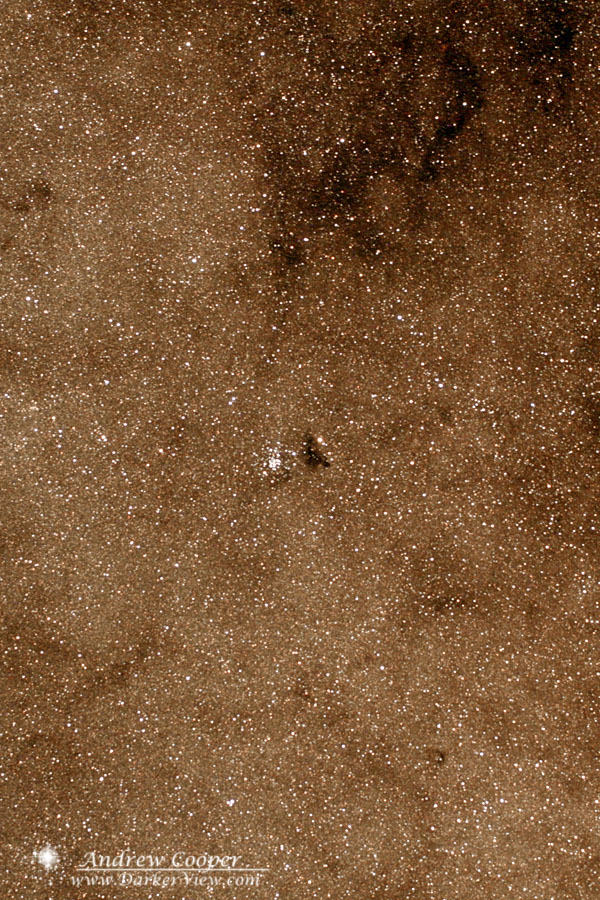
A frame filled with stars beyond counting while looking into a small part of the core of our Milky Way galaxy. This area of the sky is endlessly entrancing as you see the immensity of our galaxy demonstrated in a very dramatic fashion.
At the center is the small star cluster NGC6520 and the dark nebula B86. These two create one of my favorite showpiece views when viewing from a dark site with a large telescope. Even many people who have done a fair amount of observing have never looked at a dark nebula before. A great object to select when other telescopes are showing the usual stuff.
The photo is the sum of five separate five minute exposures with the Canon 20Da and a TV-76mm telescope. Taken from my driveway in Waikoloa the image is about two degrees (four times the width of the full Moon) from top to bottom.
The cluster NGC6520 and the dark nebula B86 lost in the immensity of Baade’s Window
The first Earth-sized exoplanet orbiting within the habitable zone of another star has been confirmed by observations with both the W. M. Keck Observatory and the Gemini Observatory. The initial discovery, made by the Kepler Space Telescope, is one of a handful of smaller planets found by Kepler and verified using large ground-based telescopes.
The artist’s concept depicts Kepler-186f, the first validated Earth-size planet orbiting a distant star in the habitable zone. Credit NASA AMES/SETI Institute/JPL-CalTech“What makes this finding particularly compelling is that this Earth-sized planet, one of five orbiting this star, which is cooler than the Sun, resides in a temperate region where water could exist in liquid form,” says Elisa Quintana of the SETI Institute and NASA Ames Research Center who led the paper published in the current issue of the journal Science. The region in which this planet orbits its star is called the habitable zone, as it is thought that life would most likely form on planets with liquid water.
Steve Howell, Kepler’s Project Scientist and a co-author on the paper, adds that neither Kepler (nor any telescope) is currently able to directly spot an exoplanet of this size and proximity to its host star. “However, what we can do is eliminate essentially all other possibilities so that the validity of these planets is really the only viable option.”
With such a small host star, the team employed a technique that eliminated the possibility that either a background star or a stellar companion could be mimicking what Kepler detected. To do this, the team obtained extremely high spatial resolution observations from the eight-meter Gemini North telescope on Mauna Kea in Hawai`i using a technique called speckle imaging, as well as adaptive optics (AO) observations from the ten-meter Keck II telescope, Gemini’s neighbor on Mauna Kea. Together, these data allowed the team to rule out sources close enough to the star’s line-of-sight to confound the Kepler evidence, and conclude that Kepler’s detected signal has to be from a small planet transiting its host star.
Today the minor planet 4 Vesta will pass through opposition.
4 Vesta is one of the largest objects orbiting between Mars and Jupiter, a region often referred to as the Asteroid Belt. This is the second largest asteroid, at 530km (329miles) in diameter. It is also usually the brightest asteroid that can seen by earthbound observers. When Vesta is at opposition it is bright enough to be just visible to the unaided eye, usually around 6th magnitude.
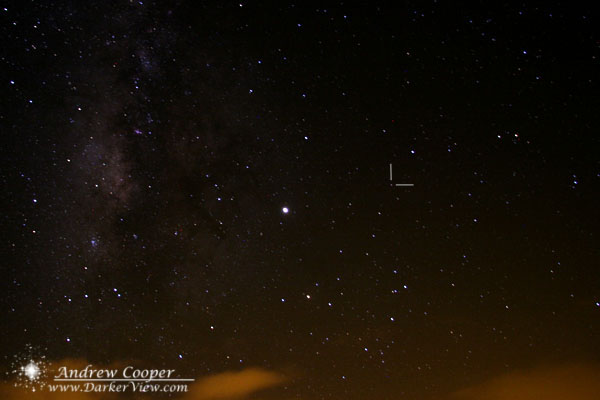
This year Vesta will reach magnitude 5.7 at opposition. This magnitude requires a dark site to view without the aid of a telescope. Precise knowledge of the location is also helpful. Given these two items it becomes possible to see an asteroid with the unaided eye.
The minor planet is currently located in Virgo about 2.5° northwest of τVir. Interestingly enough the dwarf planet 1 Ceres will be located about 2° east and a touch south of Vesta. Despite being much larger than Vesta it will be over a full magnitude dimmer at about 6.9 magnitude.
Vesta was visited by the Dawn spacecraft during 2011 and 2012. Dawn is now on course for Ceres with a planned rendevouz in February 2015.
Vesta (marked), Jupiter and Summer Milky Way, 40s, 17mm@f/4, fixed tripod on 28May2007