
Today Mercury passes through superior conjunction, passing behind the Sun as seen from the Earth. The planet will appear in the sunset near the end of the month, reaching maximum elongation on June 12th.
Category: Astronomy
Exploring the cosmos
Venus Appears in the Sunset
Venus is currently beginning an evening apparition. This evening the planet should be visible about 10° above the setting Sun. At magnitude -4 it should be easy to spot with a good western horizon. The bright planet will spend the remainder of 2013 in the evening sky, with maximum elongation occurring on Oct 31st.
Tonight also features a pairing with a very thin crescent Moon. The Moon will be a mere 1.3% illuminated and be located 2° south of Venus. A very nice pairing indeed!
Look forward to a number of planetary conjunctions in the coming months. With Jupiter approaching solar conjunction and Venus leaving, the two will cross paths nicely.
Sifting Through the Atmospheres of Far-off Worlds
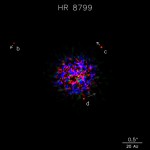
Gone are the days of being able to count the number of known planets on your fingers. Today, there are more than 800 confirmed exoplanets — planets that orbit stars beyond our sun — and more than 2,700 other candidates. What are these exotic planets made of? Unfortunately, you cannot stack them in a jar like marbles and take a closer look. Instead, researchers are coming up with advanced techniques for probing the planets’ makeup.
One breakthrough to come in recent years is direct imaging of exoplanets. Ground-based telescopes have begun taking infrared pictures of the planets posing near their stars in family portraits. But to astronomers, a picture is worth even more than a thousand words if its light can be broken apart into a rainbow of different wavelengths.
Those wishes are coming true as researchers are beginning to install infrared cameras on ground-based telescopes equipped with spectrographs. Spectrographs are instruments that spread an object’s light apart, revealing signatures of molecules. Project 1640, partly funded by NASA’s Jet Propulsion Laboratory, Pasadena, Calif., recently accomplished this goal using the Palomar Observatory near San Diego.
Continue reading “Sifting Through the Atmospheres of Far-off Worlds”
Partial Solar Eclipse from Hawai’i
We were all ready to view to eclipse from Keck HQ in Waimea. The gear was ready to go, our astronomers setup to answer questions, the public invited…
It rained.
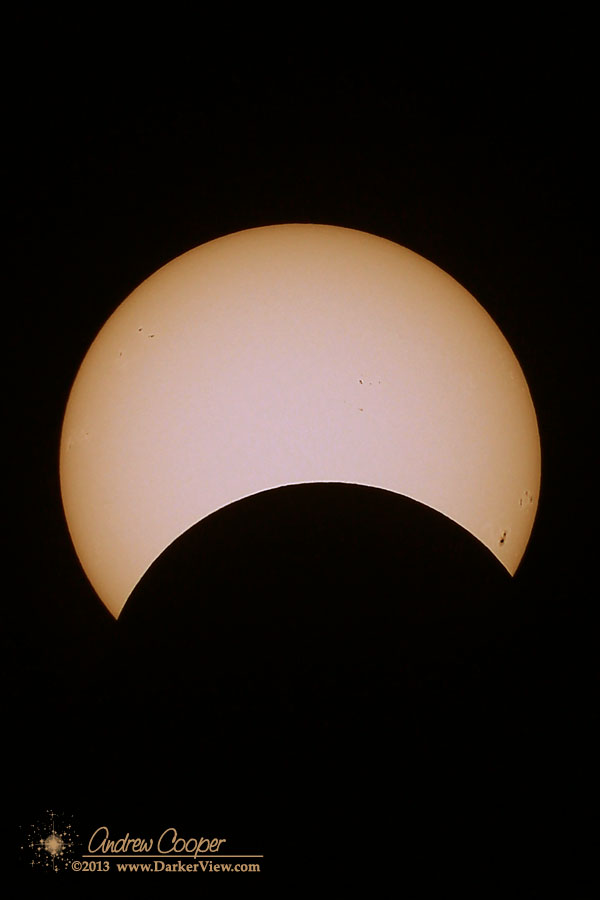
Not to be deterred I grabbed my little telescope and headed for the Sun. The satellite showed a reasonable possibility of clear skies in Kawaihae. As I rolled into the parking lot at Pu’u Kohala Heiau National Historic Site I found the hole in the clouds needed for eclipse photography.
I was not the first there, I met another gentleman setup with a 70mm Meade ETX, we chatted as I set up beside him. I found out later that a couple of the gals from CFHT were setup at Spencer Beach just below the heiau. For clear skies this was about the only reliable place on the island other than the summit.
I quickly setup my little TV-76mm and got the images I was looking for at maximum. We only got to 47% here on the big island, but still worth the effort to see.
Partial Solar Eclipse Reminder

Please exercise caution when viewing the Sun! Use appropriate eye protection or indirect observing techniques to project an image of the Sun. The link at the start of this paragraph leads to a great discussion on viewing the Sun safely. As always the single best source on the web (or anywhere) for eclipse and transit information is Fred Espenak’s eclipse website at NASA. Stop by whenever you have a question on upcoming events as well as viewing and photography tips.
During a deep partial such as this one check out the shadows under nearby vegetation. Small gaps in leaves can act like pinhole cameras projecting small crescent images of the Sun.
| Location | Begins | Maximum | Ends | Altitude | Azimuth | Magnitude |
| Honolulu | 14:23 | 15:48 | 17:01 | 43 | 275 | 44 |
| Hilo | 14:31 | 15:56 | 17:05 | 61 | 270 | 47 |
New Moon
An annular solar eclipse will sweep across Australia and the southern Pacific Ocean. For viewers in the Hawaiian Islands this eclipse will be seen as a deep partial eclipse, with a maximum of over 40% of the Sun obscured.
West Hawaii Astronomy Club Monthly Meeting
Our May meeting will take place Tuesday, May 14th, 7:00pm at Keck Observatory HQ in Waimea. This month we have local photographer Ethan Tweedie in to talk.
AstroDay 2013
It was fun. It is always fun!

Prince Kuhio Plaza is the largest mall on the island. Perhaps small by large city standards it is still the focal point of shopping in Hilo. The observatories and a few other organizations use tables all through the branches of the mall. In the center of it all is a stage with live music, giveaways and other activities for the crowd. The whole thing is a great family day and a great outreach opportunity.
STEMpede at Parker
Take two old scanners, two VCR’s, a stereo amplifier and tape deck. Place on a table with an ample supply of screwdrivers, wire cutters and other tools. Mix in a dozen middle school kids and observe the results!
As you might expect a little chaos appears. Chaos is good… Embrace the chaos! Use the result to have a little fun while learning.

I was not going to simply talk, I have always believed learning is best done by hand. Some of the gear was from my own garage, some off the electronics disposal pallet at work. A lineup of old electronics greeted the kids, then I opened the tool-bag!
AstroDay Reminder
Tomorrow is AstroDay at the Prince Kuhio Plaza in Hilo. I will be there! Will you?
