Tonight and tomorrow the pair of planets, Mercury and Mars will be about 30′ apart, close enough to easily fit in the low power view of most small telescopes. The pair will be 13° above the sunset, setting about an hour after the Sun slides below the horizon.
After the 8th the pair will separate, with Mercury heading for maximum elongation on February 16th.
For the next few evenings Mercury and Mars will pair in the sunset for a dance. Tonight the two are 3°13′ apart, with Mercury rising rapidly. Tomorrow the two will be only 2°17′ apart. On the 7th and 8th there will be about 30′ between the two. After the 8th the two will gradually draw apart. On the 10th the separation will be just over 2° with the addition of a 1.8% illuminated Moon just 7° lower and north of the pair.
The pair should be easy to spot. Mercury will be shining brightly at -1 magnitude with Mars at about 1.2 magnitude. A pair of binoculars might help spot the dimmer Mars.
Neptune is also in this dance, but at 8th magnitude it could be very difficult or impossible to spot, even with optical aid. On the 5th, with Mercury and Mars only 2° apart, Neptune will be right between the two.
Tonight and tomorrow night Mars and Neptune will be under a degree apart. But, as the pair is quite low in the sky, this may not be observable. The planets will be 40′ apart tonight, a little closer tomorrow at only 27′ separation. The pair will be 14° above the horizon at sunset. Mars, shining a 1.2 magnitude should be relatively easy to spot. The 8th magnitude Neptune may be too dim to see, even with a telescope, against the bright glow of sunset.
On the evening of February 5th, Mercury will join in to create a trio, just 2° below Mars with Neptune between the two.
The planet Mercury is starting an evening apparition. The planet should become visible this week just above the fading glow of the setting Sun as a magnitude -1 object. Currently about 10° from the Sun it will rise higher each evening, reaching a maximum elongation of 18° on February 16th.
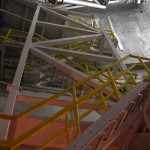
The five flights of stairs needed to climb the Keck 2 Nasmyth Deck
Wait! What is broken?!?
The elevator.
It has been broken for two days. The contractor is here to fix it, but this is the day Olivier and I need to get a job done in AO. It would have to be the Keck 2 elevator, not the Keck 1 elevator. Which telescope are we working in today? Keck 2 of course.
This will mean climbing the stairs to the Nasmyth deck, all five flights of stairs. Five flights does not sound too bad, until you remember that the bottom of these particular stairs start at 13,600ft above sea level. Climbing these stairs is guaranteed to get your heart pumping and remind you of the consequences of every one of those 13,600ft.
The job? Re-installing one of the mirrors in the rotator that was re-aluminized earlier in the week. A delicate, fiddly job that would take much of the day. There will, of course, be missing parts, needed tools, or other small things that we will have to get during the course of the job. Things that are at the bottom of those stairs.
Every trip up and down would be planned, this is not the time to remember that you also needed an #8-32 nut, after the climb. No forgotten items, everything thought through twice. We got the job done, a critical bit of optics safely secured back in the mount and correctly aligned.
In the end I only had to climb the stairs five times through the day.
It is always another little problem. But, on occasion, a problem is an excuse to have a little fun while getting the job done.
Enter an old WYKO interferometer with a composite video output. The gear is a critical piece of kit used to monitor the deformable mirror used in the adaptive optics system. The images from the interferometer are analyzed by a windows PC with special software. Windows, as in Windows 98!
Updating this computer has been on our to-do list for way too long. Time to get it done… When installing the new computer and video board to update this system I found that the video quality was quite bad. It would tear about halfway down the image, something wrong with the horizontal sync? Looking back it was not great on the old system, but usable. On the new system it was just not going to work.
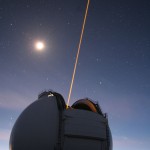
The Keck 2 laser acquires the first target of the night with the glow of sunset behindIt works… We think.
In theory TBAD will detect the TCAS transponder on an aircraft, turning off our AO Laser to avoid illuminating the aircraft. This work via means of a directional antenna mounted to the front of the telescope that is able to detect the 1090MHz TCAS transmissions from the aircraft. The system has been operational for the better part of a year, mounted to the Keck 2 telescope. It operates all the time, whether or not we are using the laser.
The problem is that there is very little air traffic over the summit, it is even more rare that a plane goes directly in front of the telescope while we are observing. It is these test cases we need to prove the system, an aircraft passing through where the laser would be. Though the first year of running the system we logged a total of one detection that would have resulted in a laser shutter event. We need more test cases if we are to prove to the FAA that the system works as designed.
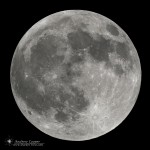
This evening sky-watchers will note Jupiter directly beside a bright Moon. The pair will be very close separated by only 1°09′ as of sunset here in Hawai’i. Accounting for the radius of the Moon this will mean that the planet will be only 55′ off the limb of the Moon.
Observers further east and south will be able to see an occultation, with the Moon passing in front of Jupiter. Here in Hawai’i the occultation will be over before sunset. It is no use observing during the daytime either, as the planet will pass north of the Moon for our latitude.
The proximity of the two does provide a nice opportunity to see Jupiter in the daytime, as the Moon will provide a signpost to the location of the planet. The pair will rise about 14:00HST and be well up before sunset. Look just to the north of the Moon (left as they rise) for a pinpoint of light. At -2.6 magnitude the planet should be easy to spot as long as the sky is clear and not hazy.