Shutter
When you want to see the stars, find someplace dark

Exploring the cosmos
An international team of astronomers has released the largest ever compilation of exoplanet-detecting observations made using a technique called the radial velocity method. By making the data public, the team is offering unprecedented access to one of the best exoplanet searches in the world.

“HIRES was not specifically optimized to do this type of exoplanet detective work, but has turned out to be a workhorse instrument of the field,” said Vogt, a professor emeritus of astronomy and astrophysics. “I am very happy to contribute to science that is fundamentally changing how we view ourselves in the universe.”
Continue reading “Astronomy Team Releases Planet-Search Data”
W. M. Keck Observatory press release…
Many scientists believe the Earth was dry when it first formed, and that the building blocks for life on our planet — carbon, nitrogen and water — appeared only later as a result of collisions with other objects in our solar system that had those elements.

Continue reading “Dwarf Star 200 Light Years Away Contains Life’s Building Blocks”
W. M. Keck Observatory press release…

Continue reading “Over 100 New Exoplanet Candidates Discovered With W. M. Keck Observatory”


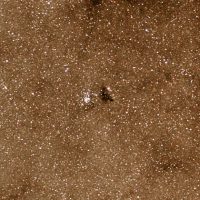

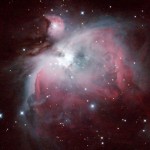

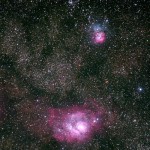


Even when Venus is high in the sky and well placed for observation I will seldom take the effort of turning a telescope towards the planet. Why? Because Venus is pretty boring to look at. Perpetually cloud covered it has all the detail of a cue ball. It is a white disk with nothing of note to be seen. Yeah, pretty boring. Now turn the telescope to Jupiter.

This begins as the planet passes maximum eastern elongation, about two months before inferior conjunction. At this point the planet is seen from the side with respect to the sunlight, the planet will be about half illuminated. In the weeks after maximum elongation the planet will appear ever more crescent.
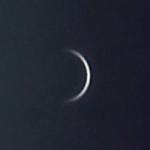
It is possible to enjoy this sight in the daytime, while the planet is high in the sky, the seeing can be better and the view sharper. Of course this also occurs when the planet is near the Sun, thus extreme caution should be practiced at the telescope to avoid any direct sunlight and possible eye damage.

While the the evidence challenged prevailing ideas of the time, some astronomers attempted to explain the phases of Venus by any other means to preserve their Earth centered universe, which led to rather tortured models of planetary motion. But it was clear to most that Galileo was right, the simple and elegant answer was that the Sun lay at the center. The orbits of Mercury and Venus, the phases, along with other observations like the moons of Jupiter, were hard evidence that few could ignore.
In 2017, eastern elongation occurred on January 12th. By now Venus has begun to show a substantial crescent, about 30% illuminated if you look today, Feb 12th. Over the next few weeks as the planet sinks into the sunset, the crescent aspect will thin dramatically.
By the end of February the planet will be only 17% illuminated, another week after that it becomes only 11%, by which time the planet will be difficult to spot in the sunset. Inferior conjunction will occur on March 25th. A couple weeks later and it will be possible to spot the planet in the dawn and observe the now thickening crescent.
Venus Events for 2017 |
||||
|---|---|---|---|---|
| Date UT | Separation | Mag | ||
| Maximum Elongation | Jan 12 | 47.1°E | -4.4 | |
| Inferior Conjunction | Mar 25 | |||
| Maximum Elongation | Jun 3 | 45.9°W | -4.3 | |
| Source: NASA Sky Calendar | ||||
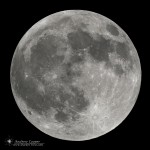
With this full Moon a penumbral lunar eclipse will also occur, visible across Europe and Africa, and partially visible from North America. None of this eclipse will be visible from the mid-Pacific including Hawaiʻi. For the islands the next good lunar eclipse will occur Jan 31, 2018.