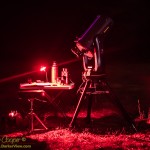
We are good to go! I have the DLNR permit for using the site. We will hold the Mauna Kea Messier Marathon 2016 on the evening of March 12 at the Ka’ohe observing site.
The 11″ NexStar GPS telescope, GyPSy set up at Ka’OheSunset: 18:31 HST
Astronomical twilight ends: 19:44 HST
Astronomical twilight begins: 05:19 HST
Sunrise: 06:32 HST
Please arrive before sunset so as not to annoy other observers with lights and dust, allowing a few extra minutes to find the setup site. This will provide plenty of time to set up gear and have a picnic dinner. I hope to be at the site around 5:30pm. I will sign the group in at the check-in station with the permit number, you need not sign in.
For those who wish to marathon I will have a checklist available for the effort. There are a lot of MM checklists, the one I provide is optimized for our 20N latitude which changes the priority of the evening and morning objects. If you do not want to participate, just come to observe.
If you are participating in the MM I would also suggest a low-power, wide field instrument. Smaller telescopes are actually better at this pursuit than larger. For MM I leave the 18″ at home and bring a 6″ telescope. Any finding aids are acceptable, including GOTO. If you are a purist like me? I will use nothing but a chart and a Telrad to locate the objects.
The site is to be found along the old Saddle Road just above the Kilohana hunter check in station. There is a line of pine trees a couple hundred yards above the gate, I plan to set up on the makai side of the trees where you will find a large flat area and a big pile of gravel stockpiled. A precise location and Google map for the Ka’ohe site can be found here.
A reminder that the DLNR permit has a few restrictions, nothing we would not do anyway… No open flame, no hunting, and please keep the area clean.
Now all we need is clear weather for a successful Marathon!
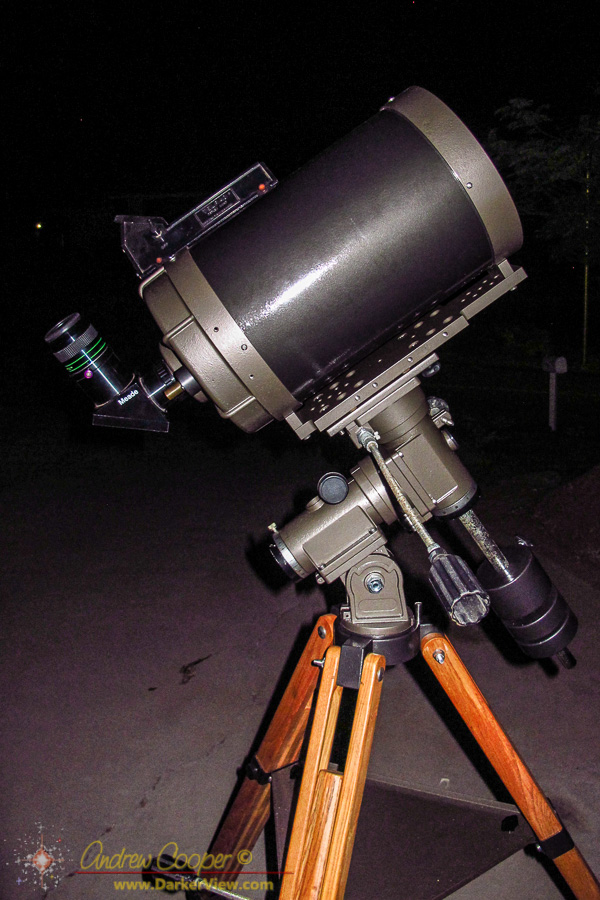
I have already posted about the restoration of an orange tube C8. That was only part of the story, the telescope is paired with a TeleVue Renaissance mount that was in the same poor condition as the optical tube. The mount required the same treatment, a complete tear down and restoration to reverse the ravages that tropical humidity had wrought upon the metal parts.
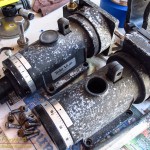
The RA and declination axis removed from the mount for further disassembly and restoration
Corrosion was the issue. While the mount was mostly functional, it was looking horrible. The aluminum under the paint was corroding into a fine white powder. Most of the screws were quite rusted along with the counterweight shaft where the chrome was flaking away and the rust spreading. If allowed to continue the mount would soon be the piece of junk it looked like. There was something wrong with the clutches as well, they do not lock firmly and needed to be inspected.
The mount was sold by TeleVue in the 1980’s paired with their APO refractors. The mount is actually a re-labled unit manufactured by the Japanese firm Carton Optics as the model Super Nova or RSM2000. Well regarded by amateur astronomers you can find postings of well used and beloved mounts still in use thirty years later. Examining the mount I find I agree with those who like it. There is much to love in the solid smooth motion, this looks to be worth the effort of restoration.
Thus I set about the task of stripping down the mount into component pieces… Of the rusted hardware only one screw required drilling out, the hex drive head stripping when I tried to remove it. Fortunately I again had the proper tools, a set of easy outs to remove the remains of the screw after I had drilled the head off. I was able to remove the screw without any damage to the aluminum castings.
I still have an 8″ solar filter on-hand, leftover from the Meade LX50 I used to have many years ago. A quick inspection to insure it is in usable condition (take no chances with solar filters) and a fit check… It fits the restored C8 perfectly.
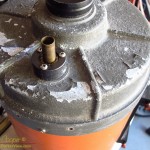
It looked horrible! The paint was coming off everywhere with heavily corroded aluminum underneath. Most of the screw heads were small balls of rust, with hopefully enough remaining to fit a screwdriver to and remove. For a precision optical instrument this small telescope was not very encouraging.
Looking at what remains of the paint on an old Celestron C8 orange tube telescopeOn the bright side the optics looked to be in decent shape. While there was some dirt and mold on the corrector, the primary looked almost perfect. Not bad considering the condition of the metal parts. Maybe, just maybe, this telescope is salvageable.
The telescope in question is an old orange tube Celestron C8. Thousands of these little telescopes were manufactured in the 70’s and 80’s. It was the C8 that set the standard for amateur telescopes at the time. The C8 is still in production forty years later, but the tubes are no longer painted orange as they were originally. Compact, yet offering decent performance, these telescopes were well regarded and hold a special place in the memories of many amateur astronomers. I have seen these little orange telescopes at dozens of star parties, even bolted to the side of huge professional telescopes for use as finders.
The confirmation of gravitational waves is simply a huge moment for science. A lot of people have spent their lives building instruments in hope for this day. From one who maintains another great scientific instrument to those who built LIGO… Congratulations!!
Not to understate the magnitude of the achievement, this is a huge discovery, but as usual XKCD puts a fun spin on the moment…
The 1999 Total Solar Eclipse from France, image credit Luc ViatorThe path of totality passes well north of the Hawaiian Islands, just south of Midway Island. If you want to see this eclipse as a total your best bet is an eclipse cruise. For the islands this will be a deep partial eclipse, ranging from about 67% for Kauai and the around 55% for the Big Island. Of course, the exact amount of the Sun covered by the Moon will depend greatly on your location. See the table below for predictions and timing for your location.
Note, you might be confused by some references that state the eclipse occurs on March 9th. It does occur on the 9th! For our islands greatest eclipse occurs around 03:30 on March 9th universal time. If we convert to Hawaiian Standard Time this will be the 17:30 (5:30pm) on the afternoon of March 8th. You must remember that universal time is ten hours ahead of Hawaiian Standard Time.
Diagram of the March 9, 2016 Total Solar EclipseThere are several cruises scheduled to intercept this eclipse. Most look to observe the eclipse somewhere near Indonesia, where the eclipse will be at its maximum. This is where you will find the hardcore eclipse chasers, including a few island folks I know. Most of us will just have to settle for seeing this eclipse as a partial, including myself. The information presented here covers viewing the eclipse from the islands.
A deep partial can be very interesting. Even people not expecting the eclipse may notice a dimming of the Sun and an odd, subdued nature to the sunlight. Even a quick glimpse of the Sun will reveal that half of the disk is covered. Eclipse glasses or a welding filter will provide a nice image of a partially eclipsed Sun. Tree leaves and other makeshift pinhole cameras will show crescent images of the Sun on the ground. For best viewing a small telescope with a solar filter, or a pinhole camera will allow excellent images of the eclipse. My standard eclipse viewing setup is a 76mm refractor with a Baader film solar filter. I assembled this gear for the 2012 Venus transit and it has seen several eclipses since.
The table at the right gives the eclipse timing for a few locations across the Hawaiian Islands. All times are given in Hawaiian Standard Time, just remember that 17:36 is 5:36pm in 12 hour time, just subtract 12.
As you can see the magnitude of the eclipse increases notably the closer you are (further north in the main islands) to the path of totality. The timing does not vary by nearly as much, with maximum eclipse occurring around 17:36 for the islands.
If you would like to see precise information for your location, or for someplace other than the islands, just use the interactive map and click on your location for data.
A partial solar eclipse from Kawaihae, 9 May 2013Observing a partial solar eclipse requires proper eye protection. If you can not look safely, do not look! Even dimmed by 50% or more the Sun can cause permanent eye damage if viewed without proper protection. A solar filter is required for telescopic or binocular use. A good view can be had without magnification simply using a welding filter (shade 13 or darker) or solar viewing glasses to look directly at the Sun. A pinhole camera can be made out of things lying around in your kitchen that provides a very good image. Read my Guide to Safe Solar Viewing for a lot more information on viewing the Sun safely.
There are no further solar eclipses near the Hawaiian islands until 2031 and 2035, the path of totality for both of which pass well south of the main islands. There is also an annular eclipse in 2024, for which the center line also passes well south of the islands.
You have heard it before, but it really is true! Looking at the Sun for longer than a few brief moments with an unprotected eye can lead to permanent damage. Looking at the Sun with any sort of optical deceive that has not been properly filtered can lead to instantaneous eye damage.
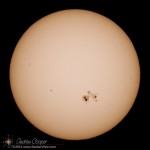
The complex sunspot AR2192 visible on 24 October, 2014
Discussed below are the only safe methods I am aware of to view the Sun. There are some dodgy methods out there. Take chance with your irreplaceable eyesight? I think not. Be careful and do it right if you want a look.
For the unaided eye there are a couple options to view the Sun safely…