
Category: Astronomy
Exploring the cosmos
Segment
Mercury Appears in the Dawn
The planet Mercury is starting a morning apparition. The planet should become visible this week just above the dawn as a magnitude -1 object. The planet is moving more than 1° further from the Sun and higher in the morning sky each day, reaching a maximum elongation of 18° on October 15th.
Mercury at Inferior Conjunction
Today the planet Mercury passes through inferior conjunction, passing between the Sun and the Earth. In a week or so the planet will again be visible in the dawn sky, climbing higher each day. Maximum elongation will occur October 16th.
No Moon in the Shadow
I had planned to go up and photograph the tail end of tonight’s eclipse as the full Moon rose just inside the mountain shadow… No luck.
Thanks to tropical storm Niala passing south of the island the summit is totally weathered in. Fog, rain and no shadows…

A Star Party for WHEA
They got lucky.

We try anyway.
WHEA, or West Hawaii Explorations Academy is a charter school located in the NELHA complex just north of Kona and just south of the airport. They concentrate on science, mostly marine science, with an outdoor hands-on curricula. Large pavilions serve as additional classrooms. The campus is littered with evidence of various projects, from large pools, various gardens, and a phalanx of handmade cargo pallet catapults in the back.

There were some clouds to hamper us, but nothing that would obscure the view for more than a minute or two. A nearly full moon, just a few days shy of this week’s eclipse, was beautiful in the telescope. We also had Saturn, still available in the evening sky at the head of Scorpio. As the evening passed so did the clouds, thinning to a few wisps across the sky.
Maureen was there with her big dob. Chris and Doris with the C-14, Brad with his twin refractor that shows the Moon beautifully. Cliff set up the C-11 giving us five telescopes in all, plenty of eyepieces to supply visions to waiting eyes. I need to spend a little time working on our NextStar GPS 11″, the motor control issue is back, I was running in manual mode much of the evening.
We gazed at the terrain of the Moon and I showed kids, and a few teachers, how to take photos with a cell phone through the eyepiece. A good school star party and a well spent Friday evening. Even if it did take half an hour for the security guard to arrive to open the gate and let us leave. There were also too many chocolate chip cookies available.
Full Moon
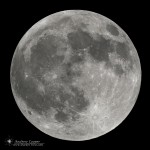
This full moon is a perigee full Moon, with the moment of lunar perigee occurring at 15:46, about an hour away from full moon. This full Moon will be a bit larger and a bit brighter than an average full moon.
Along with perigee, a total lunar eclipse will occur with this full Moon. Observers on either side of the Atlantic, including western Europe and the eastern seaboard of North America will be able to see the entire eclipse. Observers in Hawaii will only be able to see the last moments of the penumbral eclipse, not significant and not visually observable.
The Definitive Pluto Image
The NASA New Horizons team has released a gorgeous full disk image of Pluto. I would predict that this high resolution image will be the definitive image of Pluto for at least a century. Expect to see this image any time you run across Pluto in any media, from Wikipedia to school textbooks.
Panning across the image one can see that Pluto does feature a fair number of impact craters, more than I noted on the earlier images that often concentrated on the ice fields of the Sputnik Planum. This ice cap is startlingly smooth, with flow features visible, primarily at the margins. The ice is probably nitrogen ice as water is essentially a rock at these temperatures. Indeed much of the bedrock visible across the image is probably water ice.
The ice sheet is made up of polygons, a feature sometimes seen in ice here on Earth. For some reason the boundaries of the polygons are marked with long linear double depressions. These depressions look like 4WD roads across a desert of sand, if the vehicles had tires a mile across.
On the right side of the ice fields of Sputnik Planum there are a a large number of aeolian features, huge ridges one would suppose are aligned with the prevailing winds. Given that the image resolution is 0.8 miles per pixel these features must be miles high. These have recently been dubbed snakeskin terrain. I expect the planetary scientists will have a bit of fun trying to figure these out.
It is a beautiful image, conveying a great sense of what this dwarf planet is really like. Download the high resolution image and just wander. The larger image is bigger than WordPress will allow, use the link above to get the full size image.

Autumnal Equinox
Fall equinox occurs today at 22:20HST. Today there will be little difference between the length of the night compared to number of daylight hours. This is the first day of fall as marked by many cultures in the northern hemisphere.
This year many calendars will mark September 23rd as the beginning of fall, and so it is for much of the world. Here in Hawaiʻi the equinox actually occurs on the 22nd when considering the time zone differences.
| 2015 Solstices and Equinoxes | ||||
|---|---|---|---|---|
| UT | HST | |||
| Perihelion | Jan 4 | 08:59UT | Jan 3 | 22:59HST |
| Vernal Equinox | Mar 20 | 22:45UT | Mar 20 | 12:45HST |
| Summer Solstice | Jun 21 | 16:38UT | Jun 21 | 06:38HST |
| Apehelion | Jul 6 | 12:59UT | Jul 6 | 02:59HST |
| Autumnal Equinox | Sep 23 | 08:20UT | Sep 22 | 22:20HST |
| Winter Solstice | Dec 22 | 04:48UT | Dec 21 | 18:48HST |
| Source: NASA Sky Calendar | ||||
The Moon and Mercury
