
The screws are rusted, the brass inserts darkend with exposure to salt and rain, the post it is clamped to is likewise suffering from corrosion in the salt air, but the 3D print is just fine.
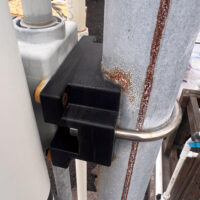
Some plastics used for 3D printing decay fairly rapidly with exposure to sunlight and weather. Certianly PLA, the most common 3D plastic, crumbles to dust in just a year of harsh weathering. ABS or Acrylonitrile Butadiene Styrene on the other hand, seems to perform quite well.
Working at Symbrosia I have created dozens upon dozens of designs, many of which are installed in the extremely harsh environment of our outdoor cultivation area. Here the prints sit in intense tropical Hawaiian sunlight for days on end, subject to both intense UV light and high temperatures. The plastic is also subject to continual exposure to salt water used in our operation, or raining from the sky on days with heavy surf, when the waves are crashing just 100 yards away. It does not get much worse than this.
I recently took a look at some of the first ABS parts I put outside in this enviroment, a few pole clamps used for mounting equipment installed over four years ago. They are in quite good shape, no surface degredation, no breakdown of the plastic visible, they are still doing the job they were printed for. Around the same time I had installed some parts printed with PLA, these have long since crumbled and failed.
It may help a bit that the parts are black, the dark pigment stopping UV light from penetrating into the plastic. But those PLA parts were also black, and still they failed.
I struggled a bit to print ABS parts at first, it was certianly more challenging to print as I experienced warping, bed adhesion issues, and layer separation in my first attempts. Eventually I learned to deal with the material to the point now nearly everything I print is printed in ABS.
Share this:

