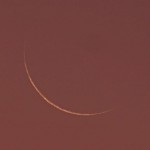
Today Mercury will be at inferior conjunction. After today the planet will reappear in the dawn, rising high enough from the Sun’s glow to be seen around the end of the month.

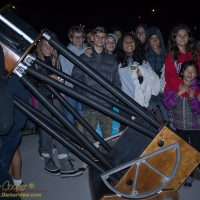
When you want to see the stars, find someplace dark
Today Mercury will be at inferior conjunction. After today the planet will reappear in the dawn, rising high enough from the Sun’s glow to be seen around the end of the month.


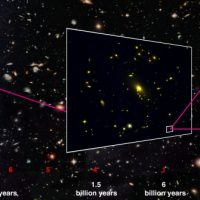
Seven years of meticulous observing have resulted in a cosmic discovery that comes from an era dating back 13.1 billion years, giving scientists a detailed glimpse of what may have happened just after the Big Bang.
Using the world-class W. M. Keck Observatory on Maunakea, Hawaii, an international team of astronomers from the United States, Australia, and Europe has confirmed the existence of one of the most distant galaxies in the universe.
To characterize the faint galaxy, the discovery team, led by Austin Hoag, a University of California, Davis physics graduate student, used MOSFIRE, the most in-demand instrument on the 10-meter Keck I telescope.
What makes this galaxy extraordinary is that it is ordinary. It is thought to be a common galaxy at that distance and age of the universe. However, such galaxies would normally be too faint to detect. The astronomers used a method called gravitational lensing to magnify the galaxy so they could study it.
“Most objects that we’ve seen at that distance are extremely bright, and probably rare compared to other galaxies,” said Hoag. “We think this galaxy is much more representative of other galaxies of its time.”
Continue reading “Primordial Galaxy Discovered, First of Its Kind”
W. M. Keck Observatory press release…
W. M. Keck Observatory overnight captured the very first successful science data from its newest, cutting-edge instrument, the Keck Cosmic Web Imager (KCWI).

“I’m thrilled to see this new instrument,” said Keck Observatory Director Hilton Lewis. “It takes years to design and build these very sophisticated instruments. KCWI is a superb example of the application of the most advanced technology to enable the hardest science. I believe it has the potential to transform the science that we do, and continue to keep Keck Observatory right at the forefront of astronomical research.”
KCWI is extremely sensitive, specifically designed to capture high-resolution spectra of ultra-faint celestial bodies with unprecedented detail. It is able to differentiate even the slightest changes in spectral color with a great degree of accuracy.
This powerful capability is key for astronomers because a highly-detailed spectral image allows them to identify a cosmic object’s characteristics, including its temperature, motion, density, mass, distance, chemical composition, and more.
Continue reading “W. M. Keck Observatory Achieves First Light with New Instrument”
There are not a lot of native lenses found in the Canon EF-M series, but this is changing with a number of new offerings. There is a new 18-150mm general purpose zoom that looks pretty good. The new lenses include a rather specialized lens, the EF-M 28mm f/3.5 Macro IS STM, a purpose built macro lens.

This lens is different. The lens is designed from the start to be a macro lens, not a general purpose lens that also does a little macro as a secondary feature. There are a number of features that are quite unusual found on this macro lens.
The first, and most obvious feature is the built-in ring light, a rather useful feature in very close macro photography where light is everything. A set of bright white LEDs is arranged on the front of the lens behind a diffuser. The LED’s are powered by the camera, no separate battery is necessary.
Continue reading “The Canon EF-M 28mm f/3.5 Macro IS STM lens”
W. M. Keck Observatory press release…

This research publishes today in the journal Nature, with Professor Karl Glazebrook, director of Swinburne’s Centre for Astrophysics and Supercomputing , as the lead author. To characterize the faint galaxy, the discovery team used MOSFIRE, the most in-demand instrument on the 10-meter Keck I telescope.
“This observation was only possible due to the extreme sensitivity of the new MOSFIRE spectrograph,” said Glazebrook. “It is the absolute best in the world for faint near-IR spectra by a wide margin. Our team is indebted to the accomplishment of Chuck Steidel, Ian McClean, and all the Keck Observatory staff for building and delivering this remarkable instrument.”
Astronomers expect most galaxies from this epoch to be low-mass minnows, busily forming stars. However, this galaxy is ‘a monster’ and inactive.
Picture postcard beaches of white sand with turquoise blue water are what so many tourists imagine when Hawaiʻi is mentioned. Add a few coconut palm trees and you have the ideal beach of song and legend.

It is the coral that is the source of the white sand beaches here in Hawaiʻi, ground coral chewed and digested by the many coral eating fish. The pretty triggerfish and parrotfish chew the coral constantly, crushing the coral into a fine grained sand. Our pretty sandy beaches are literally fish shit.

This stands as a stark contrast to other tropical shorelines around the world, where miles upon miles of beach are not uncommon, sand as far as the eye can see. Here on the Big Island the few truly good beaches are treasured and well used parks.
Coconuts are not the usual shoreline tree either, that role belongs to either the kiawe tree or what is locally called ironwood. Both names are not what you would find in the botanical texts. Kiawe is the island name for what the rest of the world calls mesquite or Prosopis pallida, a drought tolerant tree that covers much of the dry leeward shorelines. Likewise the local ironwood is actually the beach she-oak or Casuarina equisetifolia. The rather confusing name ‘ironwood’ is used for over thirty different species around the world.
Another surprise to many is that this island has black sand beaches. In place of ground coral these beaches are ground up lava, often created by the interaction of hot lava and cold water shattering the rock into a deep black sand. There is even a green sand beach, where the sand is in large part made up of the semi-precious gemstone olivine.
Hawaiʻi is the youngest island in the chain, the forces of erosion, coral growth, and hungry fish, have not had enough time to create the long sandy beaches. These beaches become more common as you jump northward from island to island. Oahu or Kauai have extensive beaches along a much large percentage of shoreline. The islands in the northwest Hawaiʻian islands, places like Kure and Midway are pretty much nothing but sandy beach.
We do have beaches, and they are pretty good.
Jupiter will pass through opposition at 10:58HST today.

Look for a bright object rising in the eastern sky after sunset. It is difficult to mistake for anything else, shining at it’s brightest during opposition, a brilliant -2.7 magnitude. For the remainder of the spring and much of the summer, the planet will be quite prominent in the evening sky.
Often you just need to take note of the small scenes that make up daily life. Over the years I have made an effort to photograph these scenes, there is so much richness in our everyday existence that too many do not notice…