There are not a lot of native lenses found in the Canon EF-M series, but this is changing with a number of new offerings. There is a new 18-150mm general purpose zoom that looks pretty good. The new lenses include a rather specialized lens, the EF-M 28mm f/3.5 Macro IS STM, a purpose built macro lens.
EOS M5 and 28mm f/3.5 macro lens
This lens is different. The lens is designed from the start to be a macro lens, not a general purpose lens that also does a little macro as a secondary feature. There are a number of features that are quite unusual found on this macro lens.
The first, and most obvious feature is the built-in ring light, a rather useful feature in very close macro photography where light is everything. A set of bright white LEDs is arranged on the front of the lens behind a diffuser. The LED’s are powered by the camera, no separate battery is necessary.
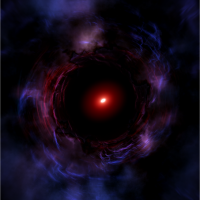
Artist’s impression of galaxy ZF-COSMOS-20115. The galaxy has likely blown off all the gas that caused its rapid star formation and mass growth, and rapidly turned into a compact red galaxy. Credit: CREDIT: Leonard Doublet/Swinburne University of Technology.An international team of astronomers has, for the first time, spotted a massive, inactive galaxy from a time when the Universe was only 1.65 billion years old. This rare discovery, made using the world-class W. M. Keck Observatory on Maunakea, Hawaii, could change the way scientists think about the evolution of galaxies.
This research publishes today in the journal Nature, with Professor Karl Glazebrook, director of Swinburne’s Centre for Astrophysics and Supercomputing , as the lead author. To characterize the faint galaxy, the discovery team used MOSFIRE, the most in-demand instrument on the 10-meter Keck I telescope.
“This observation was only possible due to the extreme sensitivity of the new MOSFIRE spectrograph,” said Glazebrook. “It is the absolute best in the world for faint near-IR spectra by a wide margin. Our team is indebted to the accomplishment of Chuck Steidel, Ian McClean, and all the Keck Observatory staff for building and delivering this remarkable instrument.”
Astronomers expect most galaxies from this epoch to be low-mass minnows, busily forming stars. However, this galaxy is ‘a monster’ and inactive.
Picture postcard beaches of white sand with turquoise blue water are what so many tourists imagine when Hawaiʻi is mentioned. Add a few coconut palm trees and you have the ideal beach of song and legend.
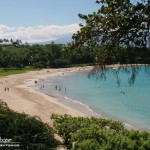
The ideal Hawaiian beach represented by Mauna Kea beach on the Kohala Coast.What surprises many tourists is that this postcard ideal is not the reality of our island. Black rock shorelines are the norm. Once under water you will find the sandy areas are interspersed with coral reef, the rocky shorelines usually supporting extensive coral reef rather than sand.
It is the coral that is the source of the white sand beaches here in Hawaiʻi, ground coral chewed and digested by the many coral eating fish. The pretty triggerfish and parrotfish chew the coral constantly, crushing the coral into a fine grained sand. Our pretty sandy beaches are literally fish shit.
Typical shoreline along the Kona coast, if there is sand, it usually becomes rock and coral at the waterlineWhile not exactly rare, there are quite a few, beaches where the sand continues into the water are not the rule along the Kona coastline. Most of the coastline feature black lava shorelines where the water crashes against bare rock. This rocky shoreline accounts for something like 90% or more of the coastline of the Island of Hawaii.
This stands as a stark contrast to other tropical shorelines around the world, where miles upon miles of beach are not uncommon, sand as far as the eye can see. Here on the Big Island the few truly good beaches are treasured and well used parks.
Coconuts are not the usual shoreline tree either, that role belongs to either the kiawe tree or what is locally called ironwood. Both names are not what you would find in the botanical texts. Kiawe is the island name for what the rest of the world calls mesquite or Prosopis pallida, a drought tolerant tree that covers much of the dry leeward shorelines. Likewise the local ironwood is actually the beach she-oak or Casuarina equisetifolia. The rather confusing name ‘ironwood’ is used for over thirty different species around the world.
Another surprise to many is that this island has black sand beaches. In place of ground coral these beaches are ground up lava, often created by the interaction of hot lava and cold water shattering the rock into a deep black sand. There is even a green sand beach, where the sand is in large part made up of the semi-precious gemstone olivine.
Hawaiʻi is the youngest island in the chain, the forces of erosion, coral growth, and hungry fish, have not had enough time to create the long sandy beaches. These beaches become more common as you jump northward from island to island. Oahu or Kauai have extensive beaches along a much large percentage of shoreline. The islands in the northwest Hawaiʻian islands, places like Kure and Midway are pretty much nothing but sandy beach.
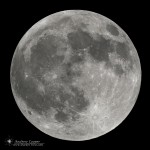
Jupiter will pass through opposition at 10:58HST today.
Jupiter and the moons Europa, Ganymede and Callisto (left-right)Jupiter orbits the Sun once every 11.86 years. As the giant planet continues on its way the Earth swings around much faster on our inside track. As a result we lap Jupiter once every 399 days, passing between the planet and the Sun. During opposition Jupiter will rise at sunset, transit at midnight, and set at dawn. This makes the planet available for observation for the entire night.
Look for a bright object rising in the eastern sky after sunset. It is difficult to mistake for anything else, shining at it’s brightest during opposition, a brilliant -2.7 magnitude. For the remainder of the spring and much of the summer, the planet will be quite prominent in the evening sky.
Often you just need to take note of the small scenes that make up daily life. Over the years I have made an effort to photograph these scenes, there is so much richness in our everyday existence that too many do not notice…
A tiny portion of the extensive cabling that connects the various elements of the Keck Interferometer
A dense bit of temporary wiring in the Keck 2 SAA cabinet
A scatter of tools at CSO
Racks of wire available for use in the Keck summit electronics lab
Analog ammeters indicate the motor current
Multiple cables enter the Keck 2 Adaptive Optics bench.
The control panel for the telescope hydraulic bearing system pumps
Electronics test leads and patch cables hanging from the rack in the Keck summit electronics lab
An electrician’s tool bag, complete with lockout tag
A set of tools ready for use on the Keck 1 nasmyth deck
The many cables needed to operate the Keck 2 telescope thread through the azimuth wrap.
A bank of relays form the safety interlock system for the telescope.
Spools of wire await use in the electronics shop
Bins full of stainless steel machine screws in the supply room
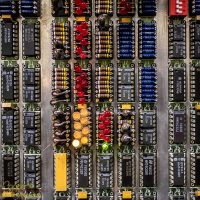
Part of the Keck 2 logic board, this PCB assembly controls the various control and safety logic for the Keck 2 telescope.
Tools and drawing lay on the table in the welding shop
A pile of power drills await use on a shelf in the supply room
A handheld radio used at Keck for daily communication.
A tangle of cables for the Keck 2 optical bench subsystem
The new telescope control system servers take up much of a rack
A collection of keys
Bins of bolts in the Keck supply room
Hard hats ready for use just outside the Keck 1 dome
A pile of 3/8″ air hose in the supply room
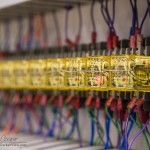
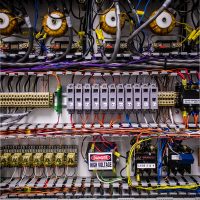
Fuses, relays, and contactors in the Keck 2 telescope control system
A sample of the control wiring and circuitry in the Servo Amplifier Assembly
The facility cooling lines that supply cold water to the K2AO electronics vault.
Looking at the back of a segment with the radial support removed
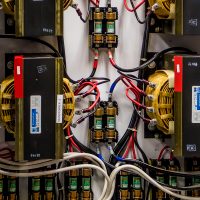
The transformers for the Keck 2 telescope servo drives
A distribution video amplifier built around a THS7324
The Nasmyth Deck tool set in the Keck 2 dome
A section of the whiffle tree that supports each Keck primary segment
A Keck primary mirror segment jacked up out of the array
A row of circuit breakers in the Keck 2 computer room
An assortment of cable pass through the Keck 2 telescope elevation cable wrap
The usual mess littering a workbench in the Keck summit electronics lab in the midst of a project
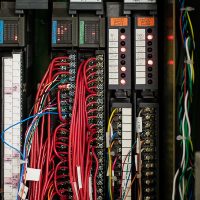
I/O cards and field wiring in the Keck 2 local controls PLC
Patching in an experimental control system to move the Keck 1 telescope, one step closer to a major upgrade.
The bright planet Venus will appear in the dawn sky over the next couple weeks, climbing higher to become the morning star for the remainder of 2017. It is currently 15° from the Sun and shining at magnitude -4.3, bright enough to be seen against the dawn sky. It will reach maximum elongation on June 3rd, 46° ahead of the rising Sun.
I took a break from working with a “big” microcontroller to work with a little one. The PIC12C671 is definitely little when compared with the PIC18F66K80 I am using in the GenPIC utility PCB. With less than 2k of program space and a mere 128 bytes of RAM it is definitely limited. Consider that the chip only has eight pins, two of which are power and ground, leaving six I/O pins to get the job done. No problem, I only need two I/O pins for this task and that few bytes of RAM is more than enough!
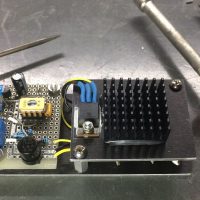
A simple heater using a bang-bang controller.This project is pretty basic… A bang-bang heater controller. This simple form of controller simply turns on and off as the temperature (or some other controlled parameter) goes up and down, there is no attempt to vary the output, all or nothing. Bang on, bang off, or simply a bang-bang controller as it is known in the trade.
A bang-bang controller is inherently reliable and stable because it uses two different control setpoints, a high and a low. Because these control points are separated by a large margin, called hysteresis, the controller will not oscillate or rapidly turn on and off. In this case the heater will not turn on until the temperature falls below 10°C and will not turn back off until the temperature rises above 15°C. That five degree margin is called hysteresis, and ensures a good period of time between on and off.
Today Mercury will be at maximum eastern elongation, as high in the evening sky as it will appear for this current apparition. After today the planet will slide back into the sunset, passing through inferior conjunction on April 19th to reappear in the morning sky around the end of the month.
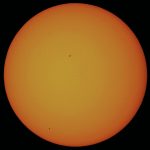
Mercury transiting the Sun on May 9, 2016. Celestron C8 and Canon 6D at f/10.Mercury typically completes three morning and three evening apparitions in each year. While the innermost planet never gets very far from the Sun, maximum elongation represents the best time to observe Mercury as high in the sky as possible.
There are no transits of Mercury in 2017, the next will be Nov 11, 2019.