The vernal or spring equinox occurs today at 00:29HST. Today there will be little difference between the length of the night when counted against the number of daylight hours. This is the first day of spring as marked by many cultures in the northern hemisphere.
When 700 tons of steel and aluminum just keeps going when it is commanded to stop people tend to notice. When you let up on the switch it is supposed to stop, when that something is the Keck 1 telescope dome it gets interesting.
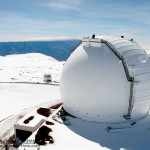
Looking across at the Keck 1 dome from the top of Keck 2 with Mauna Loa in the backgroundThe first I knew about it was from John, our summit supervisor on the phone. Actually he had several folks on his end using the speakerphone, never a good sign when a phone call from the summit starts this way.
Three people describing a problem on the phone is a bit confusing, it takes a few minutes, and a few questions before I have a clear idea of what happened. Basically the dome did not stop when commanded to while they were operating with the radio controller, a bit of kit we call Capt. Marvel.
Of course a few minutes later our safety officer walks into my office… I wonder what she wants to talk about?
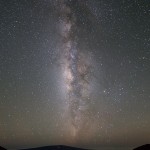
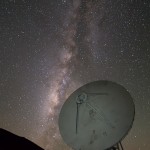
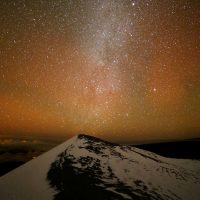
The summer Milky Way soars over the VLBA antenna atop Mauna Kea
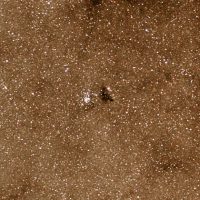
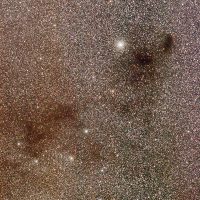
B72, the Snake Nebula, single 8 minute exposure at ISO 800, Canon 20Da DSLR camera mounted on a Televue-76 APO telescope with a 0.8x focal reducer/field flattener
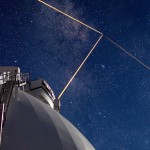
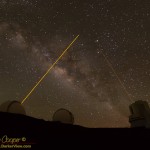
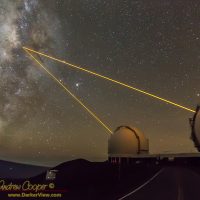
Three AO lasers aimed at the center of our Milky Way galaxy, the lasers are from both Keck 1 and Keck 2 as well as the Subaru telescope
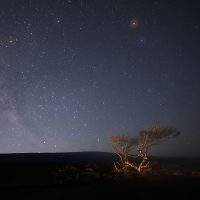
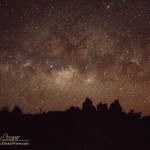
The rising Milky Way silhouetting and old a’a lava flow on Mauna Kea, Canon 60D @ ISO12800, 17mm f/4, eight 10 second frames aligned and averaged
Both Keck lasers aimed at the center of the Milky Way galaxy
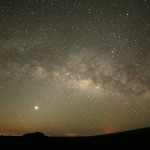
The rising summer Milky Way, Mars and dawn over Mauna Loa
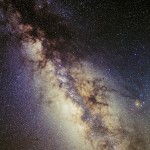
The central Milky Way from Mauna Kea, 37 x 30sec, Canon 6D w/24-105mm- f/4.5 @ ISO6400
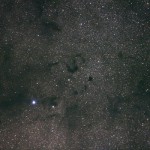
Baade’s Window, single 8 minute exposure at ISO 800, Canon 20Da DSLR camera mounted on a Televue-76 APO telescope with a 0.8x focal reducer/field flattener
A bright summer Milky Way shines over Mauna Loa
The Lagoon, M8 and the Trifid, M20 nebulae in Sagittarius
Venus and the summer Milky Way rising over Pu’u Huluhulu
The cluster NGC6520 and the dark nebula B86 lost in the immensity of Baade’s Window
The globular cluster M9 next to the dark nebulae B64
Horizon panorama from Ka’ohe, on the side of Mauna Kea
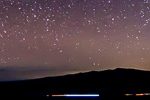
The Keck 2 and Subaru lasers cross the Milky Way above Mauna Kea
The winter Milky Way over the summit of Mauna Kea, Canon 6D and Samyang 14mm f/2.8 lens, 30s at ISO 6400
We have been having a lot of short network dropouts lately, something that is rather troubling when playing online games.
The GUI for a little ping tester tracking the stability of our household internet.I was wondering just how prevalent the issue is, just how good or bad is the service at any given moment. I know I can download any number of network testing utilities, but what is the fun in that? Maybe just write something!
The little app is a Python/Tk gui. It simply pings an IP address and plots the results. The program is nothing serious, but it does the job. I have included the Python code below, a simple example of a Tk GUI.
The code is written for Python 3.5 or better as it uses the subprocess.run() method that was introduced with 3.5. This method just makes getting the stdio output so much easier. There are native ping libraries available for Python, they do require running the script in administrator to allow low level socket use. By using a subprocess I avoid that, if not quite as neat a solution.
Any IP address can be pinged, I am currently using 8.8.8.8 which is a Google DNS server. Using this server pretty much guarantees the issue is the local network, not an issue at the server end.
The results? Our local net is not looking too bad. There are periods when a cluster of dropouts occur, each lasting a minute or two. You can see one of these on the screen cap above. Fortunately these are unusual and not the norm… At least so far. I may update that evaluation when I get more data.
First word came through a mountain staff mailing list used to let everyone know about safety conditions of the mauna…
A wrecked Toyota pickup truck about a mile below Hale Pohaku
Hawaii police dept. requests the public to avoid the Maunakea access road for the next 4 to 6 hours due to a major traffic accident. This accident is below the VIS on the access road. One lane is currently open going down the road.
– Mahalo from the VIS staff
Reading between the lines it is quickly obvious that this was a fatal accident and the police are doing a full investigation, the usual reason for such a long closure. Sure enough a notification soon came through the local emergency services alert system on my phone…
AVOID the Mauna Kea Access Road for the next 4 to 6 hours due to a major traffic accident. The entire roadway above the visitor center is closed while police conduct an investigation. – HPD Notification
A few more details showed up as messages flew back and forth on Facebook, this really is a small island sometimes. Knowing I would be up the next morning I expected to get the details first hand at breakfast.
A trip past the sun may have selectively altered the production of one form of water in a comet – an effect not seen by astronomers before, a new NASA study suggests.
Comet C/2014 Q2 Lovejoy passing by the Pleiades star clusterAstronomers from NASA’s Goddard Space Flight Center in Greenbelt, Maryland, observed the Oort cloud comet C/2014 Q2, also called Lovejoy, when it passed near Earth in early 2015. Through NASA’s partnership in the W. M. Keck Observatory on Mauna Kea, Hawaii, the team observed the comet at infrared wavelengths a few days after Lovejoy passed its perihelion – or closest point to the sun.
Scientists from NASA’s Goddard Center for Astrobiology observed the comet C/2014 Q2 – also called Lovejoy – and made simultaneous measurements of the output of H2O and HDO, a variant form of water. This image of Lovejoy was taken on Feb. 4, 2015 – the same day the team made their observations and just a few days after the comet passed its perihelion, or closest point to the sun.
Several hours without transportation. My vehicle is in the transmission shop for a checkout, have been having some rough shifts. Stranded for the morning without wheels in the old industrial area I had no intention of sitting in the shop’s waiting area for a few hours.
Looking down the old runway at the Old Kona Airport Recreation AreaJust up the coast from the old industrial area is a large beach park. Called Old-A’s or Old Airport, it is the site of the original landing strip just north of town. Abandoned when the jet age rendered this airstrip far too small. The area was used for a while as a drag-strip, the old airport was eventually converted to a park. The old terminal building was renovated into a multi-use pavilion. The old runway is still there, now an enormous parking lot that fronts the rocky shoreline along one side and a community garden on the other.