Over the next week Venus will be lost to the Sun’s glare. It is currently about 15° east of the Sun, but getting closer quite quickly now and becoming tough to spot in the sunset. The planet will pass through inferior conjunction on March 25th. The planet will appear in the dawn sky around mid April. When it does appear, it will spend the remainder of 2017 as the morning star.
Venus approaching inferior conjunction, 24Dec2013Even when low in the sunset, Venus is worth picking up in a telescope. As the planet approaches inferior conjunction it shows an ever more crescent appearance to our earthbound vantage point. During the last days of visibility it will be a razor thin crescent, worth the effort to look.
Today Mercury will be at superior conjunction. After today the planet will reappear in the evening sky, rising high enough from the Sun’s glow to be seen around the end of the month.
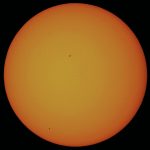
Mercury transiting the Sun on May 9, 2016. Celestron C8 and Canon 6D at f/10.Superior conjunction is when the planet passes around the far side of the Sun as seen from Earth. For a few weeks the planet will be lost in the Sun’s glare, hidden from view.
As Mercury is on an orbit inside that of Earth’s it will see both inferior and superior conjunctions as it passes from the evening sky to the dawn sky and back again.
When two bodies of fluid are moving in different directions interesting things happen at the boundary. The result is usually some sort of wave… Waves on the surface of the ocean or waves in the sky.
Waves on the sea surface are easy to see. Waves in the sky? Not so much. These waves are only betrayed if clouds form in the waves, revealing these structures.
Kelvin-Helmholtz Waves in the Saddle with Mauna Loa in the background. Photo by Joe Gargiulo, used with permissionThis sort of wave is called a Kelvin-Helmholtz wave after Lord Kelvin and Hermann von Helmholtz who first investigated how these waves form. Yes this is the same Kelvin for whom the units of temperature are named. KH waves are visible all around us for those who know to look, from the surface of our ocean to the clouds of Jupiter, these characteristic swirling patterns are seen.
In the Saddle region over Mauna Kea and Mauna Loa, there are usually two air masses moving in different directions. Below the inversion level the tradewinds push westward. While above the inversion level, usually about 6-7,000ft, the upper air moves to the east. Where these two meet there are often KH waves, and occasionally some clouds to outline these fascinating structures.
We are now in March, looking back to October when the TMT contested case began. Five months of hearings endlessly repeating the same details about every aspect of the case.
Yes… My patience has run out long ago.
Retired Judge Riki May Amano presides over the TMT contested case hearingAfter all that has been said and done it is clear that the actual substance of the case could have been thoroughly discussed in a couple weeks, not five months.
Among the endless hours of testimony there have been occasional moments of fireworks. We have heard wild theories, mangled science, inexcusable ignorance, evidence of unemployment claims fraud, and several very likely incidents of outright perjury by telescope opponents.