
Argiope
When you want to see the stars, find someplace dark

The Canon EOS M5 is the latest offering by Canon in the mirrorless form factor. Offering the same sensor and much of the performance of the mid-range DSLR’s, the mirrorless bodies are far smaller. This allows the photographer the chance to use these cameras in places a full sized DSLR would be too cumbersome.

I am a veteran of the original M and the M3, carrying both cameras extensively. From Nicaragua to Alaska, and around the islands, I have used these little cameras to capture some excellent images.
I had issues with the original, returning my first copy. I eventually gave the camera another chance and have learned to like the capability the cameras provide a mobile photographer. I carry the camera on the job atop the incomparable Mauna Kea, a place where you always want a camera handy!

The critics have not been kind to the previous M series cameras. While they are decent cameras, offering excellent photo quality, they have lagged behind the competition, particularly the Sony mirrorless, on the features.
The M5 marks a change in this, several reviews from the key sites note that M5 performance and features places it among the best on the market in terms of features and cost. The comment echoed by several critics… This is the camera Canon should have built to start with.
Yeah… I wanted one.
A new device on the W.M. Keck Observatory in Hawaii has delivered its first images, showing a ring of planet-forming dust around a star, and separately, a cool, star-like body, called a brown dwarf, lying near its companion star.

“The vortex coronagraph allows us to peer into the regions around stars where giant planets like Jupiter and Saturn supposedly form,” said Dmitri Mawet, research scientist at NASA’s Jet Propulsion Laboratory and Caltech, both in Pasadena. “Before now, we were only able to image gas giants that are born much farther out. With the vortex, we will be able to see planets orbiting as close to their stars as Jupiter is to our sun, or about two to three times closer than what was possible before.”
W. M. Keck Observatory press release…
Astronomers have just made a new measurement of the Hubble constant, the rate at which the universe is expanding, and it doesn’t quite line up with a different estimate of the same number. That discrepancy could hint at “new physics” beyond the standard model of cosmology, according to the team, which includes physicists from the University of California, Davis, that made the observation.

Led by Sherry Suyu at the Max Planck Institute for Astrophysics in Germany, the H0LICOW team used the NASA/ESA Hubble Space Telescope and other space- and Earth-based telescopes, including the Keck telescopes in Hawaii, to observe three galaxies and arrive at an independent measurement of the Hubble constant. Eduard Rusu, a postdoctoral researcher at UC Davis, is first author on one of five papers describing the work, due to be published in the Monthly Notices of the Royal Astronomical Society.
Continue reading “Astronomers Measure Universe Expansion, Get Hints of ‘New Physics’”

Look for the trio in the western sky this evening just after sunset, it will be nearly impossible to overlook. You have plenty of time to enjoy the show as the trio will not set until around 9:30pm.
With the Moon only a few degrees from Venus this afternoon, it should be relatively easy to spot the brilliant planet long before sunset.
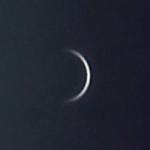
Today the Moon will aid finding Venus in the sky as it is about 5° north of the Moon. Having the Moon nearby will not only aid in locating the Planet, it will also provide your eyes something to focus on.
Of course these bright objects will be even more dramatic after sunset when Mars will also be visible nearby.
The Moon is approaching the pair of Venus and Mars, tomorrow will see the trio in close proximity, forming a triangle of about 5° separation.

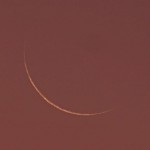
W. M. Keck Observatory News Release…
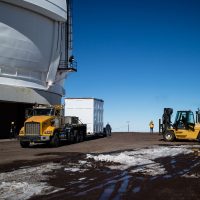
Keck Observatory is pushing the cutting edge of scientific discovery with the addition of the world’s most sensitive instrument for measuring the tendrils of faint gas in the intergalactic medium known as the cosmic web. The 5-ton instrument, the size of an ice cream truck, is named the Keck Cosmic Web Imager (KCWI). KCWI will uncover vital clues about the life-cycle of galaxies, helping to unravel mysteries about our universe.
“For decades, astronomers have demonstrated that galaxies evolve. Now, we’re trying to figure out how and why,” says Martin, describing the potential of this instrument. “We know the gas around galaxies is ultimately fueling them, but it is so faint – we still haven’t been able to get a close look at it and understand how this process works.”
The design of KCWI is based on its predecessor, the Palomar Cosmic Web Imager. KCWI will be installed on one of the twin 10-meter Keck Observatory telescopes, the largest optical/infrared telescopes in the world. The telescopes’ location on Maunakea provides the most pristine viewing conditions in the world for this science. This unbeatable combination of technology and location will enable KCWI to provide some of the most-detailed glimpses of the universe ever, including the study of gas jets around young stars, the winds of dead stars and even supermassive black holes.
“The best location in the world for astronomy calls for the best tools for astronomy,” said Hilton Lewis, director of the Keck Observatory. “With KCWI on the world’s largest telescope, we are well positioned to develop our understanding of the evolution of galaxies by capturing high-resolution spectra of some of the faintest, most difficult to study objects in the universe in ways never before possible.”
KCWI arrived by ship from Los Angeles on January 20 and was carefully transported up to the observatory atop Maunakea. The instrument will be installed and tested, followed by the first observations in the coming months.