
Sealion Cove
When you want to see the stars, find someplace dark


Being an inveterate volcano watcher, I have not only been watching the new flow on Kilauea, but keeping a wary eye on Mauna Loa as well. The USGS has steadily been increasing the alert level on this largest of the Hawaiian volcanoes over the last year.
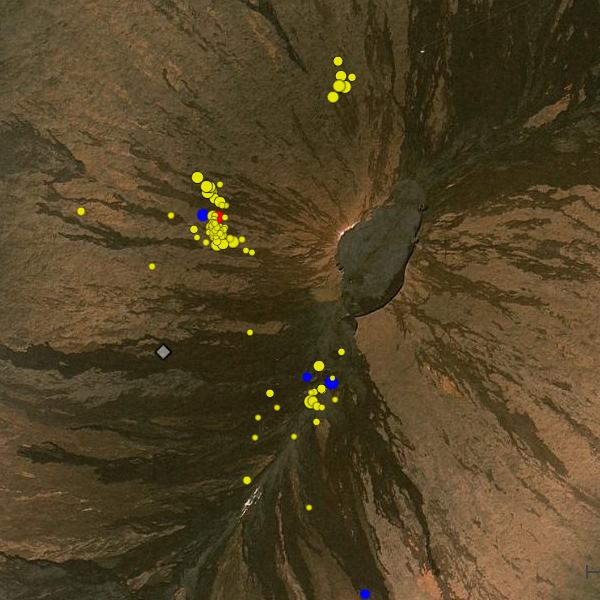
On this unstable rock we live, we get a fair number of earthquakes. Of course not every bump you feel is seismic, sometimes it is just a big truck on the highway. You look on the USGS Recent Earthquakes page anyway, just to see what it was. Not this time, must have been a truck. While I have the page loaded I look about… Wait? What is that cluster on the NW flank of Mauna Loa? I do not remember seeing that before!
For the last year or more there has been a steady cluster of small earthquakes just to the southwest of the main caldera. This notable cluster is usually visible when you stop by the earthquake page and indicates magma motion below the summit. It is a big part of why the USGS has upped the advisory level. The cluster on the west flank looks new to me, a lot of small quakes, some deep, some as shallow as 600m.
I am sure someone over at the USGS is looking at the same cluster and asking the same questions. Maybe they have better answers, but they have not published anything yet. Maybe, like so many times before this cluster will fade away, not to appear again. It is however a reminder that magma is moving down there, the mountain is swelling, someday she will erupt again.
Today I will be driving up and down the mountain. I know I will be looking across the saddle at the looking bulk of Mauna Loa and wondering for the thousandth time. Will I see an eruption from her during my years on island?
The Sealion Cove trail is a beautiful hike over remote Kruzof island north of Sitka, Alaska. The only way to access the trailhead is by boat or seaplane. The trail starts on Kalinin Bay, passes through a small pass between two mountains and then drops down to the Pacific Ocean and the beautiful beach at Sealion Cove. At the midway point, in the pass, is a small and apparently unnamed lake.

The first section of the trail follows the shore of the wide estuary that drains into Kalinin bay. The trail follows the treeline where the high tides and saltwater prevent the spruce from encroaching further. While there has been some effort to improve the trail here, with gravel spread and rock strategically placed at the many small streams, the effort looks to be futile. Deep mud pockets sucked at our feet and required careful footing. The dry socks in my pocket were obviously going to stay in my pocket, my river sandals often full of mud.

Not a call I want to get just a few hours before our astronomy club meeting… My presenter for the evening? Tooth extraction?

The West Hawaii Astronomy Club is not a large club, more than a dozen folks is a big meeting. Still, these are dedicated amateur astronomers that can be relied upon to help out with school star parties and observatory events. They have driven all the way to Waimea because I promised them a lecture from an astronomer. A few folks come from Kona 45 minutes to an hour away. I really want to give them something worth the effort of getting here.
They will just have to settle for a talk with Andrea Ghez.
Yes, that Andrea, the closest thing we have to a superstar in astronomy. Discoverer of the black hole at the center of our galaxy, winner of the Crafoord Prize and the Bakerian Medal… That Andrea.
I ran into Andrea at dinner next door to the observatory, we know each other from other outreach events and swapping photos. She is a regular Keck observer with research that concentrates on the massive black hole at the core of our Milky Way galaxy. I asked her if she could come talk with the club, or rather I begged a bit. Being the gracious lady she is, she said yes. Thanks Andrea!!
It was so much better than the warmed over presentation I had thought I would be giving this evening. The small group allowed something closer to a conversation than a lecture. There were some good questions too! We moved past the basics pretty quickly with a group that knew more than a little about the subject. I found the evening very informative, I think everyone did.

The 2016 Pacific hurricane season has begun in earnest with Hurricane Celia spinning away east of the islands. This storm is predicted to weaken and pass just to our north, but it is a reminder that there will be further storms. Hurricane Darby is right behind and there are new depressions forming that will most likely spawn new storms. The question is how many letters in the alphabet can we go through this year? Need to go through our storm preparation checklist again.

The two inner planets will rendezvous in the sunset over the next few days. Venus appeared in the sky a few days ago having just emerged from superior conjunction. Mercury will emerge quickly from the solar glare to pass Venus only 10° from the Sun. This conjunction will be quite low and a bit in the bright glow of sunset, perhaps somewhat challenging to spot.
This evening the two will be about 2° apart, and will quickly converge. On July 16th the two will be only 32′ apart, about the diameter of a full Moon. After that the two will quickly separate. Interestingly on the 17th the pair will pass through the M44 star cluster, though perhaps it will still be a bit bright to appreciate this dimmer cluster.
Late in the month this trio of bright planets will continue their dance in a set of conjunctions that lasts into September. The highlight will be on August 27 when Jupiter and Venus will pass within 12′ of each other while Mercury is only 5° away.

