
Mauna Loa and Mamane
When you want to see the stars, find someplace dark


An impassioned argument is one thing. I realize that tempers can flare and some people may say things that they might otherwise not say. But strong emotion can also reveal the truth behind the facade that we all maintain. What is revealed under stress can be our finest or our worst.

My thanks to Ian Lind for covering this on his blog as well as posting the response from the Mauna Kea Hui. Sorry, this sort of behavior must be called out and condemned by those on both sides of the discussion.
A lot of emotion and bandwidth has been swirling around our mountain this past month. It has been unfortunate that two otherwise positive forces have collided atop one summit. Last night the local community had a chance to listen to various perspectives in a more personal and reasoned forum. The Honokaʻa Peoples Theater, located on the slopes of Mauna Kea is the perfect place for this to happen. An evening of face to face discussion.

The format was simple, a presentation by Hāwane Rios, explaining her perspective on growing up in the traditions of Mauna Kea. This was followed by a presentation by Doug Simons, executive director of the Canada-France-Hawaii Telescope. After a 15 minute intermission there was another hour of panel discussion with questions provided by the audience. What started at 6pm went on until well after nine, with personal conversations that kept the theater a buzz until well after 11pm.
Unfortunately one of the featured speakers Lanakila Mangauli was unable to attend, having flown to Oahu for a hasty meeting with OHA and state officials. He was not completely absent, a Skype connection projected on the theater screen allowed him to give a short presentation at the start. After having watched video of his tirade (Yes, I will call it that!) at the TMT groundbreaking ceremony, I had been given a somewhat less than flattering opinion of him. The person who addressed the audience this night was much more impressive, giving an intelligent and reasoned argument to his cause. I wish he had been able to address the audience in person.

Doug Simons also related his personal connection to the mountain, having spent the last 30 years working, hunting and raising his family here in Waimea and on Mauna Kea. Starting with the great discoveries that have been accomplished by the telescopes atop Mauna Kea, Doug did an admirable job of covering the importance of the research done at the telescopes and why these great instruments belong to all of mankind.

I spent the evening listening and operating a production video camera we had brought over from Keck. CFHT, Subaru and Keck staff operated a battery of audio/visual gear, live casting the event on YouTube, recording video for later editing and managing a Skype connection for Lanakila. I expect we should have good videos up shortly, they are definitely worth watching by anyone interested in the issues surrounding our mountain. The presentation by Hāwane should be worth watching just to hear her sing. I will put the links here as soon as they become available.
Update… Check out the video here.


A small shrub, most of the specimens I have seen are one to two feet high and a few feet in diameter. The leaves are ovate with linear veins and a forked tip.
The name is partially shared with the silversword found higher on the mountain, as hinahina means silver in Hawaiian. Several silvery plants share the common name hinahina across the islands. I prefer the name ʻāhinahina for the silversword and reserve hinahina for this pretty little geranium.
Dennis likes to go out on Sundays… I go when and where the boat goes, no complaints! Any day on the water is a good one.
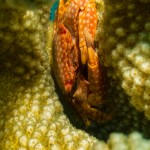
I also had a new toy along, a Sola Photo 800 dive light. I am really interested in improving my underwater video, thus looking forward to using this new light.
Reaching the dive site we encountered a problem… No mooring to be found. We had the correct coordinates, but multiple passes with everyone on the bow failed to spot the ball. Thus we dropped Mark in the water to take a look, he spotted the cable lying on the bottom, the mooring ball was gone. Off we headed for another dive site.
We ended up diving Carpenter’s instead. Not a bad choice, this is a nice area with a lot of topography to explore. Large coral pinnacles reach from depths of 40′ to near the surface, with a few canyons and shallow caves to add to the terrain.
I can not say I found anything unusual or new. Just a nice dive with lots of fish. It appears to be a good recruitment year, a lot of juvenile fish about. This included several dragon wrasse to chase through the coral rubble with the camera. I love how they swim, somehow going in the direction they desire without appearing to move. Seeming to just drift like the piece debris they attempt to mimic as camouflage.
Despite the shallow dive site we dove the nitrox anyway, the tanks were rented and needed to be returned full or empty. No nitrogen lethargy after these dives! Everyone was ready to go for more, nitrox really does keep you from feeling the after effects of the dive.
Trying not to take it for granted just how good we have it here on the island. As we cruise back to harbor we are enjoying the sunlight on the bow and talking about life. The conversation turns to just how miserable life can be in much of the world. We look about and make a point to notice… Life is good here.

On May 9th, 2016 Mercury will transit the Sun. While transits of Mercury are not rare, they are not all that common either. The last transit was almost a decade ago in November of 2006. On average there are fourteen transits of Mercury each century or one every seven years. If you wish to observe one the situation is much better than transits of Venus which occur in pairs over a century apart.
This particular transit will favor observers in Europe and North America where the entire transit will be visible. Unfortunately for observers in the islands only the final three hours of the transit will be visible having begun well before local dawn. Sunrise will occur around 05:48 for the island of Hawaiʻi, with the transit ending at 08:42 in the morning.
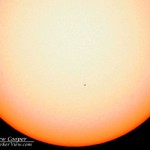
| Mercury Transit May 9th, 2016
|
||||
|---|---|---|---|---|
| UT (geo) | HST | HST (offset) | ||
| First Contact | 11:12 | 01:12 | –:–:– | |
| Second Contact | 11:15 | 01:15 | –:–:– | |
| Greatest | 14:57 | 04:57 | –:–:– | |
| Third Contact | 18:39 | 08:39 | 08:39:58 | |
| Fourth Contact | 18:42 | 08:42 | 08:43:10 | |
| Source: NASA Eclipse website | ||||
First contact is simply the first moment that the disk of Mercury begins to impinge on the disk of the Sun. Second contact will be the moment when Mercury is entirely in front of the Sun. Third and fourth contacts are a reverse of first and second with fourth contact as the end of the event.
Observing a planetary transit of the Sun requires proper eye protection. If you can not look safely, do not look! The Sun can cause permanent eye damage if viewed without proper protection. As Mercury is quite small some magnification will be useful in observing this event, a telescope of binoculars with a solar filter. A pinhole camera can be made out of things lying around in your kitchen that provides a very good image. Read my Guide to Safe Solar Viewing for a lot more information on viewing the Sun safely.
The next transit of Mercury will occur November 11, 2019 at 15:20UT (mid-transit). This next transit also favors Europe and eastern North America where the entire transit will be visible.
The planet Mercury is starting an evening apparition. The planet should become visible this week just above the fading glow of the setting Sun as a magnitude -1 object. The planet is moving about 1° further from the Sun and higher in the sunset each day, reaching a maximum elongation of 21° on May 6th.
