
Computer Room at Night
When you want to see the stars, find someplace dark

Some parts of the job are simply fun. Installing the various upgrades to the weather system has been just that. The latest piece of kit being more fun than usual.
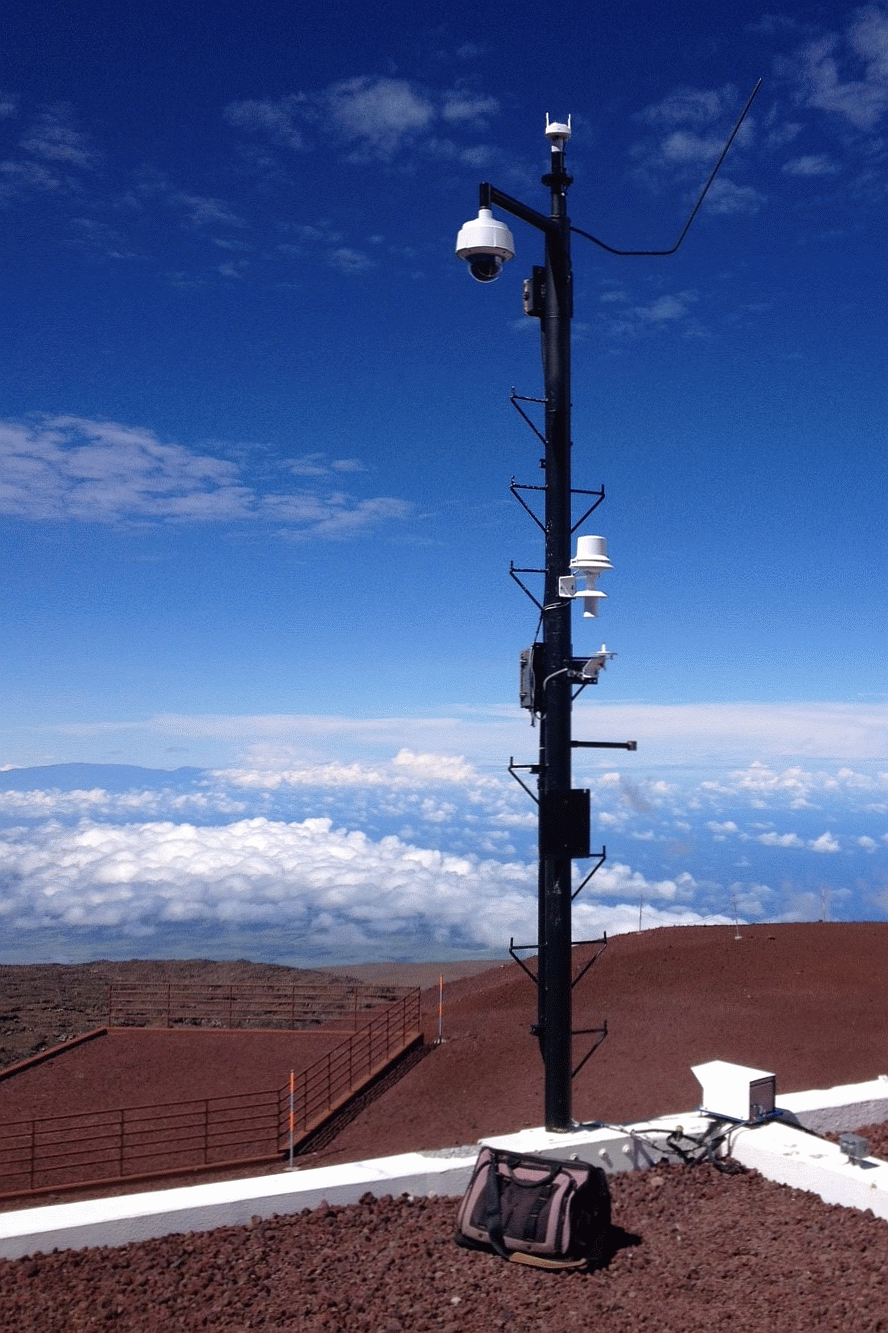
Even that is topped by the camera I installed this fall. The latest camera is a new pan-tilt-zoom camera attached to the weather mast.
The camera does have more prosaic reasons to justify the effort of installing it. With the camera the operators can observe the weather conditions around the telescope, observing supervisors can view the ice and snow on the domes from Waimea, the day crew can check the weather conditions before driving to the summit, and more. The camera does have enough sensitivity to see the brighter stars and the banks of fog that roll over the summit. In full dark and at full gain the image is noisy and faint, not all that great. Given just a little moonlight the performance is much better, allowing visibility of oncoming clouds.
Even more fun! On Christmas Eve I was contacted by Hawaii News Now for photos of the storm, they were eager to do something about a white Christmas for the evening news. As I had not been to the summit and no one on our crew was up, I simply grabbed some MastCam images and forwarded them. The images were aired in the first couple minutes of the Honolulu evening news!
The camera is not available to the public, it would be too much wear and tear to the pan-tilt mechanism and a huge hog of bandwidth. You have to be inside the Keck network to use, from there it is available to anyone on staff. It has proven quite popular, with many folks using the imagery to check on mountain conditions in the latest bad weather.
Next up, yet more cameras in the dome and even a couple on top of the domes. there is also a precipitation sensor and more in the works for the weather station.
OK, enough fun, back to revising the Keck 2 dome schematics.
My wife noticed the swarm of small objects in the remains of the web. She just did not realize that the little dots were tiny spiders…

Mercury and Venus will be in a close conjunction this evening. While the pair has been drawing closer for the last week, tonight will see them at their closest, about 38′ separation.
Look for the bright planet Venus low in the sunset. Mercury will slightly down and to the north of Venus. A separation of 38′ is just a bit more that the width of the full Moon. Both objects are fairly bright, with Venus shining at -3.9 magnitude and Mercury at -0.7. Bright enough to be quite obvious, the pair will be 17° above the horizon at sunset.
Over the coming week the pair will slightly separate. Mercury will be at maximum elongation on January 14th, after which it will begin its slide back into the sunset.
W. M. Keck Observatory press release…
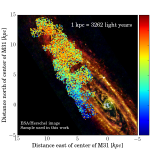
The structure and internal motions of the stellar disk of a spiral galaxy hold important keys to understanding the galaxy’s formation history. The Andromeda galaxy, also called M31, is the closest spiral galaxy to the Milky Way and the largest in the local group of galaxies.
“In the Andromeda galaxy we have the unique combination of a global yet detailed view of a galaxy similar to our own. We have lots of detail in our own Milky Way, but not the global, external perspective,” said Puragra Guhathakurta, professor of astronomy and astrophysics at the University of California, Santa Cruz.
The new study, led by UC Santa Cruz graduate student Claire Dorman and Guhathakurta, combined data from two large surveys of stars in Andromeda conducted at the Keck Observatory in Hawaii as well as data from the Hubble Space Telescope.
Continue reading “Comprehensive Andromeda Study Hints of Violent History”
The storm that deposited a heavy layer of ice on Mauna Kea has kept Keck Observatory shuttered for a week now. The last night we observed was New Year’s Day. Despite clear skies, there was just too much ice on the domes that could come crashing in on the telescope if we attempted to open. For a few days the Keck II dome was frozen in place by a pile of solid ice against the lower skirt.
We just got word that day crew, with a little solar help, has cleared the worst of the ice from the domes and we will be observing tonight.

This photo is getting a little comment, no surprise, it is hilarious. When I stopped at park two to look around I had no idea and when I saw it I broke out laughing. Alone on the side of an ice covered mountain, laughing loudly with no one to hear but the wind…

Over the next week Mercury and Venus will rendezvous in the sunset. This evening will see the two separated by 48′, well under one degree. This will close to about 38′ on the evening of January 10th, just a little over the width of a full Moon apart. Both objects are fairly bright, with Venus shining at -3.9 magnitude and Mercury at -0.7. Bright enough to be quite obvious, the pair will be 17° above the horizon at sunset.
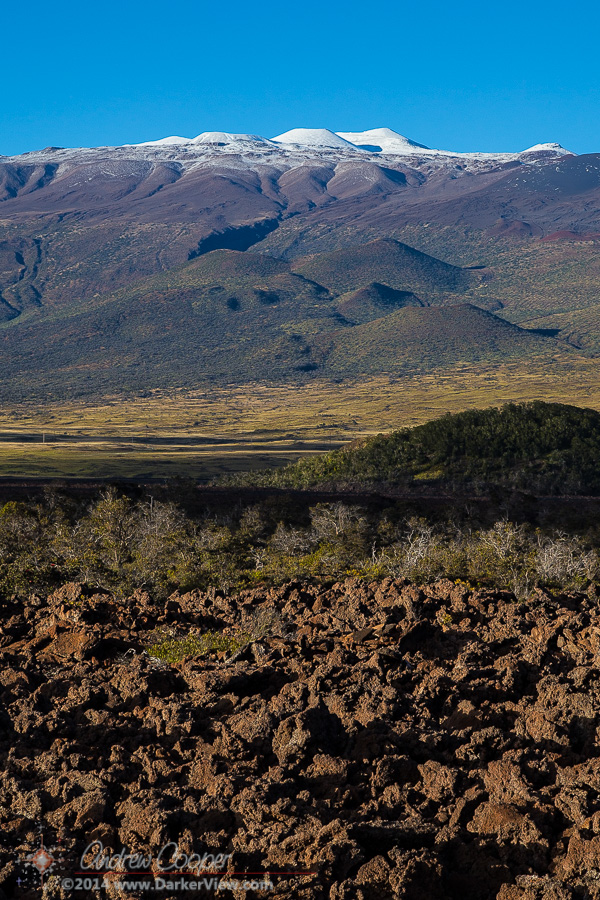
The instruments were warming up. Liquid nitrogen exhausted, cooling interrupted by loss of power, the cryogenic dewars had begun to warm. Recovering instruments takes many days of vacuum pumps and re-cooling to restore function if cooling has been loss. Other problems caused by the storm and power outages plagued the summit, some systems not responding to remote queries.

Sunday offered at least a hope of making it to the summit. The storm had abated and beautiful sunny skies appeared over the summit. We readied for an attempt at the summit of Mauna Kea. As the engineer on call I would join the support techs at the summit. Maybe we could salvage something from the chaos.