All Pau

Living in Hawaiʻi you pick up a few additions to your vocabulary. For centuries the islands have been a stew of languages, each borrowing words from one another. Hawaiian, Portuguese, Chinese, Japanese, English, Spanish and more have all added to the flavor of these islands. Everyone uses a few words from other languages in everyday conversation. Then there are local folks who grew up speaking the full mixture, a pidgin unique to the islands.
Radio
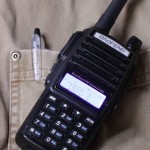
A handheld radio used at Keck for daily communication.
Working with a bunch of island guys you need to learn a bit of pidgin simply to understand the conversations around you. To an English speaker, such as myself, the syntax seems mixed about. The words are mostly English and Hawaiian, with a clear context and a little exposure you begin to pick it up. After a while it seems natural to hear pidgin around you.

Some of the words that Hawaiian supplies seem much better than the English equivalents, it is understandable that they are used in preference to the English words. Some are simply more appropriate on an island… Mauka and Makai make perfect sense where everything is either towards the mountain or towards the sea. Puʻu us the perfect name for the numerous volcanic hills that dot the island. Puka, for small hole, just sounds right.

My favorite is Pau, meaning finished or done, a word that is commonly heard on the Keck radio channels. “How are you guys doing up there?” might go the radio chatter, “We all pau!” Something about the word just works, the sound and the meaning in agreement.

I expect these words will stay in my vocabulary, alongside British expressions I picked up living in England decades ago. Language is a fluid and dynamic thing, part of the richness of our lives.

Unintended Photos

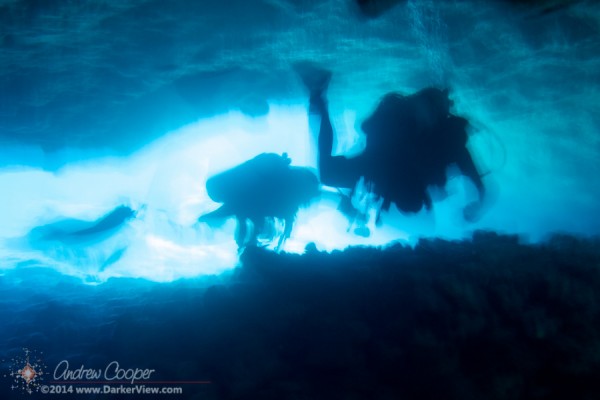
Sometimes the photo does not quite work as planned. Turn to shoot the guys following me into a cave, except that the flash does not fire… It helps to turn it on. Expecting the result to be a discard, I am surprised to see a rather interesting photo…

Entering the Cave
Divers entering a cave, accidental long exposure as the flash did not fire.

Mysterious G2 Cloud Near Black Hole Identified

W. M. Keck Observatory press release

The mystery about a thin, bizarre object in the center of the Milky Way headed toward our galaxy’s enormous black hole has been solved by UCLA astronomers using the W. M. Keck Observatory, home of the two largest telescopes on Earth. The scientists studied the object, known as G2, during its closest approach to the black hole this summer, and found the black hole did not dine on it. The research is published today in the journal Astrophysical Journal Letters.

G2 at the galatic center
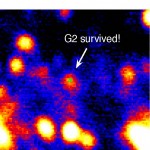
An image from W. M. Keck Observatory near infrared data shows that G2 survived its closest approach to the black hole. Credit Andrea Ghez/Gunther Witzel/UCLA Galactic Center Group/W. M. Keck Observatory
While some scientists believed the object was a cloud of hydrogen gas that would be torn apart in a fiery show, Ghez and her team proved it was much more interesting.

“G2 survived and continues happily on its orbit; a gas cloud would not do that,” said Andrea Ghez, UCLA professor of physics and astronomy who holds the Lauren B. Leichtman and Arthur E. Levine Chair in Astrophysics, and directs the UCLA Galactic Center Group. “G2 was completely unaffected by the black hole; no fireworks.”

Instead, the team has demonstrated it is a pair of binary stars that had been orbiting the black hole in tandem and merged together into an extremely large star, cloaked in gas and dust, and choreographed by the black hole’s powerful gravitational field.

“G2 is not alone,” said Ghez, who uses Keck Observatory to study thousands of stars in the neighborhood of the supermassive black hole. “We’re seeing a new class of stars near the black hole, and as a consequence of the black hole.”

Ghez and her colleagues — who include lead author Gunther Witzel, a UCLA postdoctoral scholar in Ghez’s research group, and Mark Morris, a UCLA professor of physics and astronomy — studied the event with both of the 10-meter telescopes at Keck Observatory.

Continue reading “Mysterious G2 Cloud Near Black Hole Identified”

Disabling the Ask Toolbar with Java Update

Why does Oracle insist on bundling the Ask toolbar with Java updates? I can understand making a little money to offset the costs of a freely distributed product. But is the money worth the ire of every internet user in the marketplace? Just type “Ask toolbar” into Google and you see hundreds of articles about user frustration and instructions for removing the useless thing. It truly belongs in the category of malware.

Ask is not even a decent search engine. OK, it works fine if you are looking for Justin Bieber news, but it sucks at technical and scholarly searches. On the other hand, the money paid to Oracle and other software vendors is probably the only thing keeping Ask corporation alive. A truly despicable business model with no redeeming traits.

Yes, there is a checkbox to opt-out of the toolbar. Yes, I have missed this checkbox during one of the many routine updates of Java that occur each month. Then I have to go through the chore of removing the junk from my browsers.

There is a way to avoid the Java installation trap on Windows OS at least, something that deserves to be passed around. It does require a registry change, but that is not that difficult. Just create a textfile with the extension .reg, this is a registry modifiction script. Cut and paste the snippet of code below into this text file, save and double click to execute… Done.

Windows Registry Editor Version 5.00

[HKEY_LOCAL_MACHINE\SOFTWARE\JavaSoft]
"SPONSORS"="DISABLE"

[HKEY_LOCAL_MACHINE\SOFTWARE\Wow6432Node\JavaSoft]
"SPONSORS"="DISABLE"

Unfortunatly this only works for Java, keep an eye out for other sneaky install options from Ask. At least Java is the only one I usually encounter.

Mercury at Maximum Elongation

Today Mercury reaches maximum elongation, the furthest point it will reach from the Sun in the sky and the highest it will be above the sunrise for this morning apparition. The planet is easily visible as a bright, starlike object about 19° above the rising Sun as the twilight begins. Over the next couple weeks Mercury will slide back into the sunrise, heading for superior conjunction on December 7th.

Continue reading “Mercury at Maximum Elongation”

The Advance of Pāhoehoe Lava Flows

An excellent video showing how pāhoehoe lava flows advance. A flow is a surprisingly complex process. A quick look or photograph will fail to reveal what it going on, it takes time to observe something that occurs this slowly. I have spent hours watching and filming flow fronts advance, totally amazed at what I saw when I really watched…

Time lapse shows the process more clearly than watching in person. It is the inflation of a pāhoehoe flow that shows in a compressed timescale. A flow a foot or two thick becomes six or ten feet thick over the course of a few hours. Also revealed are how other features of the flow form… The ropy surface, the broken plates, the cracks where lava has oozed out. After having watched a flow in process I see old lava flows in an entirely new way.

Below is an old video, filmed over several visits to the lava during the summer of 2010. I have better material now. Some time I need to put it together into a new video. Still, you can see the process of breakout, advance, crust over, inflate, then breakout again.

Flowing Rock from Andrew Cooper on Vimeo

I have yet to have an opportunity to see an ʻaʻā flow advancing. They move entirely differently. I understand the sound of an ʻaʻā flow is impressive, a moving gravel pile of grinding and falling rock.

Another Milestone

You do not see milestones on modern highways. In the US they have been replaced by green, metal markers that number the miles you have traveled. Of course modern vehicles have odometers counting away those miles, distance and years put behind us in the many little journeys of life. Back and forth to work, around the island, daily routine and explorations. In a good life those miles represent both the mundane and little adventures.

I put well over 200,000 miles on my last vehicle. The new vehicle? Purchased with 78,000 miles already on the odometer, thus I can only claim the last 22,000 as mine alone. But this was a Keck fleet vehicle, I put a smattering of the previous 78,000 miles on this truck, either driving or riding up and down the mountain.

Odometer at 100,000
The odometer of the 2006 Ford Explorer at 100,000 miles