MastCam

Some parts of the job are simply fun. Installing the various upgrades to the weather system has been just that. The latest piece of kit being more fun than usual.
Weather Mast
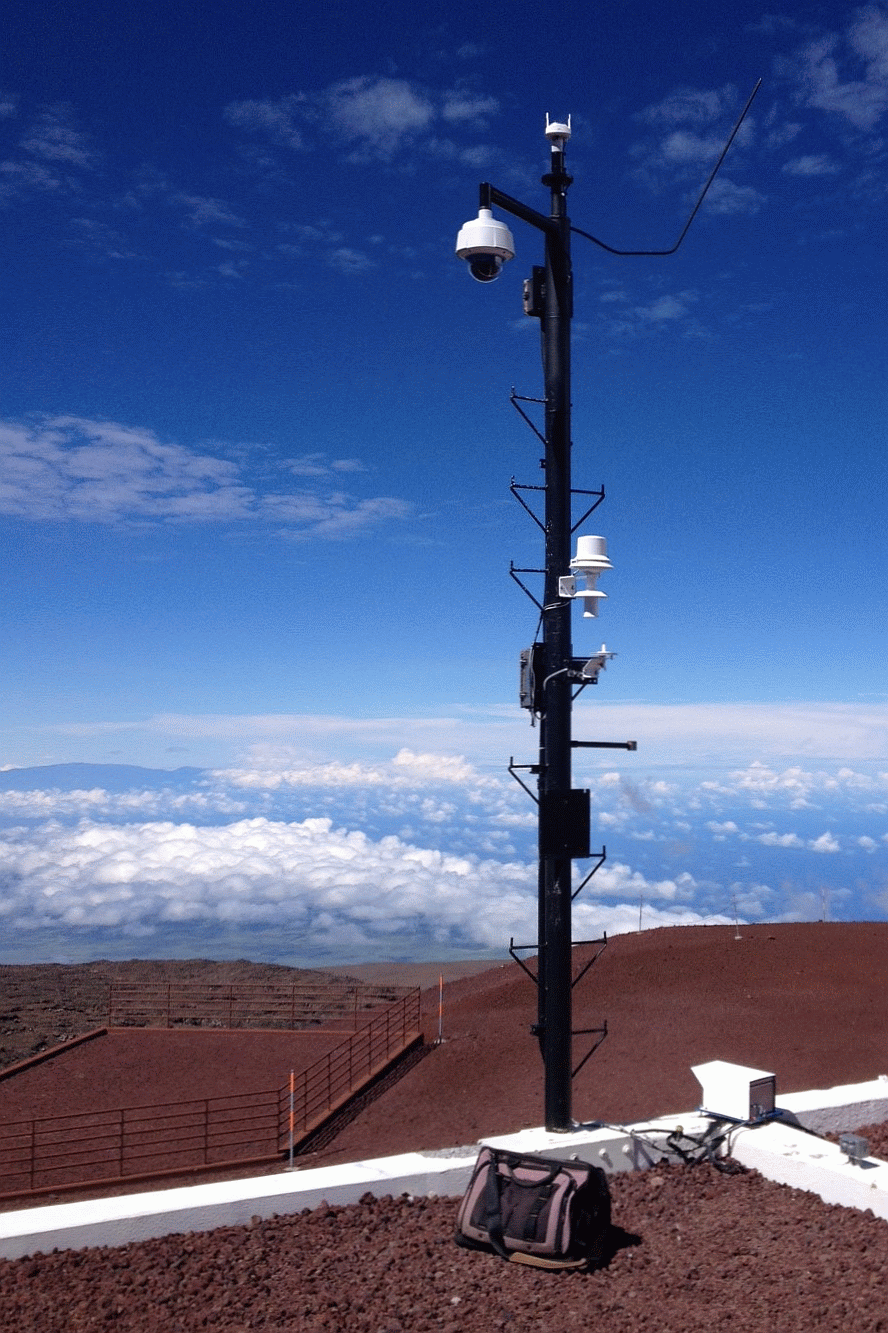
The Keck weather mast with a sonic anemometer at top, MastCam, and the housings for the temperature, humidity and barometric pressure sensors.
We are installing a number of new cameras throughout the facility. Replacing an ancient CCTV system that still uses composite video and black and white monitors. Yeah, that ancient. The system is quite useful, it allows visibility of the telescopes from the operator stations and the manual control panels when you are driving the telescope.

Even that is topped by the camera I installed this fall. The latest camera is a new pan-tilt-zoom camera attached to the weather mast.

The camera does have more prosaic reasons to justify the effort of installing it. With the camera the operators can observe the weather conditions around the telescope, observing supervisors can view the ice and snow on the domes from Waimea, the day crew can check the weather conditions before driving to the summit, and more. The camera does have enough sensitivity to see the brighter stars and the banks of fog that roll over the summit. In full dark and at full gain the image is noisy and faint, not all that great. Given just a little moonlight the performance is much better, allowing visibility of oncoming clouds.
MastCam Ice
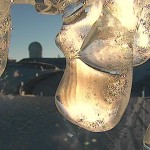
Hanging ice blocks the view of MastCam after a severe winter storm on January 4th, 2015
Weather conditions can be extreme on the summit. Last week’s storm being a good example… 100mph sustained winds, 135mph gusts, more than a foot of ice coating any vertical surface and several inches on the ground. The camera is rated to survive such conditions, and has now survived its first major winter storm. Electronic operation is guaranteed by the manufacturer for -40°C, and there is a heater and blower inside the camera dome to remove ice. It was able to melt its way clear, at least partially on the first day, while it took a week to clear the domes for operation.

Even more fun! On Christmas Eve I was contacted by Hawaii News Now for photos of the storm, they were eager to do something about a white Christmas for the evening news. As I had not been to the summit and no one on our crew was up, I simply grabbed some MastCam images and forwarded them. The images were aired in the first couple minutes of the Honolulu evening news!

The camera is not available to the public, it would be too much wear and tear to the pan-tilt mechanism and a huge hog of bandwidth. You have to be inside the Keck network to use, from there it is available to anyone on staff. It has proven quite popular, with many folks using the imagery to check on mountain conditions in the latest bad weather.

Next up, yet more cameras in the dome and even a couple on top of the domes. there is also a precipitation sensor and more in the works for the weather station.

OK, enough fun, back to revising the Keck 2 dome schematics.
Comprehensive Andromeda Study Hints of Violent History

W. M. Keck Observatory press release

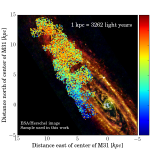
Dots show locations of stars in the Keck Observatory spectroscopic survey superimposed on an image of Andromeda. Credit: Claire Dorman/ESA
A detailed study of the motions of different stellar populations in Andromeda galaxy by UC Santa Cruz scientists using W. M. Keck Observatory data has found striking differences from our own Milky Way, suggesting a more violent history of mergers with smaller galaxies in Andromeda’s recent past. The findings are being presented on Thursday, January 8, at the winter meeting of the American Astronomical Society in Seattle.

The structure and internal motions of the stellar disk of a spiral galaxy hold important keys to understanding the galaxy’s formation history. The Andromeda galaxy, also called M31, is the closest spiral galaxy to the Milky Way and the largest in the local group of galaxies.

“In the Andromeda galaxy we have the unique combination of a global yet detailed view of a galaxy similar to our own. We have lots of detail in our own Milky Way, but not the global, external perspective,” said Puragra Guhathakurta, professor of astronomy and astrophysics at the University of California, Santa Cruz.

The new study, led by UC Santa Cruz graduate student Claire Dorman and Guhathakurta, combined data from two large surveys of stars in Andromeda conducted at the Keck Observatory in Hawaii as well as data from the Hubble Space Telescope.

Continue reading “Comprehensive Andromeda Study Hints of Violent History”

Back On-Sky

The storm that deposited a heavy layer of ice on Mauna Kea has kept Keck Observatory shuttered for a week now. The last night we observed was New Year’s Day. Despite clear skies, there was just too much ice on the domes that could come crashing in on the telescope if we attempted to open. For a few days the Keck II dome was frozen in place by a pile of solid ice against the lower skirt.

We just got word that day crew, with a little solar help, has cleared the worst of the ice from the domes and we will be observing tonight.

Heavy Ice
Ice on the Keck 2 dome ladders after the New Year’s storm of 2015

A Failed Attempt at the Summit

The instruments were warming up. Liquid nitrogen exhausted, cooling interrupted by loss of power, the cryogenic dewars had begun to warm. Recovering instruments takes many days of vacuum pumps and re-cooling to restore function if cooling has been loss. Other problems caused by the storm and power outages plagued the summit, some systems not responding to remote queries.

Keck Under Ice
Keck Observatory covered in heavy ice
On Friday, the crew had abandoned early in the day in the face of deteriorating weather conditions. With the storm raging, no one had made it to the summit on Saturday. We all watched as remote weather instruments reported sustained winds of over 100mph and gusts as high as 134mph. With the wind came freezing fog, a thick coating of ice forming on every surface. The snowplow crews did not even try Saturday, it was just too dangerous.

Sunday offered at least a hope of making it to the summit. The storm had abated and beautiful sunny skies appeared over the summit. We readied for an attempt at the summit of Mauna Kea. As the engineer on call I would join the support techs at the summit. Maybe we could salvage something from the chaos.

Continue reading “A Failed Attempt at the Summit”

Snow on Mauna Kea

Not a great deal of snow, maybe an inch or two rearranged by the winds. More snow is expected over the coming few days before this storm is over. Where to find the heaviest snow on the mountain? Puʻu Poliʻahu of course, just look at the images below.

This is the first winter storm that our new weather mast camera is operating, since I bolted it in place a couple months ago. It is great fun to have a full pan-tilt-zoom camera available during weather events like this.

Summit Ridge Snow
The summit ridge with an inch of fresh snow
Subaru in the Snow
Snow around the Subaru telescope

Blizzard Watch? In Hawaii?

NWSWatch20141222
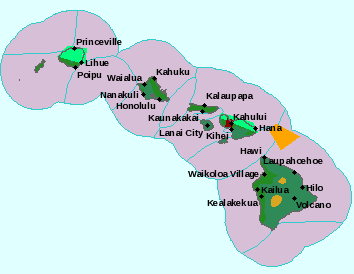
National Weather Service watch map for 22Dec2014.
Yes, it can happen… The local NWS office has issued a blizzard watch for the summits of Mauna Kea and Mauna Loa.

It will be interesting to see just how much snow we do get. The Mauna Kea Weather Center is predicting a possible six inches. I do not plan on being on the summit until Friday. A white Christmas?

Scientists Accurately Quantify Dust Around Planets in Search for Life

W. M. Keck Observatory press release

A new study from the Keck Interferometer, a former NASA project that combined the power of the twin W. M. Keck Observatory telescopes atop Mauna Kea, Hawaii, has brought exciting news to planet hunters. After surveying nearly 50 stars from 2008 to 2011, scientists have been able to determine with remarkable precision how much dust is around distant stars – a big step closer into finding planets than might harbor life. The discovery is being published in the Astrophysical Journal online, on December 8th.

A dusty planetary system (left) is compared to another system with little dust in this artist's conception. Credit NASA/JPL-Caltech
A dusty planetary system (left) is compared to another system with little dust in this artist’s conception. Credit NASA/JPL-Caltech
“This was really a mathematical tour de force,” said Peter Wizinowich, Interferometer Project Manager for Keck Observatory. “This team did something that we seldom see in terms of using all the available statistical techniques to evaluate the combined data set. They were able to dramatically reduce all the error bars, by a factor of 10, to really understand the amount of dust around these systems.”

The Keck Interferometer was built to seek out this dust, and to ultimately help select targets for future NASA Earth-like planet-finding missions.

Like planets, dust near a star is hard to see. Interferometry is a high-resolution imaging technique that can be used to block out a star’s light, making the region easier to observe. Light waves from the precise location of a star, collected separately by the twin 10-meter Keck Observatory telescopes, are combined and canceled out in a process called nulling.

“If you don’t turn off the star, you are blinded and can’t see dust or planets,” said co-author Rafael Millan-Gabet of NASA’s exoplanet Science Institute at the California Institute of Technology in Pasadena, California, who led the Keck Interferometer’s science operations system.

Continue reading “Scientists Accurately Quantify Dust Around Planets in Search for Life”

Evicted? Possible Black Hole Found 2,600 Light Years from Home

W. M. Keck Observatory press release

Markarian 177 and SDSS1133
Using the Keck II telescope in Hawaii, researchers obtained high-resolution images of Markarian 177 and SDSS1133 using a near-infrared filter. Credit: W. M. Keck Observatory/M. Koss Et Al.
An international team of researchers analyzing decades of observations from many facilities — including the W. M. Keck Observatory on Mauna Kea, the Pan-STARRS1 telescope on Haleakala and NASA’s Swift satellite — has discovered what appears to be a black hole booted from its host galaxy. The team was led by Michael Koss, who was a postdoctoral fellow at the Institute for Astronomy (IfA) at the University of Hawaii at Manoa during most of the time the study was ongoing. The study will be published in the Nov. 21 edition of Monthly Notices of the Royal Astronomical Society.

The mystery object is part of the dwarf galaxy Markarian 177, located in the bowl of the Big Dipper, a well-known star pattern within the constellation Ursa Major. Although supermassive black holes usually occupy galactic centers, SDSS1133 is located at least 2,600 light-years from its host galaxy’s core. The team was able to detect it in astronomical surveys dating back more than 60 years.

In June 2013, the researchers obtained high-resolution near-infrared images of the object using the 10-meter Keck II telescope at Keck Observatory. “When we analyzed the Keck data, we found the emitting region of SDSS1133 is less than 40 light-years across, and that the center of Markarian 177 shows evidence of intense star formation and other features indicating a recent disturbance that matched what we expected for a recoiling black hole,” said Chao-Ling Hung, a UH Manoa graduate student performing the analysis of the Keck Observatory imaging in the study.

Continue reading “Evicted? Possible Black Hole Found 2,600 Light Years from Home”