
Today Mercury reaches maximum elongation, the furthest point it will reach from the Sun in our sky and the highest it will be above the sunset for this evening apparition. The planet is easily visible as a bright, starlike object about 26° above the setting Sun as twilight begins. Over the next couple weeks Mercury will slide back into the sunset, heading for inferior conjunction on October 16th.
Postcard from the Reef – Banded Urchin

The Moon and Jupiter
Tomorrow morning the Moon and Jupiter will be close. The Moon will rise first, followed by Jupiter at 03:06 to be almost 40° above the eastern horizon at sunrise. The Moon will be about 18% illuminated and about 8° above a bright Jupiter. The next day the Moon will have moved to the other side of Jupiter but will be even closer, about 7° separation.
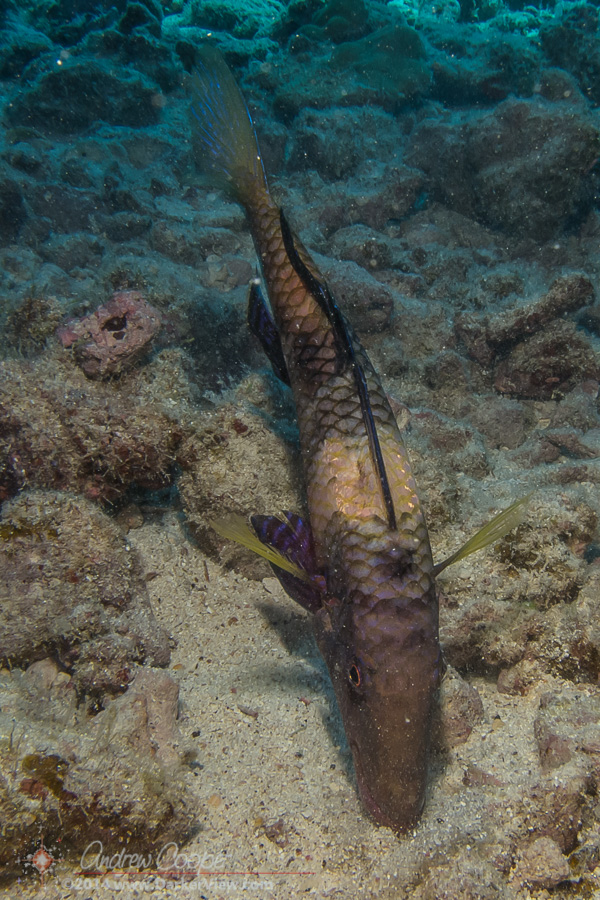
Postcard from the Reef – Goatfish Feeding
The fish did not seem too concerned at my presence, or perhaps it was taking advantage of my being there. It was rooting about in the cave rubble, using its sensitive barbels to detect prey under the debris and sand. As I watched it would slowly sweep over the rubble, then suddenly and vigorously rummage about in a cloud of sand. I could not see if the fish was having any success, but it was interesting to watch.
So often fish and other marine creatures will modify their behavior when a diver is present. It is always interesting when you run across something continues on despite being watched. It is worth a few minutes of air to sit and observe, sit and learn.
Working Late Again
When most folks work late at the office it is a boring evening at a desk staring at a computer. I may have stared at a computer a bit, but it was hardly a boring evening.
Waiting for darkness had it’s advantages, an opportunity to do a little photography. In addition to the usual tool bag and lunch I took my camera gear with me.
With Sniffen on the roof while I watched the frames on the computer, I called the corrections up to him on the radio. It is tricky work to focus a fast lens, made worse by the need to do it remotely. We had to wait for each 30 second exposure, painfully slow. I hesitated to ask Sniffen to sit much longer out in the cold, but he was game and ready to assist. His tiny adjustments were deftly made, I watched as the lens moved through focus.
After leaving Keck I took my time wandering down the mountain. I stopped at IRTF for a set of panorama shots. One of the first things I noted was the lack of airglow. Last time I shot from the summit the airglow was intense. Despite using the same camera and lens, with the same settings, the bright red glow was missing. Only a pale green near the horizon to be seen in the shots.
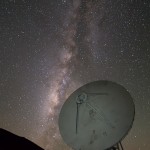
On a whim, I drove out to the VLBA antenna for a set of shots. This radio telescope was something different than the usual telescope shots I take. I walked around the dish until I could position the summer Milky Way beside the antenna. As the VLBA is a radio telescope there was no issue in using a little light from my flashlight to paint the dish and illuminate it for the photo.
I arrived home just before midnight, tired from a full day on the summit. The photos will wait for another day for processing.
Milky Way over VLBA

Venus Disappears into the Dawn
After spending much of the year in dawn skies, this week will see Venus disappear into the dawn. Superior conjunction will occur October 24th, with the planet appearing in the evening sky at the end of November.
Gemini Panorama
Last week I visited Gemini to see their TBAD installation. While we were on the dome floor I used Google Photo Sphere to shoot a few full panoramas of the telescope…

Postcard from the Reef – Raccoon Butterflyfish

Diving ʻAuʻau and The Hive
When Dennis let me know he was heading south for ʻAuʻau Crater and that I was invited I didn’t even think about it… I’m in! When do we go?
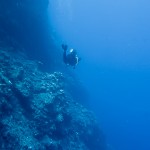
It is a long drive past Kealakekua Bay to the ʻAuʻau Point area. As such we left Honokohau much earlier than usual, ready for a long day of diving. ʻAuʻau crater itself is visible on the shore, a classic littoral cone formed where lava met water and created an edifice much like a cinder cone from the resulting hydrothermal explosions. The cliffs are pocked with sea caves, many small, and some huge, large enough for us to drive the boat into on a calmer day.
The first hint about the site was the amazing glimpses of the terrain you could see from the surface as we crossed the area looking for the mooring. Boulders and coral 30 feet below us one moment, then nothing but deep blue the next. This site has a wall! Not just a little twenty foot wall as you see along the Kohala Coast. A sheer wall that we could not see the bottom of while we hovered at 100 feet. The wall just drops into the depths, inviting you ever further down into oblivion. On 32% EAN nitrox we dared not venture any deeper. This thing is at least 200 feet high, probably much more.
The wall is a mix of volcanic rubble, in places you can see layers, but mostly it is remnants of thousands of years of lava flows hitting the sea and creating sand and fragments of rock. On the ledges and in the little cavities life flourishes. Urchins and sea stars roam, but there is relatively little coral. This unstable surface is a poor place for the hard corals to colonize. One exception is wire coral, meter long specimens protrude here and there.
For our second dive the choice was The Hive. Arriving at the site revealed a small sea arch adjacent to the mooring large enough to drive the boat through. We did not know what to expect at the site. Thus the dive plan was to make a sweep out the edge of the reef and then back towards shore to check out the sea arch for possible caves. The sweep was pretty routine, a steep coral covered slope, nothing to hint at why there was a dive mooring here. Coming back to the arch revealed what was special about this spot! A set of great caves hide right under the arch at 25-30 ft depth. There were lobsters, innumerable flat rock-crabs, and several species of nudibranch to be found.
As I thought about leaving the caves after a first sweep I looked at my gauge… Still a thousand PSI in the tank! I turned around and headed back into the cave to find still more.
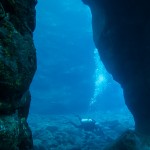
We surfaced, a set of very happy divers, conversation buzzing as we compared notes. Diving has an interesting complication… Communication is limited underwater, you have to wait until you surface to ask questions and compare notes. We identify critters, sometimes grabbing the ragged and well used books Dennis keeps aboard to identify some rarity. We find out what others saw and what we missed. Through the conversation the dive is extended as we relive it one more time.
These are some of the most fantastic dive sites on the island. Not easy to get to but worth it. There are very few boats that run this far south, most vacation divers are happy with the dive sites near Honokohau and the boats need not venture very far from harbor. Jack’s Dive Locker runs a long range dive if there is sufficient interest. The Kona Agressor live-aboard is the only boat that regularly calls at these sites. The very occasional private boat like us is the only other practical way to get to these fantastic dive sites.