The Wall
When you want to see the stars, find someplace dark




It may look small, but this image is anything but small, click on it to find out. The panorama is assembled from seven frames, with final dimensions of over 12,000 x 2,000 pixels. The version posted here is a bit smaller, only 4,000 pixels wide. While it is a big image it does not really come close to the effect of actually standing there beside the camera. Also missing from the photo? The biting cold wind.
The image includes ten telescopes, two planets, two galaxies, two meteors, four volcanoes, and innumerable stars.
It helps that I now have an iPhone 4S in place of my ancient 3GS. Yes, I was nearly three models behind. I was in no rush to update as long as the phone did the job. The phone is a hand-me-down from Deb, who just updated to a 5S. It is not all one-sided, I recently updated to an iPad Air, while she gets by with the old iPad 2.
With the new iPad I had downloaded PhotoSynth from Microsoft, a free panorama application. My experiments with this software were far from successful, I have never achieved a satisfactory result. It is sufficient if all you want is a once around pano, but if you start to add a little vertical the stitching suffers. There are terrible stitching errors in every attempt I made to capture more than a single pass.
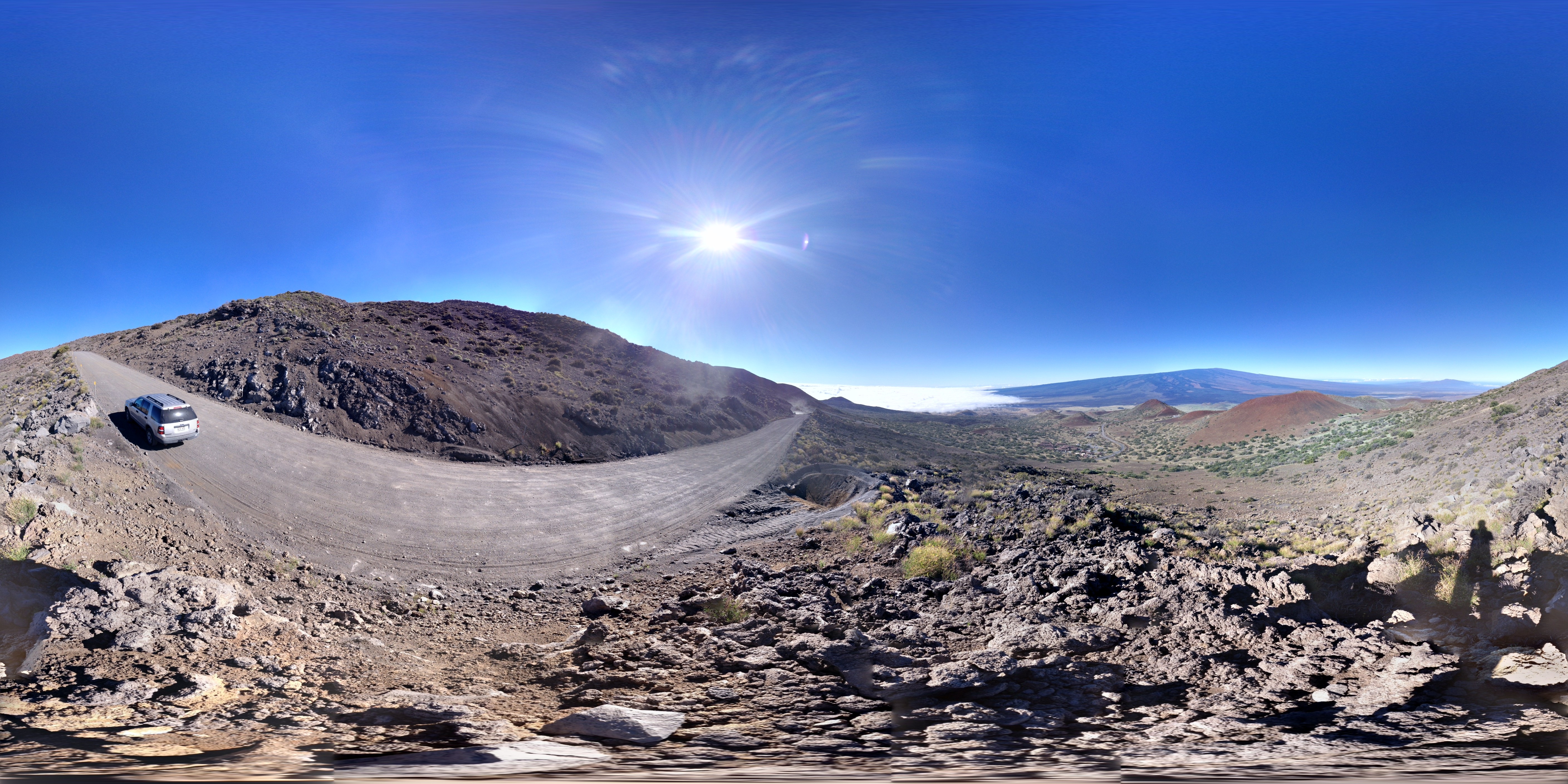
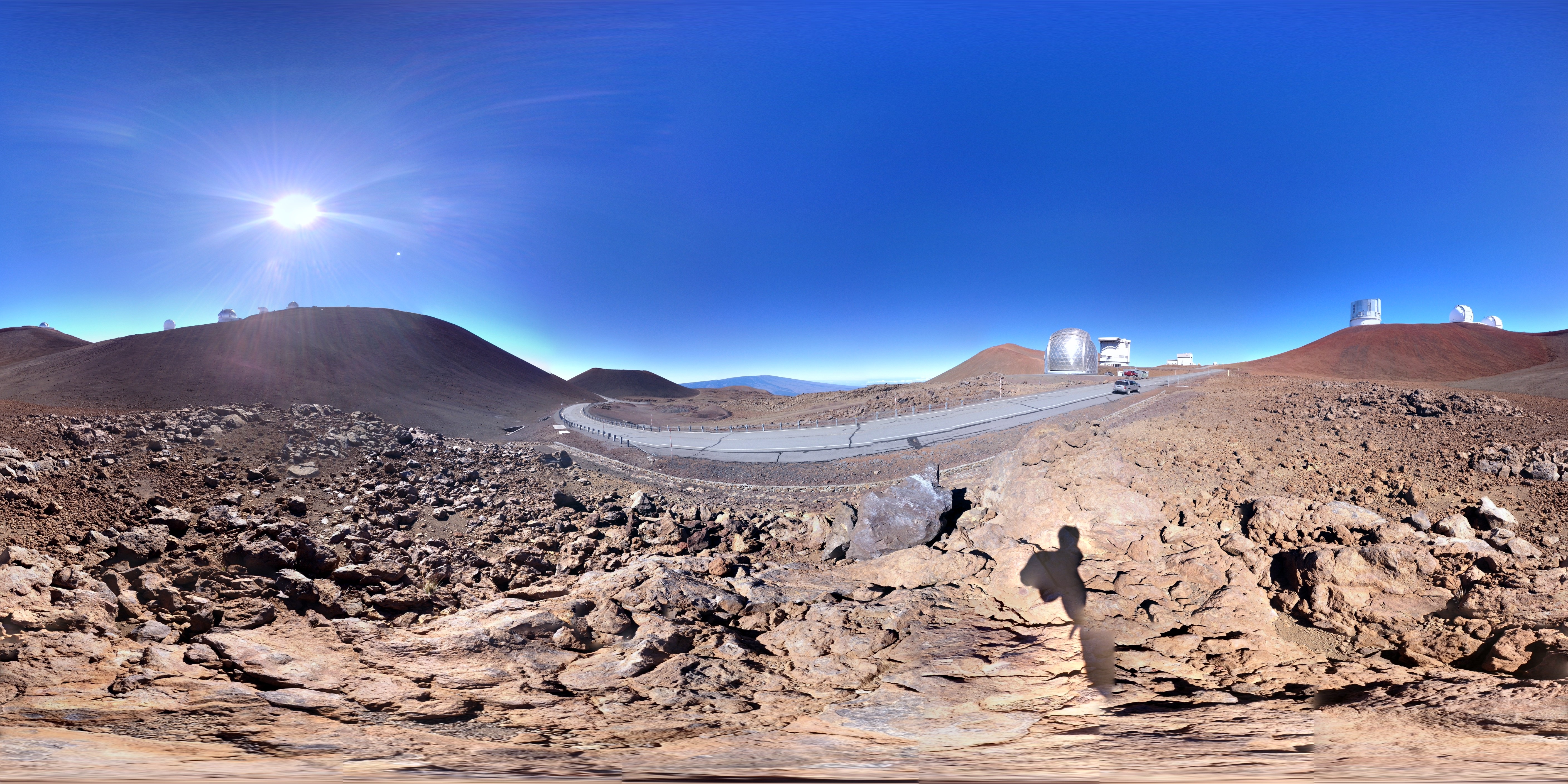
A few days later I learned that Google’s Photo Sphere app had been released for iOS I quickly headed to the app store to get it and give it a try. I shot a couple panoramas on my way up to the summit. The results? Much better, the program does assemble decent 360°x360° spheres.
There are some conditions that will give the software trouble. Dramatic lighting around sunrise or sunset will cause trouble. The varying exposures are not handled well, over-exposing the ground and other large areas of shadow. I have gotten the best results at mid-day with the Sun high overhead and even lighting as you spin. Alternately I have seen decent twilight results when the lighting is again fairly even over the entire scene.Some stitching errors will be visible if there are a lot of straight lines visible. This will be most apparent in a built up environment, with large structures in the image. In natural surroundings it becomes more difficult to pick out the stitch lines between frames.
It takes two to three minutes to shoot a complete sphere. You spin in place, moving the camera from image to image as you shoot. Positioning of the camera is performed by simply aligning the camera at each aim point provided in the software. It appears that the software uses the phone accelerometer to detect the correct orientation of the camera. It is a bit like a shooting video game, aim and shoot, aim and shoot, each shot is fired automatically when you get the aim right. A progress bar surrounding the button at the bottom of the screen lets you know how much you have yet to do.
The app is designed to upload the images to Google Maps, making it appear as if the free app is designed as a way to create more content in Maps. While you do not have to upload your images, I have uploaded a few anyway. I do not mind contributing to a tool I have found enormously useful.
The full spheres are a lot of fun. Easy to take with the one camera you will have with you at all times. Given the half-decent photo quality of the later iPhone cameras the results are pretty good.


With 24 exposures, each 4 minutes long, it is possible to animate the comet’s movement among the stars. Just process the photos individually and import into photoshop as an animation, then export as an animated GIF. Just click on the image to view…

An assembled version of the imagery I took of comet C/2014 E2 Jacques. 24 x 4min exposures, stacked in Images Plus and final processed in Photoshop. While traces of the tails were visible, I was unable to preserve the faint signal in this processed color frame.