Stormy Weather on Uranus

W. M. Keck Observatory press release

Weather on any planet can be quite unpredictable. As hurricanes threaten the Aloha State, astronomers working at W. M. Keck Observatory on the island of Hawaii were surprised by the appearance of gigantic swirling storm systems on the distant planet Uranus.

Uranus Storms
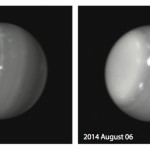
Massive storms on Uranus captured August 5 and 6, 2014 as seen by Keck Observatory. Credit Imke de Pater (UC Berkeley)/Keck Observatory
During the Voyager encounter with Uranus in 1986, only a scant handful of dim clouds were seen in its atmosphere. When the planet approached equinox in 2007 (i.e., when the Sun stood high above its equator), large storms developed on the planet, yet most of these faded.

In the past few days, however, astronomers were surprised by a multitude of bright storms on the planet, including one monstrous feature.

“We are always anxious to see that first image of the night of any planet or satellite, as we never know what it might have in store for us,” said Imke de Pater, professor at UC Berkeley and team leader. “This extremely bright feature we saw on UT 6 August 2014 reminds me of a similarly bright storm we saw on Uranus’s southern hemisphere during the years leading up to and at equinox”.

Continue reading “Stormy Weather on Uranus”

On the Summit Before the Storm

Now at the summit doing a last walk through the facility to insure everything is ready for the storm. A lot of the gear has been turned off to preserve the battery and generator capacity, keeping the network and the key servers operational so we can monitor remotely once everyone leaves.

The winds are picking up, some 60mph gusts along the summit ridge, a little less where Keck sits on the western side. Looking to the east we can see some cloud features that might be the front wall of the oncoming storm.

We plan to depart the summit in another hour and head for home. I expect the drive down to be as clear as the drive up, mostly clear with wild cloud formations over the summits.

So far today we have a hurricane, a 4.2 magnitude earthquake, and the ongoing plague of rodents. Just living in paradise… Anyone for a tsunami?

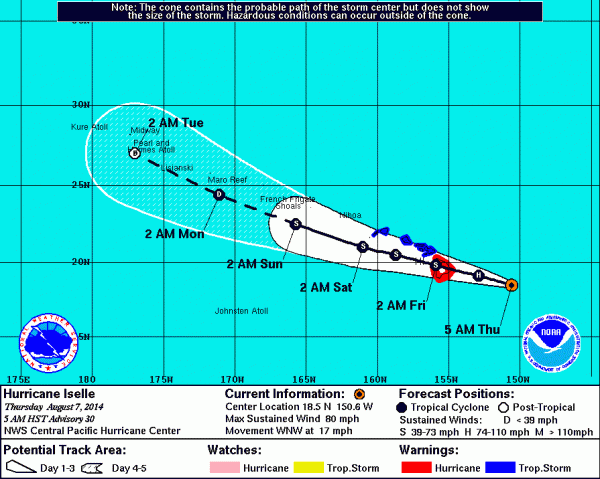
Iselle Forecast Track
The forecast track for hurricane Iselle

Jupiter Appears in the Dawn

This week will see the reappearance of Jupiter in the dawn sky. This morning the planet will be 10° above the rising Sun, climbing quickly higher each morning.

Jove
Jupiter and the moons Europa, Ganymede and Callisto (left-right)
Jupiter will join Venus in the dawn, the brighter Venus has been the dawn star for much of the year. The two will rendezvous for a very close conjunction on the 17th and 18th. After the meeting Venus will disappear into the Sun’s glare leaving Jupiter a turn as the dawn star.

Look for a bright, -2 magnitude object directly above the bright glow of dawn. Venus will be 15° higher tomorrow morning, much brighter at -3.9 magnitude. The distance between the two diminishing over the next two weeks as Jupiter rises and Venus slides towards the Sun.

Final Preparations for the Storm

Eighteen gallons of drinking water sitting in jugs in the guest bathtub, all of the lanai furniture is stashed away, a supply of propane is on-hand, the vehicle tanks are full… We are prepared for the storm.

Considering that Iselle has failed to weaken as the earlier predictions forecast, it is now going to hit the island as a full hurricane. The cone of possible paths has narrowed to where there is no doubt, the eye of the storm will come right over the island.

I have never experienced the center of a hurricane, this will be new. Getting brushed by the outer edge of hurricane Howard while in Mexico a decade back is as close as I have been before. If the predictions hold we will see the eye go right over us. It will also be interesting to see what the interaction with two nearly 14,000ft mountains will do to the storm.

I am not expecting damaging winds on our side of the island. Perhaps a lot of rain? My worst fear is an extended power outage. There is a lot of Alaskan halibut in the freezer that would be painful to lose. I have filled the remaining space in the freezer with water bottles, now ice, to increase the thermal mass and the hold time without power.

I am on the minimal summit crew that will head up first thing tomorrow morning. We depart at the usual 7am and hope to be off the summit before noon. Certainly before the storm makes landfall later in the day. In any case tomorrow will be an interesting day.

Iselle Approaches
Hurricane Iselle approaching the island of Hawai’i

Preparing for the Hurricanes

We currently have two hurricanes bearing down on the island of Hawaiʻi. Not one, but two!

GEOS West 4km IR 5Aug2014
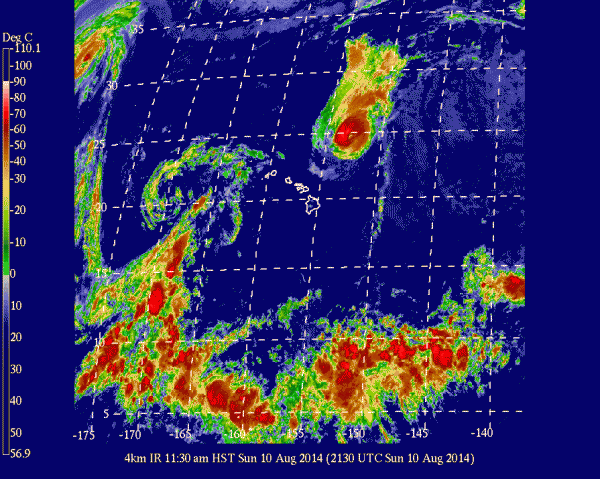
A GEOS infrared image of the Eastern pacific on the afternoon of August 5th. Visible are three hurricanes… Genevieve, Iselle and Julio (west to east)
First up is hurricane Iselle, currently a category 2 storm with 110mph sustained winds. Fortunately the storm is expected to weaken and cross the island as a mere tropical storm on Thursday. The track does predict that the storm will come right over the island, bringing heavy rains and possibly damaging winds.

Behind Iselle is Julio, now 1900 miles southeast of Hilo. This storm is expected to cross the island as a hurricane, the first hurricane to hit a Hawaiian island in over two decades. This is the storm everyone is watching. It is still a bit early, the storm is not expected to arrive until Sunday. The forecasts will be interesting and well read over the coming days.

Hurricane Iselle Forecast
The forecast path for hurricane Iselle, 5 Aug 2014
Fortunately our house is on the lee side of the island from these approaching storms, and is somewhat better sheltered than many of our neighbors. Storm preparations are quickly accomplished… Secure any outside furniture and gear, and insure we have a little extra water and propane on hand.

Preparations at the observatory are notably more complex.

The major concern is an extended power outage. We rely on long power lines that cross the saddle between Mauna Loa and Mauna Kea. If one or both of these storms prove damaging the power lines are likely to be part of the damage. These lines are also likely low on the list of repairs if there is extensive damage across the island.

Yes, there is a backup generator on site with a storage tank filled with diesel. How long will it last? What if the power lines along Saddle road are damaged? The power lines to the summit may be low on the priority list to repair if there are lines down all over the island.

If we are without power for a long period, we could lose power when the generator runs out of fuel. Of first concern are the instruments… The sensitive interiors of these cameras and spectrographs are kept at cryogenic temperatures, hundreds of degrees below freezing. Without power the instruments will start to warm up. Returning the instruments to service can take weeks. The vacuum dewars will have to be pumped again to restore the high quality vacuum conditions, then the instrument carefully cooled again.

Not that we are plunging blindly into this. We have a plan. Shutting down as much as we can, with priority given to the instruments. Hopefully the worst will not occur and we can continue smoothly on. But if the island does take damage we will be prepared to weather out the worst of it and preserve the facility.

Observations Reveal Massive Eruptions on Jupiter’s Moon Io

W. M. Keck Observatory Press Release

Three massive volcanic eruptions occurred on Jupiter’s moon Io within a two-week period, leading astronomers to speculate that these presumed rare “outbursts,” which can send material hundreds of miles above the surface, might be much more common than previously thought. The observations were made using the W. M. Keck Observatory and Gemini Observatory, both near the summit of Mauna Kea, Hawaii.

Io Eruptions
Images of Io obtained at different infrared wavelengths (in microns, μm, or millionths of a meter) with the W. M. Keck Observatory’s 10-meter Keck II telescope on Aug. 15, 2013 (a-c) and the Gemini North telescope on Aug. 29, 2013 (d). Credit: Imke de Pater and Katherine de Kleer, UC Berkely
“We typically expect one huge outburst every one or two years, and they’re usually not this bright,” said Imke de Pater, professor and chair of astronomy at the University of California, Berkeley, and lead author of one of two papers describing the eruptions. “Here we had three extremely bright outbursts, which suggest that if we looked more frequently we might see many more of them on Io.”

Io, the innermost of Jupiter’s four large “Galilean” moons, is about 2,300 miles across, and, aside from Earth, is the only known place in the solar system with volcanoes erupting extremely hot lava like that seen on Earth. Because of Io’s low gravity, large volcanic eruptions produce an umbrella of debris that rises high into space.

De Pater’s long-time colleague and coauthor Ashley Davies, a volcanologist with NASA’s Jet Propulsion Laboratory at the California Institute of Technology in Pasadena, Calif., said that the recent eruptions resemble past events that spewed tens of cubic miles of lava over hundreds of square miles in a short period of time.

“These new events are in a relatively rare class of eruptions on Io because of their size and astonishingly high thermal emission,” he said. “The amount of energy being emitted by these eruptions implies lava fountains gushing out of fissures at a very large volume per second, forming lava flows that quickly spread over the surface of Io.”

All three events, including the largest, most powerful eruption of the trio on 29 Aug. 2013, were likely characterized by “curtains of fire,” as lava blasted out of fissures perhaps several miles long.

Continue reading “Observations Reveal Massive Eruptions on Jupiter’s Moon Io”