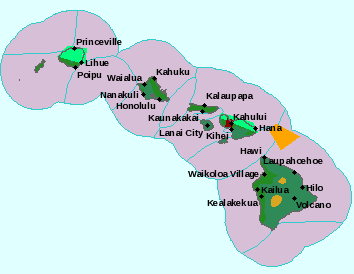
It will be interesting to see just how much snow we do get. The Mauna Kea Weather Center is predicting a possible six inches. I do not plan on being on the summit until Friday. A white Christmas?
When you want to see the stars, find someplace dark

It will be interesting to see just how much snow we do get. The Mauna Kea Weather Center is predicting a possible six inches. I do not plan on being on the summit until Friday. A white Christmas?
It works! We now have a CloudCam at Keck. It is not quite ready for full active service, but it is alive and taking images. I got the network connection running yesterday, after mounting the camera and running the various cables over the last couple weeks. A little time for commissioning and getting the software setup and the camera will be available to everyone.
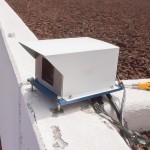
Our camera was built by Kanoa over at the Canada France Hawaii Telescope. Kanoa built the first CloudCam that has served CFHT so well. In service for a couple years now, the CFHT CloudCam gives our telescope operators an unparalleled view of the weather. This is critically important as heavy fog, rain or snow can damage the telescope optical coatings.
Post Update… The Keck CloudCam Link!
Video Archive
To secure and protect the enclosure Kanoa built I fabricated a solid mount. A heavy machined plate and an aluminum cover should shield the camera from the worst that Mauna Kea Weather can dish out. The camera electronics warm the box nicely and a heater is installed to warm and deice the window. We shall see how it fares, the summit weather can be amazing.
With the original CloudCam pointing east, over Hilo, our CloudCam points west, a complementary view of the weather approaching the summit from either direction. The imagery will be closely monitored by all of the telescope operators on the summit during marginal weather.
The imagery will be available to the public as well. Expect live images as well as compiled movies of each night. The first CloudCam has quite a following, quite a few people check the camera constantly. This includes quite a few UFO consipracists. If anything odd shows up on the camera the video quickly shows up on YouTube and linked to postings on the UFO sites.
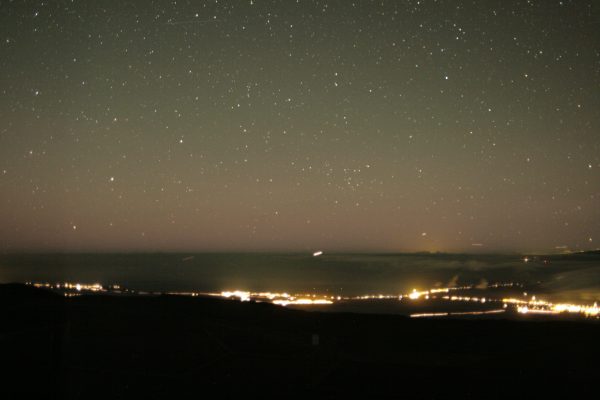
Yes, the focus needs to be adjusted (I expected that), but the scene covers a nice range from the Waikoloa resorts on the left, past Kawaihae, to Waimea on the right.
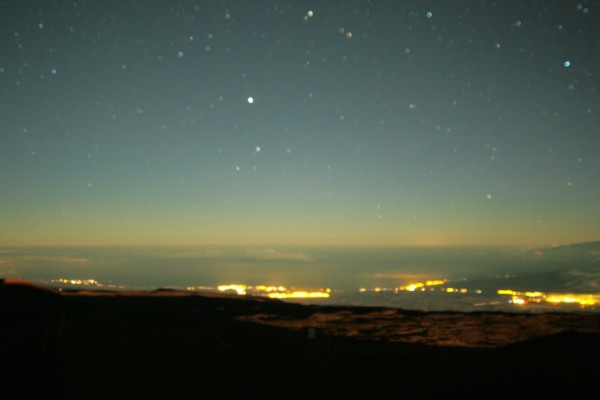
And after focus adjustment we get much nicer stars…
W. M. Keck Observatory press release…
Weather on any planet can be quite unpredictable. As hurricanes threaten the Aloha State, astronomers working at W. M. Keck Observatory on the island of Hawaii were surprised by the appearance of gigantic swirling storm systems on the distant planet Uranus.
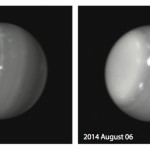
In the past few days, however, astronomers were surprised by a multitude of bright storms on the planet, including one monstrous feature.
“We are always anxious to see that first image of the night of any planet or satellite, as we never know what it might have in store for us,” said Imke de Pater, professor at UC Berkeley and team leader. “This extremely bright feature we saw on UT 6 August 2014 reminds me of a similarly bright storm we saw on Uranus’s southern hemisphere during the years leading up to and at equinox”.
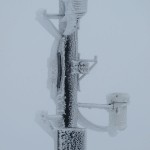
Covered with heavy ice but still functioning normally… I do get something right once in a while…

It was a gorgeous day when we arrived on the summit. A deep blue sky above brilliant white snow covering the slopes. It was difficult to put much faith in a forecast calling for truly dire weather. I could see nothing to the southwest, the direction this weather was approaching from, just the blue Pacific stretching to the horizon.

Not a bad day, I accomplished everything on my to-do list for the day. Some work in AO to check for any stray light, removing some old servers to make way for a new system, locating and labeling some optical fibers that are already in place for this same system. Everything went well, except the lunch time cribbage game, I lost badly.
The weather was degrading all day, first the clouds loomed overhead, then they descended as a heavy fog while the temperature dropped. It did indeed begin to look like the forecasts might have a bit of truth. The prediction is for heavy snow, as much as 6-10 inches. Not sure if that will materialize, it would be nice, we have not had any real snowfall this winter. I will just have to check the webcams tomorrow morning.
It was beginning to snow when we pulled out.

One of the little side jobs I have gotten assigned at Keck is updating the weather station. This involves replacing all of the weather monitoring equipment that allows the operators to keep an eye on conditions around the telescopes. This gear is absolutely critical, giving the operators the data they need to protect our equipment, including the irreplaceable mirrors.
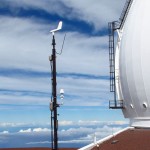
It has been fun to learn about measuring temperature, humidity, dew point and more. It seems so simple at first, but the complications of getting a good reading are subtle. Passive instrument shelters, active ventilation, instrument positioning, calibration and more. Issues that can make a good instrument give bad data.
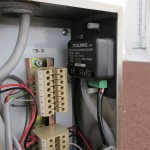
Last week I installed a new barometric sensor. This was the last part of the existing weather instrument suite that needed to be replaced. I got lucky, it was a great day on the summit, sunny with just a modest breeze. Just the day to spend a couple hours hanging off the weather mast in a climbing harness rewiring a junction box for the new cables. A few holes to drill, a few bolts, a couple cables… done!
My next item is to install an anemometer. We have not had an operational anemometer in many years and our observing staff has made it abundantly clear that they want an anemometer. Not that this one will be easy, it is a bit of a challenge to get a decent wind reading anywhere near a 100ft diameter dome. This challenge will be a bit more involved, and involve some good engineering fun. Time to learn about measuring wind-speed and how to do it right. Looking forward to the next part of the plan!
The planet Uranus, known since Voyager’s 1986 flyby as a bland, featureless blue-green orb, is beginning to show its face.
By using a new technique with the telescopes of the Keck Observatory, astronomers have created the most richly detailed, highest-resolution images ever taken of the giant ice planet in the near infrared, revealing an incredible array of atmospheric detail and more complex weather.
The planet, in fact, looks like many of the solar system’s other large planets — the gas giants Jupiter and Saturn, and the ice giant Neptune — said Imke de Pater, professor and chair of astronomy at the University of California, Berkeley, and one of the team members. The planet has bands of circulating clouds, massive swirling hurricanes and an unusual swarm of convective features at its north pole.
“This ‘popcorn’ appearance of Uranus’s pole reminds me very much of a Cassini image of Saturn’s south pole,” said de Pater.

Saturn’s south pole is characterized by a polar vortex or hurricane, surrounded by numerous small cloud features that are indicative of strong convection and analogous to the heavily precipitating clouds encircling the eye of terrestrial hurricanes. De Pater’s group suggested that a similar phenomenon would be present on Neptune, based upon Keck observations of that planet.
“Perhaps we will also see a vortex at Uranus’ pole when the pole comes in full view,” she said.
The study was led by Larry Sromovsky, a planetary scientist at the University of Wisconsin, Madison. In addition to de Pater, other team members are Pat Fry of the University of Wisconsin and Heidi Hammel of the Association of Universities for Research in Astronomy. The team will report the details of their observations Oct. 17 at a meeting of the American Astronomical Society’s Division of Planetary Sciences in Reno, Nev.
Continue reading “Keck Observations Reveal Complex Face of Uranus”

One of the miscellaneous systems in the observatory that I have inherited is the weather station. A critical set of gear that has been neglected far too long. Neglected to the point our telescope operators had been complaining, loudly, about a system that frequently gives erroneous data or provides wildly oscillating readings.
The first part I have replaced is the humidity and dew point sensor. In many ways the most important part of the system. The new unit is a modern sensor with a direct ethernet interface, simple to link into the observatory network. This is the same sensor used by the National Weather Service in their remote weather stations. All I had to do was spend a little money, and spend a day hanging off the weather tower on the observatory roof installing it. It was a beautiful, warm, sunny day up there, I got the job done, and got a slight sunburn in the process.