Keck 2 Stitched
When you want to see the stars, find someplace dark

The first Earth-sized exoplanet orbiting within the habitable zone of another star has been confirmed by observations with both the W. M. Keck Observatory and the Gemini Observatory. The initial discovery, made by the Kepler Space Telescope, is one of a handful of smaller planets found by Kepler and verified using large ground-based telescopes.

Steve Howell, Kepler’s Project Scientist and a co-author on the paper, adds that neither Kepler (nor any telescope) is currently able to directly spot an exoplanet of this size and proximity to its host star. “However, what we can do is eliminate essentially all other possibilities so that the validity of these planets is really the only viable option.”
With such a small host star, the team employed a technique that eliminated the possibility that either a background star or a stellar companion could be mimicking what Kepler detected. To do this, the team obtained extremely high spatial resolution observations from the eight-meter Gemini North telescope on Mauna Kea in Hawai`i using a technique called speckle imaging, as well as adaptive optics (AO) observations from the ten-meter Keck II telescope, Gemini’s neighbor on Mauna Kea. Together, these data allowed the team to rule out sources close enough to the star’s line-of-sight to confound the Kepler evidence, and conclude that Kepler’s detected signal has to be from a small planet transiting its host star.
Just a little bit jealous… My friend Pete shot a beautiful photo of a tinker’s butterflyfish…

A wet winter and spring has brought changes to the Waikoloa area… Green pastures and hills around the village, an enormous crop of weeds in the yard, uncountable cockroaches and gnats, and these guys… Giant African snails.
They are everywhere I look in the yard, in the corners and under any debris. They get caught out by the sun to roast on the driveway, or crunch beneath vehicle tires. The compost pile is snail city, with dozens visible and more underneath the detritus. They get big too, the specimen photographed below was nearly six inches long when crawling along.
I understand that folks in some parts of the world eat these guys. I jokingly brought a handful to my wife one day and let her know I had dinner planned. She did not think the idea was a good dining choice. I have to agree with her, I am not really tempted.


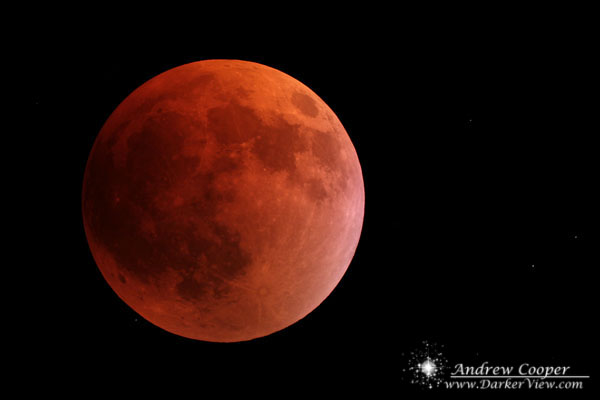
A total lunar eclipse will occur on this particular full Moon, visible across the western hemisphere.

Just a reminder that a total lunar eclipse will occur tomorrow night, on the evening of April 14th.