Postcard from the Summit – Icy Weather
A Little More Snow
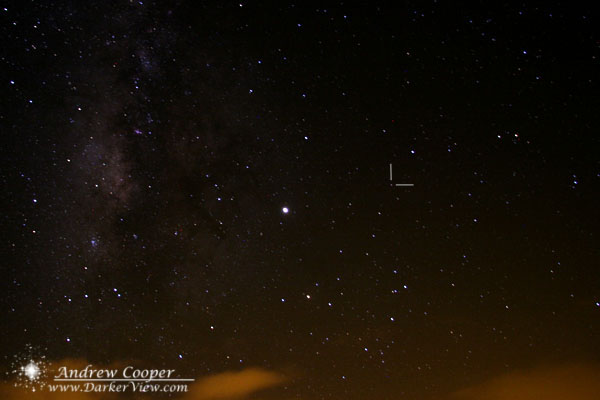
The Moon and Jupiter
Tonight the Moon and Jupiter will be close. The Moon will rise first, at 10:56HST, most of an hour ahead of Jupiter, placing the two quite high in the sky at sunset. The Moon will be 39% illuminated and about 10° from the bright planet. Tomorrow night the pair will be much closer, about 6.5° apart.
A Bit of Snow
Aussie Scientist Finds Rare Supernova at Keck Observatory
W. M. Keck Observatory press release by Dr. Duncan Forbes…
It was a dark and stormy night in the city of Angels. Well, actually it wasn’t. But more on that later…
It was a clear night on the summit of Mauna Kea at Keck Observatory on the 20th March. My colleagues and I were using the Echellette Spectrograph and Imager (ESI) instrument, which looks at faint objects in the visible wavelengths, to study star clusters and small galaxies.

Shortly into our night’s observing, we noticed a bright source in the guide camera image that wasn’t on our finding chart of that region. Still we managed to find our target and took a spectrum of it. But we decided to go back and see if that `new’ bright source was still there. Sure enough it was and it hadn’t moved. It was probably a supernova (or an asteroid coming straight at us!), so I decided to get a 5min spectrum with ESI. And indeed we had found a supernova—a type Ia to be exact. Type Ia supernovae are fairly rare in the nearby Universe and represent the explosion of at least one white dwarf star in a binary system. It is this same type of supernova that led to the discovery of Dark Energy in the Universe using the Keck Observatory, and three Nobel prizes.
Our supernova is located in the outskirts of a galaxy some 100 million light years from us—so it exploded 100 million years ago but the light only reached us that night.
I later found out that an automated telescope on the Palomar Mountain overlooking Los Angeles detected the supernova shortly before us. They also managed to get a spectrum but that was taken after our Keck II/ESI spectrum. The exciting thing is that both the Palomar Observatory and ourselves managed to observe the supernova in the 1-2 weeks before it reaches its maximum brightness (and then fades steadily after that).
The supernova has been given the designation SN2014ai.
All in all, not bad for a late night at the office…
Duncan Forbes is a professor of astronomy at Swinburne University in Melbourne, Australia, and a 2014 Evenings with Astronomers presenter at the signature Friends of Keck lecture series. Swinburne astronomers are awarded time for their research on Keck Observatory through an agreement with the California Institute of Technology.
Postcard from the Universe – Markarian’s Chain
The center of Virgo is thick with galaxies. The nearest large super-cluster of galaxies lies a mere 53 million lightyears away, includes upwards of 1300 member galaxies and spans over 8° on the sky. The center of the Virgo Cluster is marked by the large elliptical galaxies M84, M86 and M87.
Markarian’s Chain is the long sweep of galaxies stretching from the M84 and M86 pair at the lower right to NGC4477 at the upper left.

Total Lunar Eclipse 14 April 2014
A total lunar eclipse will occur on the next full Moon, April 14th. The eclipse will be visible across much of the western hemisphere, including the west coast of North America and across the Pacific. This is an excellent eclipse for observers here in Hawai’i, the entire eclipse will be visible from start to end.

The Moon will be thoroughly submerged in the umbra, the darkest part of the Earth’s shadow, with an umbral magnitude of 1.29. The Moon will not pass directly through the umbra, but rather through the northern section, thus the north pole of the Moon will remain somewhat brighter, even at maximum.
Observing a total lunar eclipse requires no special equipment, simply the desire to look up. The most useful piece of equipment will be a reclining chair or some other method of staying comfortable while watching the sky. A pair of binoculars or small telescope can provide beautiful views of the Moon during an eclipse. Photography is somewhat more challenging, but not that difficult. Focal lengths of around 1000mm will fill the field of most DSLR cameras allowing photos like that shown here.
| Penumbral Eclipse Begins | 18:53:37 HST | 04:53:37 UT |
| Partial Eclipse Begins | 19:58:19 HST | 05:58:19 UT |
| Total Eclipse Begins | 21:06:47 HST | 07:06:47 UT |
| Greatest Eclipse | 21:45:40 HST | 07:45:40 UT |
| Total Eclipse Ends | 22:24:35 HST | 08:24:35 UT |
| Partial Eclipse Ends | 23:33:04 HST | 09:33:04 UT |
| Penumbral Eclipse Ends | 00:37:37 HST | 10:37:37 UT |
The next total lunar eclipse in October will also be visible across the Pacific region. It will occur somewhat later in the night and be slightly brighter, only 1.16 umbral magnitude. With two good lunar eclipses 2014 is a treat for sky watchers across the western hemisphere. An annular eclipse is visible later in April in Australia and the South Indian Ocean, a partial solar eclipse is visible in late October across North America.
Snow Day
It was a snow day at the summit. We arrived to a new layer of snow atop the snow that had been accumulating all weekend, about 8 inches in total. It continued to snow much of the day, sometimes heavy. By the time we left the total was closer to a foot of white atop the mountain.
Instructions from summit lead were clear, start nothing we could not put away in a few moments in case the decision to abandon the summit was made. Despite this I did get some productive things done… Fixed the K1 Laser Safety System, an easy fix, helped perform a maintenance check on the MOSFIRE rotator, and arranged some fabrication for a camera mount in the K1 dome.
John made the call to leave the summit just before 3pm, as conditions began to worsen and the temperature started falling again. Observing was officially cancelled about the same time, the nighttime operators would not attempt to make the summit. An interesting day. What will we find tomorrow?