Numerologists love the number seven. Another odd number that has come to have a special meaning for no real reason.
The Keck 2 AO Laser attempting the first target of the night with the light of sunset and a setting Moon behindI have been working atop Mauna Kea for seven years now. This place that once seemed so alien is now so familiar. I walk through the observatory and look about, noting all of the things I have worked on, installed, or been involved with in some way. There are few parts of the facility I have not touched.
I helped install much of the Keck 1 laser system, from running the cables to aligning the launch telescope. The weather monitoring system atop the roof and in the domes is all my work, a complete replacement of the system over the last few years.
A self shot looking into the Keck 2 secondary, at a reflection of the primary.It is the AO systems I have been most involved with, responsible for the day-to-day functionality of the hardware. Entering an AO enclosure so many memories stream about. There is little I have not had to repair or work on in some capacity. I am familiar with every cable, every button and switch. I can recall schematics of many of the devices, the documents that show where everything is interconnected, I have drawn or edited most of them. I have had my small part in every discovery that comes from these amazing systems.
The shadow of Mauna Kea appears through the mist and haze at sunriseI recall nights with both lasers stabbing the sky, golden beams amongst the bright stars. There have been glorious sunsets, of foggy sunsets when the world turned golden. There have been days we have dug our way into the building through drifts of snow, coatings of ice on every surface with foot long sideways icicles. Of driving through drifts of snow, tire chains scraping the ice, with snow flying and the vehicle skidding towards the guardrail. Of winds so strong they threatened to overturn the vehicles as we scramble to abandon the summit. I have watched the dawn after a long night of observing, the Sun rising above billowing clouds, the first brilliant rays etched into my memories.
Mauna Kea is a place of wonder and beauty that I have been privileged to experience, a treasure of memories to enjoy for a lifetime.
Venus approaching inferior conjunction, 24Dec2013Tomorrow morning, January 28th, will see a brilliant Venus paired with a thin crescent Moon. Look for the pair to rise about 5:08HST to be 23° above the horizon at sunrise. A 7% illuminated Moon will be a nice match for Venus shining brilliantly at -4.5 magnitude. Separation will be about 6.5°.
The following morning, January 29th, will see the Moon 10° below Venus, halfway to the rising Sun.
A team of researchers led by Justin R. Crepp, the Freimann Assistant Professor of Physics at the University of Notre Dame, has directly imaged a very rare type of brown dwarf that can serve as a benchmark for studying objects with masses that lie between stars and planets. Their paper on the discovery was published recently in Astrophysical Journal.
Direct image detection of a rare brown dwarf companion HD19467B taken at Keck Observatory. Credit: Crepp et al. 2014, ApJInitial data came from the TRENDS (TaRgetting bENchmark-objects with Doppler Spectroscopy) high-contrast imaging survey that uses adaptive optics and related technologies to target older, faint objects orbiting nearby stars, and precise measurements were made at the W. M. Keck Observatory on the summit of Mauna Kea, Hawaii. Brown dwarfs emit little light because they do not burn hydrogen and cool rapidly. Crepp said they could provide a link between our understanding of low-mass stars and smaller objects such as planets.
HD 19467 B, a T-dwarf, is a very faint companion to a nearby Sun-like star, more than 100,000 times as dim as its host. Its distance is known precisely, and the discovery also enables researchers to place strong constraints on important factors such as its mass, orbit, age, and chemical composition without reference to the spectrum of light received from its surface.
Astronomers have discovered a distant quasar illuminating a vast nebula of diffuse gas, revealing for the first time part of the network of filaments thought to connect galaxies in a cosmic web. Researchers at the University of California, Santa Cruz, led the study, published January 19 in the journal, Nature.
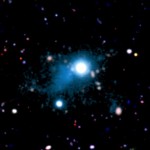
This deep image shows the nebula (cyan) extending across 2 million light-years that was discovered around the bright quasar UM287 (at the center of the image). Credit: S. Cantalupo, UCSCUsing the 10-meter Keck I telescope at the W. M. Keck Observatory in Hawaii, the researchers detected a very large, luminous nebula of gas extending about 2 million light-years across intergalactic space.
“This is a very exceptional object: it’s huge, at least twice as large as any nebula detected before, and it extends well beyond the galactic environment of the quasar,” said Sebastiano Cantalupo, first author of the paper and a postdoctoral fellow at UC Santa Cruz.
The standard cosmological model of structure formation in the universe predicts that galaxies are embedded in a cosmic web of matter, most of which (about 84 percent) is invisible dark matter. This web is seen in the results from computer simulations of the evolution of structure in the universe, which show the distribution of dark matter on large scales, including the dark matter halos in which galaxies form and the cosmic web of filaments that connect them. Gravity causes ordinary matter to follow the distribution of dark matter, so filaments of diffuse, ionized gas are expected to trace a pattern similar to that seen in dark matter simulations.