With Jupiter still near opposition and Mars opposition approaching I would like to do a little high resolution planetary imaging. For planetary I use our Nexstar 11″ telescope, with 2800mm of focal length is has the high magnification needed.
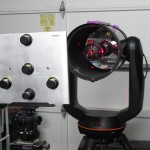
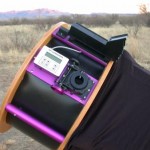
Aligning our Nexstar 11″ with a Hotech CT Collimation ToolOne lesson in high resolution imaging is that collimation matters. Having the optics in your telescope precisely aligned makes all the difference in the results. A small misalignment will result in mushy images that will not quite focus properly. No amount of fancy image processing will salvage the image.
The Nexstar has not been giving me the results I know it is capable of. I shot Venus just before inferior conjunction and noted that there was probably some issues in collimation that were not addressed in the quick star collimation I had performed.
Thus I borrowed a Hotech CT Laser Collimatior from a friend. The collimator is an interesting piece of kit, enabling the user to check more than simple the tip-tilt of the secondary.
A high quality pan-tilt-zoom camera on the roof of the observatory at an altitude of 13,630ft? Just too much fun. I have found myself logging into the camera at sunset to enjoy the view, or keeping the video in the corner of my screen through a Hawaiian blizzard. I have even forwarded images to a local television station when they requested views of a white Christmas in Hawaiʻi. Yes, they used them for the evening news!
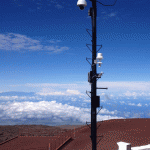
The Keck weather mast with a sonic anemometer at top, MastCam, and the housings for the temperature, humidity and barometric pressure sensors.This camera can do more… The camera is an Axis Q6044-E dome style security camera. The camera contains a small Linux computer with a huge array of scripting and control options. Combined with a 720p HD camera, reasonably decent optics, and an accurate PTZ mechanism the camera is quite capable.
To make the best of this wonderful toy I need some tools. To that end several Python programs have been written, including a camera scheduler. This program takes a text file with a schedule and captures images at the programmed time and date. All of this was easy to implement in Python, all of the necessary ‘net protocol support is available in the libraries.
The schedule file can contain any number of separate schedules for multiple sequences. At the specified time the program insures the camera is set properly, moves the camera to the correct position and captures the image. Each sequence is saved to a unique directory and given a sequential name suitable for compiling time lapse video. Add a simple GUI to allow images and status to be monitored and the program becomes a very useful tool.
There are now multiple sequences running… Photos of the summit ridge at each sunset, the shadow of the GPS antenna every day at noon, the Kohala mountain every day mid-morning, the TMT construction site several times a day, and more.
Venus is quickly rising in the dawn, appearing higher each morning. Today the planet will rise at 06:08HST, about 50 minutes before the Sun and be almost 12° above the horizon at sunrise. The planet will be quite prominent in the dawn sky for the next few months, reaching maximum elongation on March 22nd at 46.6° west.
When the planet rises far enough to catch in a telescope you will see a thin crescent that waxes a little each day.
Look for a nice pairing of this brilliant planet and a thin crescent Moon on the morning of January 28th.
Gliding across the sand, a handsome sea star catches my eye. These stars spend the day under the sand, hiding from the many predators that hunt with the light. In the darkness it rises and begins its own hunt. While two arms seem to be in the process of regrowing, the star is otherwise quite healthy. I wander off into the dark, wondering what prey the starfish is seeking, what will be eaten tonight.
A starfish (Luidia aspera) hunting across the sand at night, 40′ depth, Mahukona
Today an amateur astronomy icon passed away. John Dobson popularized the very simple design of telescope that came to bear his name, the Dobsonian. As a Vedantan monk John possessed few material means, pursuing a passion for telescope building in the monastery garden shed he designed a telescope that could be built from whatever scrap parts he could scavenge. He could often be found around San Fransisco showing the wonders of the night sky to anyone who would look through one of his telescopes. His infectious enthusiasm for astronomy led him to help co-found the San Francisco Sidewalk Astronomers.
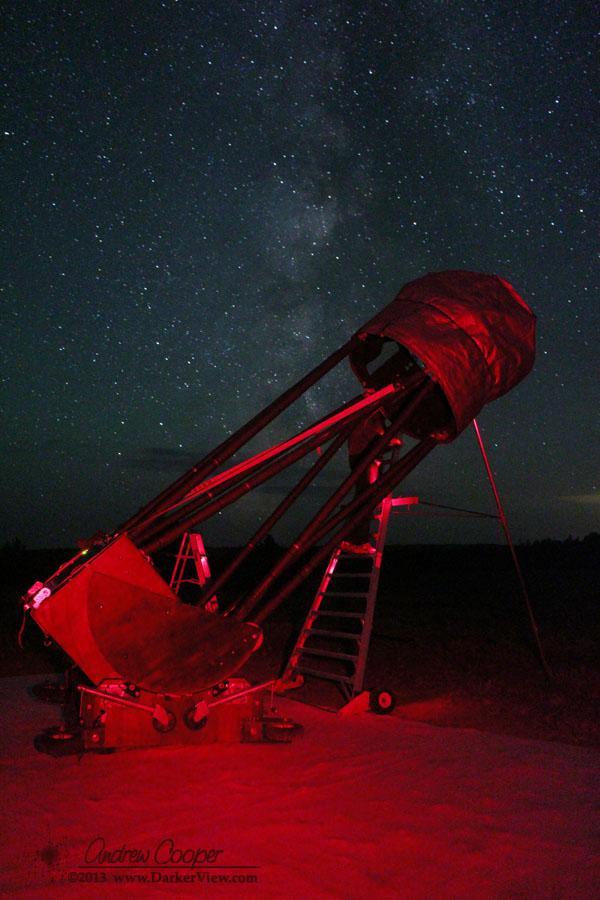
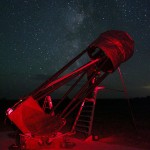
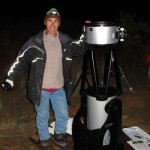
Chris Fuld using his monster 40″ dobsonian at Oregon Star Party 2013
The Dobsonian is a telescope that is characterized by an extraordinary simple and robust design. Made of plywood and other hardware store parts, there was nothing in the design that could not be built by hand.
The optical layout is a standard Newtonian design with the eyepiece at the front of the telescope. This allows the heavy primary mirror to be located quite close to the ground. The entire telescope rotates on a simple lazy-suzan azimuth bearing made of plywood, formica and teflon blocks. A simple set of trunnions allows the telescope to be raised and lowered in elevation.
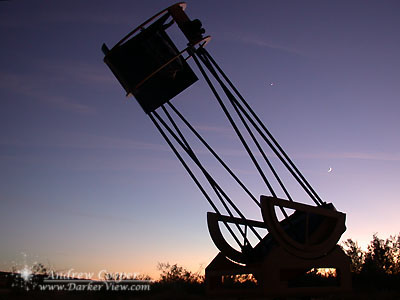
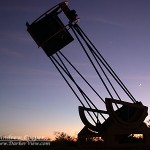
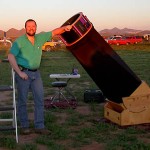
Steve Dillinger’s 20″ Dob awaiting full dark at Sentinel, AZ with Venus and the Moon shining behind
The Dob brought large aperture astronomy into reach of thousands of backyard observers. Anyone with a modicum of skill could build a Dob in a garage with simple hand tools. Commercial designs soon appeared at very affordable prices.
Amateur telescope makers have built upon John’s ideas, creating elegant designs that far surpass those simple telescopes made from scrap. Aircraft grade plywood, machined aluminum frames, carbon fiber and computerized controls are common in modern Dobsonians. The design can be scaled up, Dobsonians are sometimes enormous, with telescopes of 30 or 40 inches aperture seen at many star parties. At OSP last year I setup next to a 40″ built by Chris Fuld, a monster telescope built by hand.
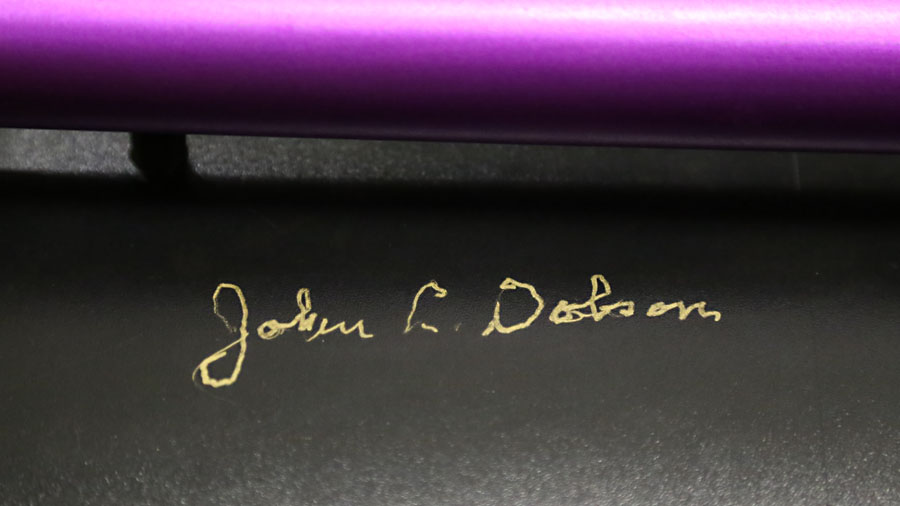
John spent much of his later life touring wherever dark skies, telescopes and people could be found. This often included national parks and regional star parties. I met John a few times across the years, at Grand Canyon Star Party and at an evening observing session at Starizona, an astronomy shop in Tucson. His signature graces the secondary cage of my 18″ f/4.5 Dobsonian, Deep Violet, beside the signature of David Levy.
John Dobson’s signature on the secondary cage of Deep Violet
John was also a proponent of a decidedly non-standard cosmology, believing that the Big-Bang model had fatal flaws. His alternate ideas make… Uh? Interesting reading. He describes a recycling steady state cosmos heavily influenced by the teachings of eastern religions and mystical thought.
John Dobson died today, 15 January 2014 at the age of 98 in Burbank, California. John leaves behind a son, many friends, and a community indebted by his contributions to amateur astronomy. My friend Dean Ketelsen knew John far better than I did, I suggest you read his notes on his passing.
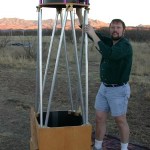
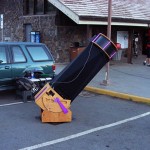
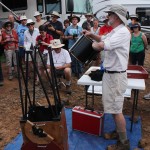
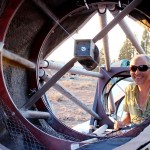
I spent a few moments and put all of the photos of dobsonian telescopes that have appeared here on Darker View into a gallery. The photos are just a little sliver of what John Dobson meant to amateur astronomy…
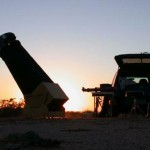
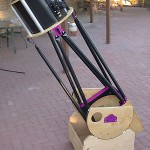
Deep Violet fully assembled and nearly ready for dark
David Nemo and his handmade 20″ string telescope
Under Arizona stars at Las Cienegas
The author’s setup awaiting a dark December sky with Deep Violet
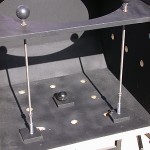
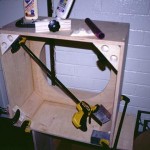
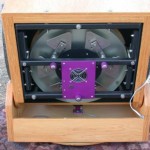
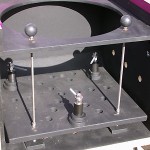
Looking into the mirror box without the primary and mount in place
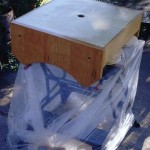
The rocker box between coats of polyurethane
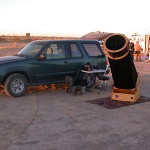
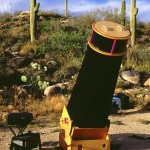
Deep Violet set up neat the Dragoon Mountains in Southern Arizona
Sunset at Arizona City awaiting dark
The 18 point mirror cell, built to the plans from Barry & Kriege
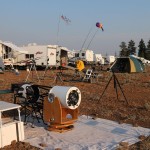
Telescopes at Oregon Star Party 2013
Gluing the laminate to the rocker box to create the azimuth bearing
A 12.5″ dobsonian telescope after the refit
Preparing to set up the telescope
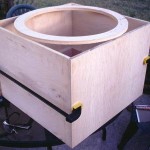
Gluing the mirror box with a cage ring atop to check the fit
Gluing the gussets into the mirror box
Secondary Cage with the focuser, digital setting circles and Telrad
First light atop Kitt Peak
Cliff at the eyepiece of his 24″
Mark Folkerts preparing his equipment for the night
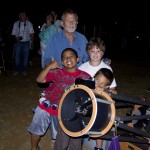
Tony shows a group of enthusiastic student views with his 12.5″ dob.
Ken and Ann Jones oberving with their 18″ at Oregon Star Party 2013
Setup among the saguaros of the Tortillita Mountians
Looking at the mounted mirror cell and primary mirror
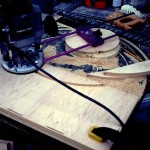
Routing the top of the rocker box to create the elevation bearing
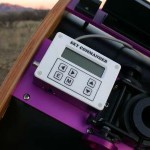
The Sky Commander digital setting circles mounted to the secondary cage
Steve Dillinger’s 20″ Dob awaiting full dark at Sentinel, AZ with Venus and the Moon shining behind
Chris Tribe with his 20″ f/4.5 built from ultralight materialsChris Tribe with his 20 inch f/4.5 built from ultralight materials
Ken Jones observes with his 18″ dobsonian
The author waiting for dark at the 2005 All Arizona Messier Marathon with my usual visual setup including Deep Violet
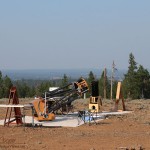
Almost all of the big dobsonian telescopes to be found on Hawai’i show up at the VIS for the night.
Assembling the truss tubes and secondary cage
Deep Violet at the Mauna Kea Visitor Information Station
Bob Clements demonstrates his 10″ dobsonian with an equatorial platform
Chris Fuld collimating his 40.5 inch dobsonian
Detail of an elevation bearing and encoder
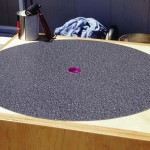
The ground board with center pivot and teflon pads in place
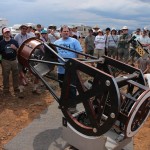
Chris Fuld using his monster 40″ dobsonian at Oregon Star Party 2013
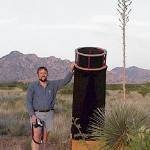
The 18″ setup at 9000ft on the side of Mauna Kea
Olivier beside his new telescope, a 12″ Orion Dobsonian
Looking into the mirror box with the mirror mount in place
Looking down the observing line at Oregon Star Party 2013
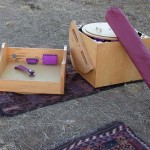
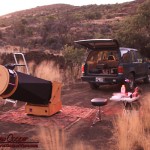
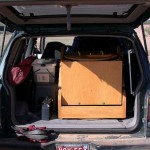
Deep Violet packed in the rear of my Ford Explorer
The Board of Directors of the W. M. Keck Observatory announced today that Taft Armandroff, executive director of the world’s premier ground-based astronomical observatory, will step down on June 1 to become a professor at the University of Texas at Austin, and director of its McDonald Observatory.
W. M. Keck Observatory Director Taft Armandroff Credit: Ethan TweedieArmandroff joined Keck Observatory in June 2006. During his tenure, the observatory continued to be a global leader in optical and infra-red astronomy. Keck Observatory serves nearly five hundred astronomers drawn not only from the United States but also from around the world, including Australia. The observatory also provides ground-based support for the National Aeronautics and Space Administration (NASA).
Before coming to Keck Observatory, Armandroff worked at the National Optical Astronomy Observatory (NOAO) in Tucson, Arizona, for 19 years, holding positions of associate director and director of the NOAO Gemini Science Center. He is a 1982 graduate in astronomy of Wesleyan University, and he earned his Master’s and Ph.D. degrees in astronomy from Yale University. His scientific research has focused dwarf spheroidal galaxies, stellar populations in the Milky Way galaxy and nearby galaxies, globular clusters, chemical evolution of galaxies, and dark matter.
As executive director of the W. M. Keck Observatory, Armandroff reports to a governing board representing the observatory’s founding partners, the California Institute of Technology (Caltech) and the University of California (UC). The governing board also has liaisons from the NASA, the W. M. Keck Foundation, and the University of Hawaii. In 2013, Keck Observatory managed a budget of $25 million to support the organization’s 120 professional staff, operations, and advanced instrument initiatives.
“Taft did an exceptional job in maintaining the high productivity of Keck Observatory,” said Tom Soifer, Caltech Professor of Physics and a member of the California Association for Astronomical Research (CARA) Board. “During his tenure federal and privately funded cutting edge instruments were built and great advances were made in adaptive optics. We wish him well in his new job.”