Getting to and from the vehicles was done as quickly as possible, running from door to door. Not only were the temperatures as low as anyone could remember, the wind was adding to the issue, blowing at a steady 35mph. The temperatures reached -8°C (17°F) at night and never rose above freezing during the day. The ice is slowly sublimating in the dry air, but there is still too much on the domes for safe observing.
Now if the wind would obey the posted speed limit…
The remains of heavy ice sublimating in cold, dry air with steady 35mph winds
More than three-quarters of the planet candidates discovered by NASA’s Kepler spacecraft have sizes ranging from that of Earth to that of Neptune, which is nearly four times as big as Earth. Such planets dominate the galactic census but are not represented in our own solar system. Astronomers don’t know how they form or if they are made of rock, water or gas.
Artist’s rendition of the Kepler Spacecraft in orbit around the Sun peering at a distant solar system, press release image from the NASA Kepler websiteThe Kepler team today reports on four years of ground-based follow-up observations targeting Kepler’s exoplanet systems at the American Astronomical Society meeting in Washington. These observations confirm the numerous Kepler discoveries are indeed planets and yield mass measurements of these enigmatic worlds that vary between Earth and Neptune in size.
Included in the findings are five new rocky planets ranging in size from 10 to 80 percent larger than Earth. Two of the new rocky worlds, dubbed Kepler-99b and Kepler-406b, are both 40 percent larger in size than Earth and have a density similar to lead. The planets orbit their host stars in less than five and three days respectively, making these worlds too hot for life as we know it.
A major component of these follow-up observations was Doppler measurements of the planets’ host stars. The team measured the reflex wobble of the host star, caused by the gravitational tug on the star exerted by the orbiting planet. That measured wobble reveals the mass of the planet: the higher the mass of the planet, the greater the gravitational tug on the star and hence the greater the wobble.
Jupiter will pass through opposition at 09:49HST today.
Jupiter and the moons Europa, Ganymede and Callisto (left-right)Jupiter orbits the Sun once every 11.86 years. As the giant planet continues on its way the Earth swings around much faster on our inside track. As a result we lap Jupiter once every 399 days, passing between the planet and the Sun. During opposition Jupiter will rise at sunset, transit at midnight, and set at dawn. This makes the planet available for observation for the entire night.
Look for a bright object rising in the eastern sky after sunset. It is difficult to mistake for anything else, shining at it’s brightest during opposition, a brilliant -2.7 magnitude. For the remainder of the winter and much of the spring, the planet will be quite prominent in the evening sky.
Sometimes you see a fish that is not familiar, asking yourself “What is that?” After so many dives I probably have seen one before, but have not paid any attention to that particular fish in the swirl of color and fish on the reef.
Then comes the challenge of identifying the photo. A first run through the book provided no answers. A second run, checking any families with similar body plans… Nothing. Great, it is probably juvenile that looks nothing like the adult… The adult photo is in the book. More browsing, this time on the Stender’s website. The website often has multiple photos of the same species, including the color variations that come with differing sex and age.
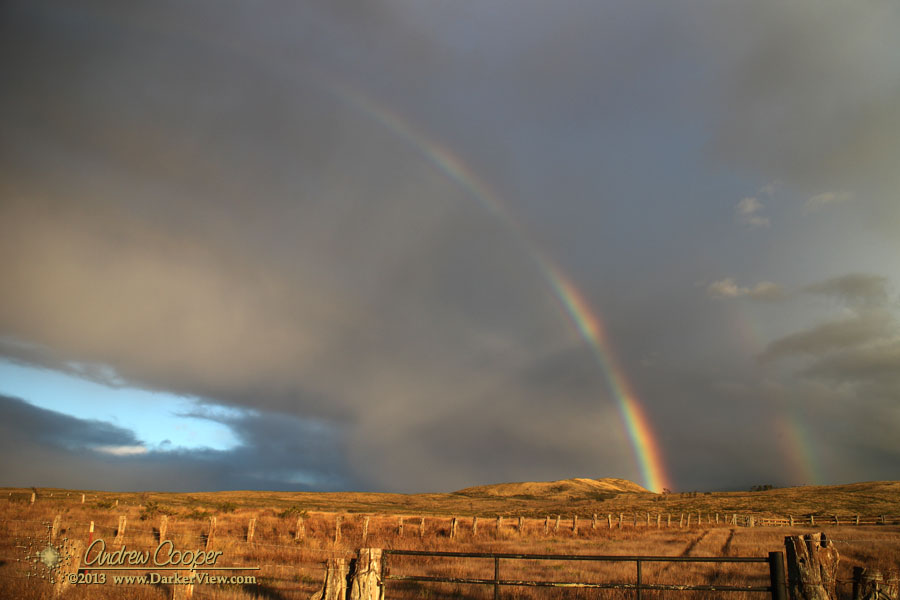
As I have mentioned previously, Waimea has rainbows. Not just a few rainbows either, but multiple rainbows through the day. Add a few cloud bows, and moon-bows into the schedule and you get the idea of how common rainbows are in this town. The last couple weeks have been above average, with rainbows even us jaded rainbow viewers have stopped and taken notice of.
I stopped for this rainbow as is looked like a good photo op, I was just on my way home from work and had plenty of time to play with a camera. To my surprise I noted that some cloud shadows were cutting the south end of the bow, creating a wheel, something I had never seen before.
Today the Earth is closest to the Sun, a point called perihelion. We will be about 147,099,000km (91,403,000miles) from the Sun. Compare this to the 152,096,000km (94,508,000miles) we will be at aphelion on July 3rd, a difference of about 4,996,000km (3,104,000miles) occurs throughout one orbit.
It may seem odd that we are actually at the closest for the middle of northern winter, you just have to remember that proximity to the Sun is not the cause of the seasons. The seasons are caused by the axial tilt of the Earth, creating short and long days throughout the year, with a resulting change in the angle and intensity of the sunlight.
A reminder that the peak of the annual Quadrantid meteor shower occurs tomorrow morning, during the predawn hours of January 3rd. There should be no moonlight to interfere, no excuse not to get out and watch the sky.
There are no exceptional sky events expected in 2014. A pair of good lunar eclipses, a decent Mars opposition, the usual meteor showers, and no bright comets predicted. There is one odd meteor shower that might provide some fireworks in May mentioned below. Otherwise there is always the possibility of a new discovery, a nova or supernova, or a new comet. For now this looks to be a routine year for sky watchers.
Mars during the 2005 opposition
Planets
Venus is as always a fun planet to follow through the year. The brilliant morning or evening star is always notable when it passes other bright objects such as the Moon or Jupiter. In April and May Venus will pass both ice giants, Uranus and Neptune with under a degree of separation. In August it will be Jupiter, passing about 35′ away on August 14th. The approach will be even closer if you are able to observe the pair during daylight hours, closing to 12′ at 08:06HST on the 14th.
Mars will pass through opposition on April 8th this year. This is a relatively good viewing opportunity with the red planet appearing just over 15″ in size. Close approach will be a week later, on April 14th. On September 27th Mars will pass about 3° from Antares.
Jupiter and Saturn continue to be well separated in the sky. This results in one or the other being available for observation much of the year. We start with Jupiter in the evening sky until early July. Saturn is currently in the early morning sky, passing through opposition May 10th and available for observation in the evening sky for the latter half of the year.
Minor Planets
The minor planets Ceres and Vesta are quite close all year. So close they will experience opposition in the same week. The dance will take place with the constellation Virgo as the backdrop. 4 Vesta will pass through opposition on April 13th, only two days later 1 Ceres will do the same on the 15th. At the same time the planet Mars will be just a few degrees south of the pair, going through opposition on April 8th. I wonder if the astrologers have noticed this? If so I am sure they will attach some ridiculous speculations to the event. They do not usually pay attention to the minor planets.
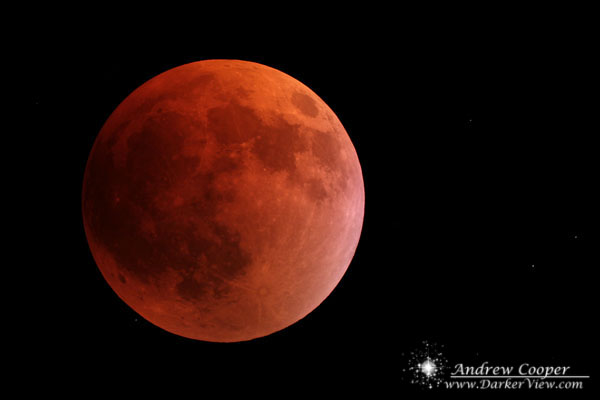
Total lunar eclipse, photo is a 8sec exposure with a Canon 20Da on a 90mm f/12 APO
Eclipses
There are two solar eclipses and two lunar eclipses for 2014. An odd annular solar eclipse will be visible from Antarctica and Australia on April 29th. A deep partial solar eclipse will be visible across much of western North America on October 23rd. Neither will be visible from the islands.
The two lunar eclipses are more interesting. Both total eclipses will feature good magnitudes and the eclipses will both be visible in their entirety from Hawai’i. Better yet, the first eclipse will begin soon after sunset, providing an excellent viewing opportunity for outreach. Occurring on April 14th and October 7th, these will be the highlight of the year for eclipse aficionados.
Meteor Showers
2014 offers an interesting year for meteor watchers. Of the three most reliable showers it is the Quadrantids that will be seen to best effect in 2014, untroubled by moonlight. The Geminids will be partly obscured, while the Perseids will peak quite close to full Moon.
In addition to the traditional showers there are predictions for a new shower associated with Comet 209P LINEAR. In late May this debris stream may produce a strong, or even storm level meteor shower. Watch here for more information on this possible event.
Comets
While no spectacular comets are predicted for 2014 there are several decent comets available for telescopic observing or photography. Late summer and into early autumn look for comet C/2012 K1 PanSTARRS to peak around magnitude 6.
As usual you should keep tuned to Darker View for timely reminders of upcoming celestial events. Over a hundred posts are already entered and waiting for the appropriate date to pop up here, reminding you and I to keep looking up.