Apparent the species can range in color from a pale gold, to a dark, almost black, red. I have seen this species a couple times now. The previous specimens I had found were the characteristic red, seeing this gold nudi I thought I had found something new to me.
But it is a red dendrodoris. This is a well known, but undescribed species that is found on island reefs. This fellow was in a cave at Horseshoe, depth about 35ft.
An undescribed species of Dendrodoris, depth 35ft on the Kohala Coast
University of Texas at Austin astronomer Steven Finkelstein has led a team that has discovered and measured the distance to the most distant galaxy ever found, using the W. M. Keck Observatory on the summit of Mauna Kea, Hawaii. The galaxy is seen as it was at a time just 700 million years after the Big Bang. The result will be published in the Oct. 24 issue of the journal Nature.
Initial observations from NASA’s Hubble Space Telescope identified many candidates for galaxies in the early universe, but this galaxy is the earliest and most distant definitively confirmed, using the 10-meter, Keck I telescope fitted with Keck Observatory’s newest instrument, MOSFIRE.
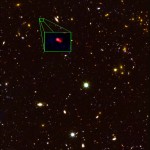
This image from the Hubble Space Telescope CANDELS survey highlights the most distant galaxy in the universe with a measured distance, dubbed z8_GND_5296. Credit: V. Tilvi, S.L. Finkelstein, C. Papovich, A. Koekemoer, CANDELS, and STScI/NASAWhat makes this distance so exciting, is “we get a glimpse of conditions when the universe was only about 5 percent of its current age of 13.8 billion years,” said Casey Papovich of Texas A&M University, second author of the study.
Astronomers can study how galaxies evolve because light travels at a finite speed, about 186,000 miles per second. Thus when we look at distant objects, we see them as they appeared in the past. The farther astronomers can push their observations, the farther into the past they can see.
“We want to study very distant galaxies to learn how they change with time,” Finkelstein said. “This helps us understand how the Milky Way came to be.”
The devil is in the details, however, when it comes to making conclusions about galaxy evolution, which means astronomers must employ the most rigorous methods and utilize the most powerful instruments to measure the distances to these galaxies in order to understand at what epoch of the universe they are seen.
The Hubble CANDELS survey uses colors from HST images to identify potentially distant galaxies. Finkelstein’s team selected z8_GND_5296, and dozens of others, for follow-up spectroscopy from the approximately 100,000 CANDELS galaxies. This method is good, but not foolproof, Finkelstein says. Using colors to sort galaxies is tricky because more nearby objects can masquerade as distant galaxies.
In order to accurately determine the distance to these galaxies, astronomers use spectroscopy to measure how much a galaxy’s light wavelengths have shifted toward the red end of the spectrum over their travels from the galaxy to Earth. This phenomenon is called “redshift”, and is due the expansion of the universe.
The team used Keck Observatory’s Keck I telescope in Hawaii, one of the two largest optical/infrared telescopes in the world, to measure the redshift of z8_GND_5296 at 7.51, the highest galaxy redshift ever confirmed. The redshift means this galaxy hails from a time only 700 million years after the Big Bang.
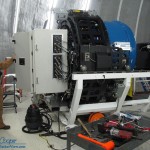
Mark Kassis stands beside the MOSFIRE spectrographKeck I was fitted with the new MOSFIRE instrument, which made the measurement possible, Finkelstein said. “The instrument is great. Not only is it sensitive, it can look at multiple objects at a time,” he said, which allowed his team to observe 43 galaxies in only two nights at Keck Observatory, and obtain the highest quality observations possible.
In addition to its great distance, the team’s observations showed that the galaxy z8_GND_5296 is forming stars extremely rapidly — producing stars at a rate 150 times faster than our own Milky Way galaxy. This new distance record-holder lies in the same part of sky as the previous record-holder (redshift 7.2), which also happens to have a very high rate of star-formation.
“So we’re learning something about the distant universe,” Finkelstein said. “There are way more regions of very high star formation than we previously thought. … There must be a decent number of them if we happen to find two in the same area of the sky.”
In addition to their studies with Keck, the team also observed z8_GND_5296 in the infrared with NASA’s Spitzer Space Telescope. Spitzer measured how much ionized oxygen the galaxy contains, which helps pin down the rate of star formation. The Spitzer observations also helped rule out other types of objects that could masquerade as an extremely distant galaxy, such as a more nearby galaxy that is particularly dusty.
Other team members include Bahram Mobasher of the University of California, Riverside; Mark Dickinson of the National Optical Astronomy Observatory; Vithal Tilvi of Texas A&M; and Keely Finkelstein and Mimi Song of UT-Austin.
Astronomy Talk: The Wonder of Comet ISON, A Relic From the Beginning of the Solar System
Thursday October 24, 2013
07:00 pm – 08:00 pm
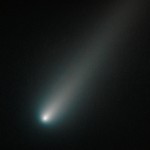
An image of comet C/2012 S1 ISON acquired by the Hubble Space Telescope on October 9th, 2013, credit: NASA, ESA, and the Hubble Heritage TeamKahilu Theatre
Dr. Carey Lisse, head of NASA’s Comet ISON Observation Campaign, will present a timely talk on how and when comets were formed, and where they come from. Also a Senior Research Scientist with Johns Hopkins University Applied Physics Laboratory, Lisse will relate how comets may have helped start life on the Earth, and also how they may have ended it for millions of creatures at least 4 times in the past. He’ll also give a bit of the history of comet observing by mankind, and explain how Comet 2012 S1 (ISON) fits into this picture of comets as relics from the beginning of our solar system.
Mercury will exit the evening sky this week. Currently about 10° above the setting Sun, it will quickly orbit back into the Sun’s glare. It will pass through inferior conjunction on November 1st to reappear in the dawn around November 6th.
Combining observations from the world’s largest telescopes with small telescopes used by amateur astronomers, a team of scientists discovered that the large main-belt asteroid (87) Sylvia has a complex interior, thanks to the presence of two moons orbiting the main asteroid, and probably linked to the way the multiple system was formed. The findings are being revealed today, October 7, at the 45th annual Division of Planetary Sciences meeting in Denver, Colorado.
Artistic representation of the triple asteroid system showing the large 270-km asteroid Sylvia surrounded by its two moons, Romulus and Remus. Credit: Danielle Futselaar/SETI InstituteThis work illustrates a new trend in astronomy in which backyard amateur astronomers team up with professional astronomers to expand our knowledge of our solar system. The study of multiple asteroids such as (87) Sylvia gives astronomers an opportunity to peek through the past history of our solar system and constrain the internal composition of asteroids. The two moons of (87) Sylvia were discovered in 2005.
The team, led by Franck Marchis, senior research scientist at the Carl Sagan Center of the SETI Institute, has continued to observe this triple asteroid system by gathering 66 adaptive optics observations from 8-10m class telescopes including those at the W. M. Keck Observatory, the European Southern Observatory, and Gemini North.
“Because (87) Sylvia is a large, bright asteroid located in the main belt, it is a great target for the first generation of adaptive optics systems available on these large telescopes. We have combined data from our team with archival data to get a good understanding of the orbits of these moons,” Marchis said.
A spectacular image of Saturn from above. Even better, the image was assembled by an amateur astronomer, Gordan Ugarkovic, working with Cassini imagery taken on October 10th. Click on the image to zoom in, then zoom in some more! You can see exquisite data in the polar cloud-tops and in the rings. Keep an eye out for the shepherd moons at the edges of the various rings…
This portrait looking down on Saturn and its rings was created from images obtained by NASA’s Cassini spacecraft on Oct. 10, 2013. It was made by amateur image processor and Cassini fan Gordan Ugarkovic. This image has not been geometrically corrected for shifts in the spacecraft perspective and still has some camera artifacts.The mosaic was created from 12 image footprints with red, blue and green filters from Cassini’s imaging science subsystem. Ugarkovic used full color sets for 11 of the footprints and red and blue images for one footprint. Credit: NASA/JPL-Caltech/Space Science Institute/G. Ugarkovic
It was a good day for photographing guard crabs. I was not finding much else worth photographing anyway. Numerous large antler coral colonies spotted the slope, each home to a small community of animals sheltering amongst the branches. Hawkfish, coral crouchers, various hermit crabs, and guard crabs. I came up with half a dozen decent photos of different guard crabs. I will not bore you with all of them, at least not all at once…
A yellow-spotted guard crab (Trapezia flavopunctata) shelters in the arms of an antler coral (Pocillopora eydouxi)
Astronomers have found the shattered remains of an asteroid that contained huge amounts of water orbiting an exhausted star, or white dwarf. This suggests that the star GD 61 and its planetary system – located about 150 light years away and at the end of its life – had the potential to contain Earth-like exoplanets.
The new research findings used data collected from NASA’s Hubble Space Telescope, both of W. M. Keck Observatory’s Keck I and Keck II telescopes, as well NASA’s FUSE telescope, and are reported today in the journal Science.
Artist impression of a rocky and water-rich asteroid being torn apart by the strong gravity of the white dwarf star GD 61. Credit: Copyright Mark A. Garlick, space-art.co.uk, University of Warwick and University of Cambridge.This is the first time both water and a rocky surface – two key ingredients for habitable planets – have been found together beyond our solar system.
Earth is essentially a “dry” planet, with only 0.02% of its mass as surface water, meaning oceans came long after it had formed; most likely when water-rich asteroids in the solar system crashed into our planet.
The asteroid analyzed is composed of 26% water mass, very similar to Ceres, the largest asteroid in the main belt of our solar system. Both are vastly more water-rich compared with Earth.
The new discovery shows the same water delivery system could have occurred in this distant, dying star’s solar system – as latest evidence points to it containing a similar type of water-rich asteroid that would have first brought water to Earth.
Astronomers at the Universities of Cambridge and Warwick say this is the first “reliable evidence” for water-rich, rocky planetary material in any extrasolar planetary system.
When we saw the sailboat on the reef Sunday morning we wondered what the story was. Just how did the vessel end up in the surf in front of Kaloko?
A large sailboat sitting on the reef in front of Kaloko-Honokōhau National Historical ParkYou would think that the local paper would have some mention of the story, just a blurb about the wreck? It was not until Thursday that there was any mention of the story. In the meantime rumors reached me about the story, rumors that turned out to be true.
The boat was stolen, taken out of its slip by someone who did not know how to sail. They made it less than a mile from the harbor before foundering on the reef. The man was arrested by rescuers, they became suspicious when it became apparent that the man did not know anything about the boat or about sailing. The local newspaper writeup was fairly good, if a bit late. Will they tow the boat out and sink it? It would be a great dive.